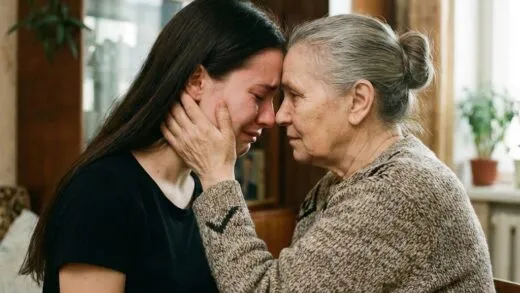
— Marina came closer and sat down beside her.
The old woman flinched and quickly hid the handkerchief in the pocket of her work coat.
— Oh, it’s nothing, Marinochka. I’m just a bit tired.
But Marina saw her reddened eyes and trembling hands. Vera Ivanovna was a thin woman of about sixty-five, with gray hair gathered in a small ponytail. Her face was gaunt, with deep wrinkles, and her hands, constantly in water and chemicals, were red and chapped.
— Are you sure you’re okay? Maybe you’re not feeling well?
The old woman was silent for a moment, then said quietly:
— I’ve run out of medicine. And my pension is still a week away. I thought I could make it last, but it didn’t work out.
— What medicine?
— For diabetes. I need to inject insulin, and it’s expensive. And pills, too. Last month, I spent almost my entire pension on them, and then I had to pay the rent. So I decided to save a little, started injecting less. But I feel bad now.
Marina silently took her wallet out of her coat pocket, counted out three thousand, and handed it to Vera Ivanovna.
— Here, take this. Buy your medicine.
— Oh, honey, no! I can’t take it from you. I know you’re barely making ends meet yourself. You have a sick father.
— Please take it. It’s not as critical for me right now, and you need it more. You can’t stop taking insulin, it’s dangerous.
Vera Ivanovna looked at the money, and tears rolled down her cheeks again.
— Thank you, dear. I’ll pay you back for sure, as soon as I get my pension.
— You don’t have to pay me back. Just buy the medicine and take care of yourself.
Almost a year had passed since that day. Every week, Marina discreetly gave Vera Ivanovna money for medicine. It was a small amount, two or three thousand, but for the old woman, it was a lifesaver. They didn’t publicize this help, usually meeting on the stairs or in the utility room, exchanging a few quick words. Vera Ivanovna would thank her with tears in her eyes every time, and Marina would just shake her head and ask her to take care of her health.
Marina didn’t tell anyone about this, not even her father. She just cut her own expenses wherever she could: she stopped buying new clothes, saved on cosmetics, and took a taxi less often when she was running late. Sometimes, instead of lunch at work, she would make do with tea and cookies she brought from home. But seeing Vera Ivanovna gradually come back to life, seeing the color return to her cheeks, and her hands stop trembling, was Marina’s reward.
Life went on as usual. Workdays were replaced by night shifts, and at home, Marina cared for her father, cooked, cleaned, and did laundry. There was absolutely no time for a personal life. She was 32, but her last relationship had ended three years ago, when her father had his stroke. Her boyfriend at the time couldn’t handle it and left, saying he hadn’t signed up to be a caregiver. Since then, Marina hadn’t even tried to date anyone, understanding that she had neither the time nor the energy for it.
Gradually, Marina began to notice strange things at the clinic. About four months ago, patients started appearing who were brought in late at night or even during the night. They were placed on the third floor, in a separate wing where regular staff were not allowed. The head doctor, Oleg Viktorovich Krylov, explained that these were special patients who required peace and confidentiality.
Marina had seen these people from a distance a few times when she mistakenly went up to the third floor for documents. They were men and women of various ages, who looked quite healthy but always seemed tense and silent. They were accompanied not by regular nurses, but by other people in white coats whom Marina had never seen before.
Another strange thing was that the head doctor, Oleg Viktorovich, began to hold frequent closed-door meetings. On those days, his office on the first floor would be locked, the windows covered, and the security guard, Semyon, wouldn’t let anyone near. Marina knew this from other nurses who whispered in the staff room, making various assumptions.
— Maybe they’re deciding about salaries, — said Sveta, a young nurse from surgery. — I heard they’re cutting the budget.
— Or there’s some kind of inspection coming, — offered the elderly Lidia Petrovna. — The management always gets nervous before inspections.
Marina didn’t participate in these conversations. She had no time for gossip, and she wasn’t particularly interested in the clinic’s affairs as long as she was getting paid and could feed her family. However, two weeks ago, an incident occurred that put her on alert.
That day, Marina was covering for a sick colleague, Anya, who worked at the reception on the first floor. She needed to get some referral forms for tests from the head doctor’s office because they had run out at the reception. Marina knocked on the office door, but no one answered. She knew that Oleg Viktorovich had gone to a meeting at the city administration and would only be back in the evening. The door was unlocked, and Marina went inside.
The head doctor’s office was spacious, with a large desk, a leather chair, and cabinets along the walls. It smelled of expensive coffee and men’s cologne. Marina went to the cabinet where the forms were usually kept, opened the door, and started looking for what she needed. That’s when her gaze fell on the desk. An open folder with documents was lying there…