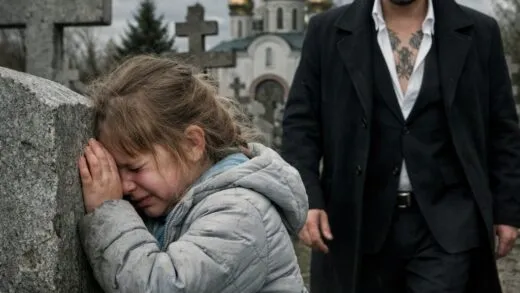
Slowly, very slowly, she raised her eyes. And everything inside her shattered. A woman was standing over her. A woman with her mother’s face. With her mother’s gaze. With her mother’s hair, gathered in that familiar ponytail. Only the eyes… the eyes were different. They didn’t have that soft light. They held pain. Deep, old, heavy.
“You?” Dasha wanted to scream, but her voice wouldn’t obey. “Mom?”
The woman shook her head. A sad smile appeared on her lips, so familiar and yet so foreign at the same time.
“No, little one. I’m not your mother.”
The voice was similar. Almost the same. Just a little lower, a little more hoarse.
“My name is Natalya. I am her sister.”
The world swayed and blurred. Dasha wanted to stand up, but her legs wouldn’t hold her. She wanted to say something, but the words were stuck in her throat.
“Sister?” she finally breathed out. “Mom didn’t have a sister. She was an only child. She said so herself.”
The woman, Natalya, sat down next to her on the bench. She smelled of something unfamiliar. But beneath that scent, Dasha caught another, faint, familiar, impossible one.
“She didn’t know,” Natalya said quietly. “Or she knew, but she didn’t remember. We were separated when I was three, and she was the same age. We’re twins, Dasha. We were born seven minutes apart. And I’ve been looking for her. All my life.”
Dasha looked at the woman before her and couldn’t believe her eyes. It was like a dream, the kind you wake up from with wet cheeks and a pounding heart. Only she wasn’t sleeping. The cold wind seeped under her jacket. The stone bench was chilling even through her jeans. And the smell of decaying leaves was too real for any dream.
“Twins?” she repeated in a hoarse voice. “That’s… that’s impossible. Grandma Raya. Mom’s mother. She would have said something.”
Natalya lowered her gaze. For a moment, her face contorted in pain—quick, like a flash, and then it became calm again, almost detached.
“Grandma Raya, the one you knew, she wasn’t our real mother. She adopted Olya when she was three.”
“And me?” “Other people took me. To the other side of the country.”
Dasha felt the ground slipping from under her feet. She grabbed the cold metal of the fence, trying to hold on. Grandma Raya had died five years ago—quietly, in her sleep, from a heart attack. Her mother had cried for three days then, looking through old photographs, whispering something about how much she hadn’t had time to say. And not once, not a single time, had she mentioned any adoption. Or any sister.
“How do you know my name?” Dasha suddenly asked. The thought came abruptly, sharp, wary. “How do you even know who I am?”
Natalya gave a faint smile.
“I’ve been watching you. For a few weeks. I would come here on Saturdays, hide behind the trees. I saw you cleaning the grave, bringing flowers, talking to her.” She nodded towards the monument. “You look so much like her. Like both of us.”
“That’s… that’s creepy,” Dasha said honestly. “You were spying on me?”
“I was gathering my courage. To approach you. To speak.”
Natalya took a photograph from her coat pocket and handed it to the girl.
“Look.”
Dasha took the picture with trembling fingers. A black-and-white photo, worn at the edges. On it were two girls, about three years old, completely identical: identical polka-dot dresses, identical bows, identical smiles. They were holding hands and looking at the camera—happy, carefree, not yet knowing they would soon be separated.
“That’s us,” Natalya said. “The last photograph of us together. A woman from the orphanage gave it to me many years later. She worked there as a cook and kept the picture because, in her words, she had never seen more beautiful twins.”
“An orphanage?” Dasha’s voice dropped to a whisper.
“Our biological mother died in childbirth. Our father was…” Natalya hesitated, searching for the words. “He wasn’t in our lives. We were sent to a shelter when we were six months old. And then we were adopted. Separately. That’s how they did it back then: they believed it was better for twins to grow up apart, that each child needed their own family, their own parents. It was foolish. Cruel. But it was a long time ago, and back then, no one asked children if they wanted to lose each other.”
Dasha was silent. She looked at the photograph, at the girls’ faces, at their intertwined fingers, and felt something huge rising inside her. An inexplicable mix of bitterness, anger, bewilderment, and a strange, painful hope.
“Why did you only come now?” she finally asked. “Mom died two years ago. Two years. Do you understand? Where were you all this time? Where were you when she was sick? When she was suffering? When she was…” her voice broke, “when she was passing away?”
Natalya flinched as if struck.
“I didn’t know,” her voice became very quiet. “I searched for her for twenty years. Twenty years, Dasha. Archives, inquiries, databases, private detectives. Our story was hidden so deep that I started to think, maybe I dreamed it all? Maybe I never had a sister? And then, six months ago, I finally got the information. A name. An address. And I found out I was too late.”
She turned away, and Dasha saw a tear slide down her cheek. A single tear, but so eloquent.
“I came to her grave the same day I found out. I stood here and thought: I’ve been looking for her my whole life. I dreamed of how we would meet, hug, how I would tell her everything. And now, there’s only a stone and a photograph. And emptiness.”
They sat in silence, the woman and the girl, separated by years but connected by something deeper than time. The wind rustled the bare branches overhead, a crow cawed somewhere, and the gray sky pressed down on their shoulders with its heavy infinity.
“And why did you decide to approach me?” Dasha finally asked. “What do you want from me?”
Natalya turned to her. Their eyes met, and the girl was again struck by the resemblance. The same gray-green irises, the same shape of the eyebrows, the same mole above the upper lip. It was as if her mother was looking at her from the other side of a river.
“Because you are all that’s left of her. All that’s left of us. Because I was alone for so many years. I thought I had no one in the world. And now it turns out I do. You are my niece. And I wanted… I hoped…”