Saturday morning was cold and damp. Dasha pulled her knitted hat down to her eyebrows, wrapped a scarf that still smelled of her mother’s light floral perfume, which had almost faded over these two years, and quietly slipped out of the apartment. Her father was asleep; he had returned from his night shift just before dawn, and she didn’t want to wake him. And why should she? He wouldn’t ask where she was going anyway.
He hadn’t asked in a long time. She was 12 when her mother died. Now she was 14, but inside she felt much older.
They say grief makes you grow up. Dasha didn’t know if that was true. But she knew something else for sure: grief makes a person invisible. You walk among people, smile, answer questions, get grades in school, but inside you there is an emptiness that no one sees or feels.
The bus to the cemetery ran every half hour. Dasha knew the schedule by heart: if she left home at 8, she would be there by 9.
Saturday was the best day to visit. There weren’t many people, so she could sit in silence and talk. She always talked to her mother. She told her about school, about her friends (though what friends? Just classmates), about the books she was reading. Sometimes she complained about her father, about his silence, the empty refrigerator, the unwashed laundry. Her mother listened. Dasha knew: she listened.
Olga Nikolaevna Terekhova died of cancer. Quickly, suddenly, as if someone had turned off a light. In the spring, she was still laughing, baking pies, taking Dasha to the cinema to see a new cartoon. By autumn, she was gone. Between those two points were three months of hospitals, IV drips, fading hope, and nights when Dasha heard her father crying in the bathroom with the water running.
After the funeral, he changed. It was as if he had locked himself up with every lock, lost the keys, and forgotten what it meant to be alive. He worked. Came home. Ate. Slept. And worked again. Conversations between them were reduced to a minimum: “Good morning,” “Good night,” “The money’s on the table.” Dasha understood: he hadn’t stopped loving her. He just didn’t know how to cope with the pain, and the only way he found was to feel nothing at all.
Grandma Zina, her father’s mother, lived in the next building and dropped by almost every day. She cooked soups, tidied up, and made sure Dasha ate properly and did her homework. But Dasha couldn’t really talk to her grandmother either. Zinaida Fedorovna was a dry, reserved woman, the kind who considered tears a weakness and talks about feelings a waste of time.
“Life goes on,” she would say. “You have to hold on. Your mother wouldn’t have wanted you to fall apart.”
Dasha didn’t fall apart. At least, not in front of people. She learned to cry silently, her face buried in her pillow. She learned to smile in public and get lost in her thoughts during classes. She learned to be an inconspicuous little shadow in the corner, one that was easy to overlook. The only place she allowed herself to be real was at her mother’s grave.
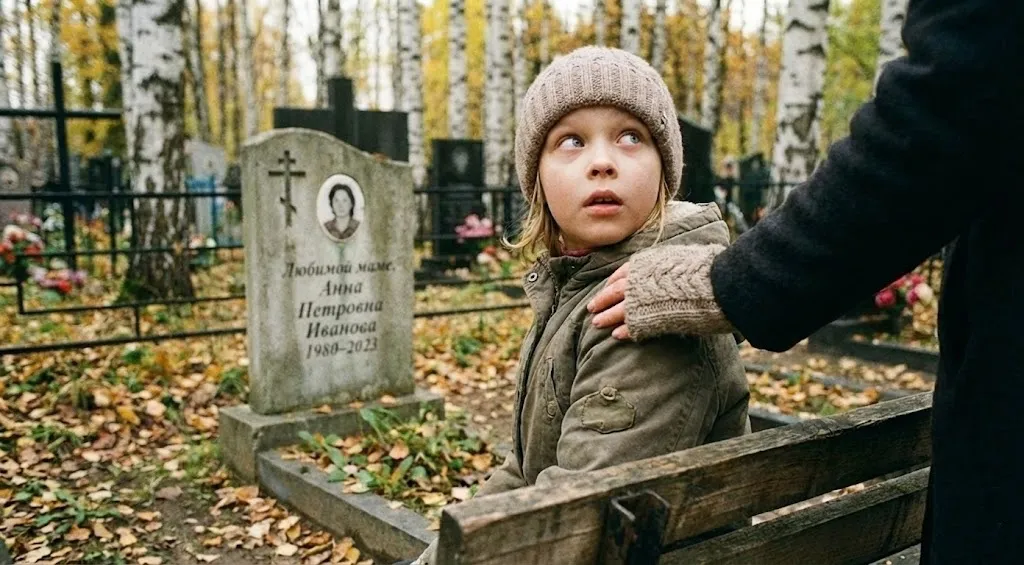
The cemetery greeted her with its usual silence. November was closing in; the trees stood bare and black. The leaves underfoot had turned into a slippery brown slush. Dasha walked down the alley past old fences and new monuments, past withered wreaths and faded bouquets. She knew this path so well she could have walked it with her eyes closed. Plot 47, row 12. A modest gray granite monument. A photograph: her mother smiling, her hair in a ponytail, that special light in her eyes that Dasha remembered so clearly, as if she had seen it yesterday.
“Hi, Mom,” she whispered, crouching down.
First, cleaning. Dasha took a cloth from her backpack, swept the fallen leaves off the monument, and wiped the photograph. Then she took out a small shovel and collected the trash around the fence. Someone had thrown a cigarette butt right by the grave. Had people completely lost their conscience? She picked it up with disgust, trying not to think about what kind of person would smoke in a cemetery.
When everything was clean, she laid down the flowers. Three white chrysanthemums, her mother’s favorites. An old woman sold them at the market entrance, and Dasha always bought from her because one day she had said, “Bringing these for your mom? I can see it in your eyes. You’re a good girl.”
Then Dasha sat on the small bench next to the fence and began to talk.
“We had an algebra test this week. I got a B. I know, I know, you would’ve said I could do better. But honestly, Mom, I’m not in the mood for studying right now. My head is a mess all the time. The literature teacher praised my essay about autumn. She said I have a feel for words. That must be from you. You always loved to read.”
She talked and talked: about little things, about trifles, about what her grandmother had cooked for dinner, about a new TV series her classmate Katya had watched, which Dasha herself didn’t watch because it was about family and love, and stories like that only hurt more now.
“Dad has completely stopped talking to me,” her voice trembled. “No, he’s not mean, you know that. It’s just as if he’s not here either. As if you took him with you, leaving only a shell behind. Sometimes I feel like I’m all alone in the world. Do you understand? Completely and utterly alone.”
The tears flowed on their own: hot, salty, familiar. Dasha didn’t wipe them away. Here, it was okay. Here, no one could see. She wrapped her arms around herself, rocking back and forth, and cried quietly, heartbreakingly, releasing everything that had built up inside her all week.
“I miss you so much, Mom. So much.”
Time passed unnoticed. The tears dried, leaving salty tracks on her cheeks. Dasha sat motionless, looking at the photograph, at her mother’s smile, at the sky above—gray, low, oppressive.
And then it happened. A hand rested on her head. Softly, gently. It stroked her hair just as her mother used to when Dasha was sick or upset.
The girl froze. Her heart pounded so loudly that the beat echoed in her ears. She was afraid to move, afraid to breathe. Was this a dream? A hallucination? Or…