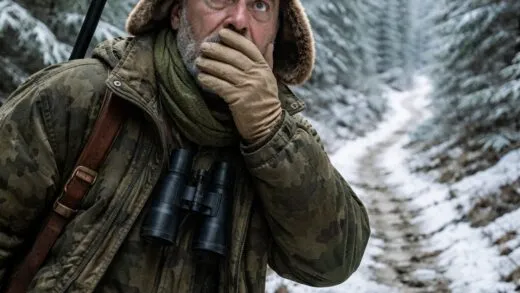

Late in October, when the first hard frosts had skimmed the puddles with thin ice, Mike began getting ready for a supply run into town. It was the usual trip before winter sealed the trails—salt, flour, kerosene, shells. He would be gone several days, taking a small tough horse and a wagon.
Anna walked with him as far as the fork in the trail. She stood there wrapped in a warm shawl, watching the wagon until it disappeared around the bend. Once she was alone, she couldn’t settle. Work slipped through her hands. She split wood, sorted dried mushrooms, cleaned the stove, but her thoughts kept circling back to the conversation she and Mike had had the night before.
He had promised to find Mr. John Peterson in town, Anna’s old schoolteacher. He was the only person from her former life she trusted completely. An old-fashioned man—honest, principled—he had known Anna since she was seven. Mike was to tell him the truth and ask a favor on which everything depended.
The four days of waiting dragged. Anna barely slept. She sat by the window looking at the darkening trees and listening to the silence. On the fifth day, near evening, she heard the dull beat of hooves and the creak of wheels on the frozen track.
Anna ran to the porch. Mike jumped down from the wagon, tired and smelling of road dust and tobacco. He gave her a short nod, tossed the reins aside, and started unloading sacks. Anna helped without asking questions. She knew him well enough. Until the horse was fed and the supplies were put away, he wouldn’t talk.
That evening, after the horse had been watered and a hot stew sat on the table, Mike lowered himself onto the stool. He ate slowly, as always. Anna sat across from him with her hands clasped in her lap.
Mike pushed away his empty bowl, reached into his jacket, and laid a folded newspaper on the table. “Found your teacher,” he said, looking at Anna. “John Peterson’s alive. Older, but sharp.”
Anna leaned forward, not daring to interrupt.
“We talked a long time. I told him everything. The trial, the prison, finding you in the snow. He believed me right off. Said he’d never believed the case against you in the first place.” Mike rubbed a hand over his beard. “He did what we asked. Went to child services, pulled records, filed the paperwork. He’s now officially listed as Ellie’s distant relative and guardian contact. He has the legal right to correspond with the children’s home and ask about her. Nobody can cut that line now.”
Anna let out a shaky breath and closed her eyes. The worst fear she had carried all these years—that she would lose all trace of her daughter forever—eased at last.
“That’s not all,” Mike said, his voice turning harder. He tapped the folded newspaper with one thick finger. “John’s the kind of man who asks questions. He used old students of his in county offices to find out what happened to the people who put you where you were.”
Anna opened her eyes. Her face tightened.
“Justice catches up sometimes,” Mike said evenly. “Your mother-in-law got hers.”
He told her what he had learned. After Anna was convicted and Ellie was sent to state care, Evelyn Carter remained the sole owner of the large three-bedroom apartment. She enjoyed the power, the status, the connections. But six months earlier she had suffered a major stroke. The paralysis was nearly complete. The relatives who had hovered around her for years because of the property lost interest overnight. No one wanted to care for a bedridden woman with a hard temper.
Nieces and nephews moved quickly, arranged legal control, transferred the apartment into their own names, took anything of value, and placed Evelyn in the cheapest state nursing home on the edge of town.
“John says she’s in a shared room now,” Mike continued. “Can barely talk. Just makes sounds. Staff checks on her once in a while, and she cries all the time. Grabs nurses by the sleeve, tries to explain something, wants them to find Ellie so she can ask forgiveness. She’s scared to die carrying that. But nobody visits. Family’s gone.”
Anna listened without moving. In her mind she saw her mother-in-law’s cold face in the courtroom, the tight mouth, the hard words: I don’t need that child in my house. Now that same woman lay in a strange bed, breathing bleach and helplessness, abandoned by the very people for whom she had ruined another family.
“And the other one?” Anna asked quietly.
Mike unfolded the newspaper. It was an old state paper from the previous month. He slid it toward her. In a small column on the third page, in dry official language, was a crime report.
“Your prison warden, Saveliev,” Mike said with the faintest hint of satisfaction. “He got caught. And good.”
Saveliev had grown careless, convinced he was untouchable. During a major audit from the capital, investigators uncovered large-scale theft. For years he had skimmed state property, stolen food allocated to the prison, and taken bribes in exchange for easier treatment for favored inmates. They caught him clean.
To avoid embarrassing the whole department, the trial was quick and public. “They stripped his rank in court,” Mike said, taking the paper back. “Took his pension, his awards, all of it. Since he was former staff, they didn’t send him to a regular prison. They sent him north to a hard-labor facility. John checked. Saveliev’s there now as a common laborer at a sawmill. The man who used to act like king of the world now hauls frozen logs twelve hours a day. Drinks hard. Frostbit his hands. The inmates despise him, the guards work him over. Broken man. Nothing left but fear.”
The cabin fell silent. The stove crackled. Anna stared into the fire. She had expected the news to bring some rush of feeling—satisfaction, triumph, something. Saveliev had nearly destroyed her mind. Evelyn had destroyed her family. They had both gotten exactly what they had earned. Their punishment was severe, almost precise.
But there was no triumph in her. Only a cold, heavy stillness and the sense that life settles its own accounts. “Everyone answers for something,” Anna said quietly. There was no gloating in her voice. She was simply closing the book on the past.
Mike nodded. That was one of the things he respected most in her—she had no taste for petty revenge. She had dignity. Then he reached inside his coat again.
“And this,” he said, his voice softening, “this is the important part. John sent it.”….