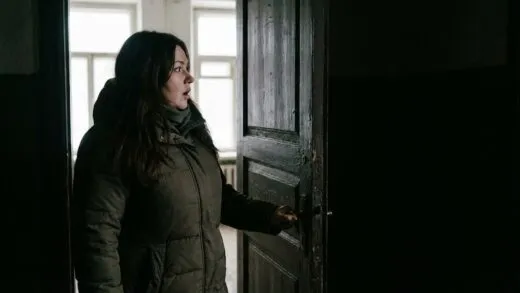

When Eleanor raised a heavy sledgehammer over an ancient, rotten dog kennel, she didn’t imagine that the blow would break not only old boards but also a silence the whole town had lived with for decades. She was forty-two, had moved to this quiet corner of the Appalachians to lay low, not to pick fights. The woman in the mirror looked older than her years — shoulders tightened by pain and a long chain of bad luck.

She had once been a respected neurosurgeon in the city, until one operation changed everything. Three years in prison after a wealthy official’s son died on the operating table — the press called it a malpractice scandal, the courts called it justice bought and sold. Prison took its toll; it hardened her, but it also taught her how to survive. Eleanor used her last savings — what remained after fines and court costs — to buy a ramshackle farmhouse at the edge of a tiny mountain town, thinking hard, honest work would quiet her head the way it once had in the hospital.
The man selling the place — the slick nephew of the deceased owner — didn’t hide his satisfaction at getting rid of unwanted property. Eleanor signed the papers without fuss; all she wanted was quiet. The first day was rain and mud, and in the middle of the backyard, like an insult to the view, stood a massive, blackened dog kennel. It made her skin crawl.
The thing was oversized, built from thick, rough boards, looking more like a lockup than a shelter for an animal. It sat in the center of an overgrown yard and ruined the view. Eleanor, used to clinical order, felt an itch to tidy it up — the same way she once removed tumors — but that evening she had only enough energy to bring in the few boxes she’d moved and stoke the stove, which smoked as if it wanted to send her right back to the city.
She stared into the flames and rubbed callused fingers that once had saved lives. The next morning, sipping instant coffee on the porch, she noticed she wasn’t alone. A black SUV gleamed at the property line, and a man leaned on the hood, smoking.
He introduced himself without ceremony as Victor Lane — the local power player, owner of a lumber mill and a lot of land in the county. He was in his fifties, big-shouldered, the sort of man who expected courtesy and payment. His eyes, however, were the sort that evaluated people as assets or problems. He dropped his cigarette and, without a hello, told her the property was worthless and she’d made a mistake buying it. He offered to buy her out — right then — for twice what she’d paid.
Eleanor had lived long enough to know when an offer was a demand. She gave him a polite, cold smile and said she wasn’t selling. There was steel in her voice that made even someone like Victor hesitate. He smiled thinly and reminded her, in a tone that was supposed to feel neighborly, that life in the county ran on favors and alliances. When he drove away, Eleanor felt the old well of anger rise inside her: not loud, but steady, the kind that had kept her alive in bleak places before. She picked up a pair of work gloves and headed for that ugly kennel.