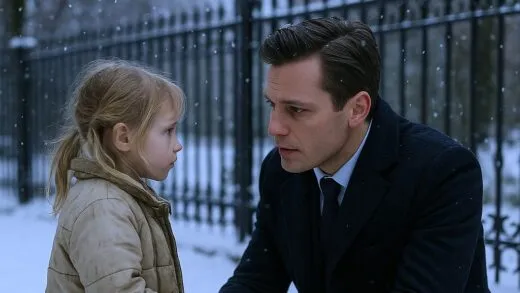
She remembered the child they never had. They had tried for two years, but nothing happened. The doctors said she was fine. But Mike needed to get checked. He flatly refused. “The problem can’t be me,” he had declared. “I’m healthy. It’s all your stress from work.” And she had believed him. Blamed herself.
Maybe if they’d had a child, things would have been different? Would her mother-in-law have interfered less? And Mike? Would he have grown up? No. Susan gave a bitter smile in the darkness. Nothing would have changed. It would have just been another lever for Eleanor’s manipulations: “Susan, you’re not swaddling my grandson correctly.” “Mikey, why is the baby crying? Susan probably didn’t feed him on time.” And Mike would have remained an eternal child, torn between his mother and his wife.
She got up and went to the window. The city was alive with its own nocturnal life. Somewhere out there, in another neighborhood, in their former apartment, was Mike. What was he doing? Drinking? Calling his mom to complain about his cruel wife? Or maybe he couldn’t sleep either, thinking of her, regretting what had happened?
Suddenly, she felt sorry for him. Not as a husband, but as a person. Weak, dependent, unable to take responsibility. He was a prisoner of his mother, of her suffocating love and total control. And he would never find the strength to break out of that cage. But she had.
This realization brought a strange sense of peace. She was no longer angry with him. She simply understood that they were from different worlds. She was a person who was used to fighting, achieving, solving problems. He was a person who was used to having someone else solve his problems for him. First his mother, then her.
She went back to bed and fell asleep almost immediately. She had a strange dream: she was walking down a long, dark corridor, and at the end was a door, from behind which she could hear Mike’s voice. He was calling her, asking for help. She walked up to the door, reached for the handle, but didn’t open it. She just turned around and walked in the opposite direction, toward a bright, warm light at the other end of the corridor.
She woke up with a clear head and a firm decision. She wouldn’t fight for the condo. That is, she would fight for her share, for what was legally hers. But she wouldn’t cling to those walls, to that past. She would start with a clean slate.
At breakfast, she announced her decision to her parents.
“I think the best thing to do is sell the condo and split the money,” she said. “I don’t want to have anything to do with them anymore. I’ll take my half, add my savings, and buy something small for myself. A studio or a one-bedroom. That will be enough for me.”
“A sensible decision,” her father nodded. “But they might not agree to sell. Eleanor will cling to it for dear life.”
“Then let them buy out my share,” Susan shrugged.
“Do they have the money for that? I doubt it.”
“So selling is the most realistic option.”
Around noon, the lawyer her father had arranged called. Andrew was a calm, confident man in his mid-fifties. He listened attentively to Susan’s story, asking a few clarifying questions about the mortgage and investments.
“The situation is clear,” he concluded. “The property was acquired during the marriage, which makes it community property. You are entitled to exactly half. The fact that you made most of the payments can be used as an additional argument in court, but most likely, the judge will split it 50/50.”
“What about the money his mother gave for the down payment?” Susan asked.
“That was a gift to her son,” the lawyer explained. “Without a loan agreement, it’s nearly impossible to prove it was a debt rather than a gift. So it won’t affect the division of assets.”
“So I can count on half?”
“Absolutely. I will prepare the divorce petition and the claim for division of property. I’ll need your documents: marriage certificate, property deeds, mortgage agreement, and your bank statements showing the payments. I’ll gather everything.”
After talking to the lawyer, Susan felt even more confident. She had a plan. A clear and understandable one. No more emotions, just cold, hard calculation.
She spent the rest of the day unpacking her boxes. She mercilessly threw away everything that reminded her of Mike: his gifts, their photos together, little trinkets that once seemed precious. She was clearing out not just the room, but her life, from the past.
In the evening, as she was almost finished, she came across an old photo album. In one picture, she and Mike were standing on the riverbank. Young, happy. Hugging and laughing. Susan looked at the photo for a long time. It didn’t hurt. It was just a little sad. Sad that the fairy tale had never become a reality. She closed the album and put it on the highest shelf. The past should stay in the past. And she had a new life ahead of her.
The process of gathering documents for the divorce turned out to be more complicated than Susan had anticipated. Some of the papers for the condo, including the originals of some payment receipts, were still in their shared apartment. She had to go back there again. This time, she was accompanied not only by her father but also by a police officer she had prudently called to avoid another confrontation.
Mike met them at the door, looking grim and hostile. Surprisingly, Eleanor was not there.
“What now?” he hissed through clenched teeth. “Come to take the last of it?”
“I came for the documents I need for court,” Susan replied calmly, walking into the apartment.
The presence of a uniformed officer had a sobering effect on Mike. She quickly found the folder she needed in a desk drawer. While she checked its contents, Mike stood in the doorway with his arms crossed.
“So, it’s really divorce?” he asked in a low voice. “You haven’t changed your mind?”
“No, Mike, I haven’t.”
“And all because of my mom? Because of one ruined evening?”
Susan looked up at him.
“No, not because of one evening. Because of seven years lived in your mother’s shadow. Because you never became my husband.” She closed the folder. “That’s all. I don’t need anything else from here.”
When they left the apartment, Susan felt the last thread connecting her to this place had been severed. Now it was just someone else’s apartment, where a stranger lived.
The court case promised to be long and unpleasant. As her father had predicted, Eleanor clung to the apartment with a death grip. At the very first hearing, appearing as a witness for her son, she put on a real show. She cried, wrung her hands, and told the court how she had saved her whole life to buy her “little boy a nest,” and how this predator now wanted to take it all away.
Mike sat next to his mother and their lawyer, nodding obediently. He looked pathetic. Susan looked at him and felt nothing but a faint sense of disgust.
Mike’s lawyer tried to argue that Susan’s contribution to the family budget was minimal, and that Mike had covered most of the expenses with unofficial income from selling his paintings. It was so absurd that even the judge, an older, experienced man, couldn’t hide an ironic smile.
“Do you have any proof of this income?” he asked. “Tax returns? Bank statements?”
“My client is a creative individual,” the lawyer replied pompously. “He prefers to deal in cash.”
“I see,” the judge nodded. “And you, ma’am, do you have proof of your income and mortgage payments?”