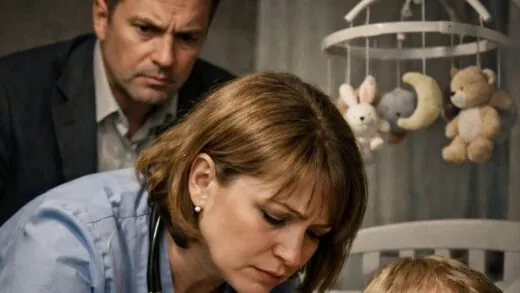

Dr. Collins froze mid-movement, the syringe suspended inches above Ranger’s skin. His eyes narrowed, his breath catching. The officers leaned forward. Lily lifted her head, her tears pausing on her cheeks. “What? What was that?” she whispered.
Ranger’s leg twitched again, but this time, it wasn’t the faint, fading spasm of a dying body. It was sharper, intentional. A response. Dr. Collins stepped back, stunned.
“Hold on, everyone, don’t move.” The room obeyed instantly. He leaned closer to Ranger’s chest, placing his hand gently over the dog’s ribcage. Seconds stretched like hours. Ranger’s breathing, which had been shallow and irregular, suddenly shifted. Not stronger, but different—uneven in a way that didn’t match the slow deterioration they were expecting.
“What is it?” Officer Miller asked, voice cracking.
Dr. Collins didn’t answer. He adjusted the oxygen mask, checking Ranger’s gums, then the pupils. Something didn’t add up. The decline had been too sudden, too dramatic, like a switch was flipped. Then Ranger let out a sound—a soft, strained grunt, not of pain, but of discomfort, like something deep inside him was pressing for release. He shifted slightly, his body tensing for a moment before relaxing again.
Lily gasped. “Ranger? Ranger, can you hear me?”
His ear twitched, this time more clearly than before. The vet’s eyes widened. He turned abruptly toward the monitor, adjusting the sensors.
“This isn’t typical organ failure,” he muttered half to himself. “This pattern, these fluctuations… this isn’t what we see at the end.”
Officer Jacobs stepped closer. “Doc, are you saying…?”
“I’m saying something is interfering with his system,” Dr. Collins said sharply. “Something we’re missing.” He placed the syringe back on the tray, his hands trembling, not from sadness now, but from adrenaline. “I need to run an emergency scan, immediately.”
Lily’s mother covered her mouth in shock. Officers exchanged confused glances, hope flickering behind their tears. Lily clutched Ranger’s paw again. “Is he… is he still dying?” she asked, her voice shaking.
Dr. Collins met her eyes. His voice changed completely, still serious but no longer final. “I don’t know,” he said honestly. “But I’m not giving up on him yet. Not after that.”
Two nurses rushed in with a portable scanner. The room buzzed with sudden urgency. The heaviness that had suffocated everyone moments ago was replaced with something electric. Possibility. As they lifted Ranger carefully for the scan, Lily whispered into his ear. “I knew you weren’t done fighting.”
The portable scanner beeped to life, its cold glow washing over Ranger’s limp body. Nurses worked quickly, sliding the device into position as Dr. Collins hovered beside them, eyes locked on the monitor as if trying to solve a puzzle with only seconds left on the clock. Officers crowded closer, no longer frozen in grief but fueled by a new kind of tension, one that trembled between hope and fear. Lily stood on tiptoe, holding Ranger’s paw. “Please, please find something,” she whispered.
The vet swallowed hard. “Starting scan now.”
The machine buzzed, sending faint vibrations through the metal table. Lines and shapes appeared on the screen, fuzzy at first, then sharpening into a grayscale image of Ranger’s internal structure. For a moment, Dr. Collins’ face remained blank, then his eyes widened. He leaned in closer, adjusting the angle, scanning the image again and again. His breath grew louder, heavier, the color drained from his face, not in fear but in disbelief.
“What is it?” Officer Miller asked, voice cracking.
Dr. Collins didn’t respond immediately. His hands moved rapidly over the controls, switching views, zooming in, analyzing. His heart hammered so loudly in his chest he could hear it over the hum of the machine. Finally, he exhaled sharply. “Oh my God!”
Lily’s fingers tightened around Ranger’s paw. “What? What is it? Is he okay?”
Dr. Collins looked at her, and for the first time since Ranger collapsed, there was something in his eyes that had been missing before. Hope.
“Everyone, look at this!” He pointed to the screen. Officers crowded around. Lily’s parents stepped forward. Even the nurses leaned in. The scans showed a shadow, an irregular dark mass pressing against Ranger’s diaphragm. Not a tumor. Not fluid buildup. Something else entirely.
“That’s… that’s not organ failure,” Dr. Collins said, voice trembling. “It’s an obstruction.”
Officer Jacobs blinked. “An obstruction? Like something stuck inside him?”
“Yes,” the vet said quickly. “A foreign object, something that’s been there for a while, maybe from a mission, maybe from a fight, maybe from debris.” He inhaled. He traced the outline on the screen. “It’s pressing against nerves and restricting his breathing. That’s why his vitals were collapsing.”
Lily’s mother gasped. “So he’s not dying?”
Dr. Collins raised a hand. “Let me be clear. He’s in critical condition. Very critical. But this…” He looked at the obstruction on the screen. “He has a chance.”
The room erupted in stunned whispers. Officer Miller staggered back, covering his face with both hands as tears slipped through his fingers. This time, tears of relief.
Lily pressed her hands to her mouth, her voice trembling. “You can fix him? You can really fix him?”
Dr. Collins knelt so he was eye level with her. “I can try,” he said softly. “I promise you, Lily, I’m going to give him everything I’ve got.”
A nurse stepped forward. “Prep the surgical room?”
“Immediately,” Dr. Collins replied.
Officers straightened their backs. The despair that had weighed them down just minutes ago lifted like fog burning off under the sun. As they gently lifted Ranger for emergency surgery, Lily leaned close to his ear. “You held on long enough for them to see,” she whispered, voice breaking. “You’re so brave. Keep fighting, okay?”
Ranger’s ear twitched, stronger this time. It was all the answer she needed.
The surgical room lights flickered on, casting a cold, sterile glow across the stainless steel trays and humming machines. Nurses moved quickly but carefully, prepping instruments with practiced precision. The doors swung open and Dr. Collins entered with the kind of focused determination normally reserved for life or death moments—because that’s exactly what this was. Ranger lay unconscious on the operating table, his chest rising in shallow, rhythmic breaths. Lily stood outside the glass window with her parents and half the police department behind her, all watching with a mixture of hope and fear. Her hands were pressed against the glass, her breath fogging a small circle on the surface.
Inside, Dr. Collins positioned himself, lowering the magnifying lights. “Heart rate unstable but holding,” a nurse announced.
“Good,” he replied. “We’re going in.”
The first incision was small but deliberate. The room fell into a tense silence, broken only by the rhythmic beeping of the monitor and the soft hum of machinery. Dr. Collins navigated through layers of tissue with the care of someone handling the most fragile treasure in the world. Then he stopped. “There it is,” he whispered.
Nurses leaned in. Even Officer Miller outside pressed closer to the glass. Embedded deep near Ranger’s diaphragm was a jagged piece of metal, no larger than a bottle cap, darkened with time and wear. It looked like shrapnel, the kind that comes from broken fences, debris, or even a criminal’s weapon. Whatever it was, it had been inside him for weeks, maybe months. But how? And why now?
Dr. Collins gently touched the embedded fragment. The moment he pressed the area surrounding it, Ranger’s vitals wavered sharply before settling again. “This is the culprit,” Dr. Collins said. “Every time he breathed, every movement he made, this thing was cutting deeper. It triggered inflammation, internal swelling, nerve pressure, everything.”
The nurse gasped softly. “How was he still working like this?”
“Because he’s Ranger,” Officer Jacobs whispered from outside. “He never stops.”
Dr. Collins nodded. “He must have taken this injury during duty and kept fighting, kept working until his body couldn’t compensate anymore.”
Lily’s father swallowed hard. “So he collapsed because his body couldn’t handle the internal damage any longer?”
“Exactly,” the vet said. “But the good news is that we can remove it.”