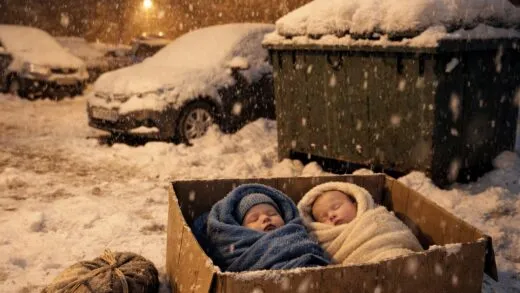
His little brother, five years old, cried all the time because he was hungry. Grisha went to the market. On a stall there was a loaf of bread, still warm, steam coming off it. He grabbed it and ran.
They caught him at the gate. They didn’t send him away because he was only seven. “After that something clicked,” Grisha said. “Not all at once. Gradually. I started to understand that when you really need something and there’s no other way, you can take it.”
“That’s a useful thought, and later it’s hard to stop it, because need and no-way-out can always be found if you want to find them.” He said it without excuses. Said plainly, “What I did was wrong. Not just because I was hungry. I just didn’t find another road.”
“Now I’m looking for one.” Agrippina answered, “You’re more likely to find it here than in a town barracks.” Grisha looked at her.
He didn’t answer, but he looked away the way people do when a sentence lands exactly where it should.
Tikhon was quiet through those evenings, listening, watching the fire. In December Agrippina told them about Stepan. Grisha asked, “What was it like with your husband?” Agrippina lifted her head and then began to talk.
How they met: she was eighteen, he was twenty, at an agricultural fair in Mirgorod. He had spoken to her first, directly, and she liked that. They married a year later. Stepan was a thorough man and a little funny at the same time.
He could spend an hour explaining why a woodpile ought to be stacked a certain way. He could laugh in the middle of a serious conversation. He always said what he thought. Sometimes that was good, sometimes not.
She told them how he left in 1941. She was holding little Kolya. Stepan hugged both of them, kissed the boy first, then her. Said, “I’ll be back. Unless I get unlucky.”
Just “I’ll be back,” said as if it were a fact, and then he turned the corner and was gone. She didn’t cry while he could see her. As soon as he disappeared, she did. Kolya didn’t understand why his mother was crying. Dad was coming back, wasn’t he?
She wiped her eyes and said, “Yes. Of course he is.” The kitchen went quiet. Semyon closed his book, and Grisha stopped carving.
Then Tikhon said softly, almost to himself, “My wife died at home too while I was at the front. Feels like I left her, even though I didn’t.” Agrippina looked at him and said nothing. Just moved a little closer to the stove.
And the four of them sat in that silence a long time. A full silence, the kind that comes when people have said enough and words aren’t needed anymore. Nobody had expected that. By February 1955 life had settled into a groove—not the old groove each of them had known before, but a new one, shared.
Mornings were for work, evenings for sitting by the stove, and Sundays were a little easier. Agrippina learned to tell when each man needed silence and when he needed a word. They learned to read her too. By February winter was still holding hard, nighttime temperatures dropping well below zero.
The wood in the walls cracked in the cold. First thing every morning was to get the stove going. Life moved along steadily, no shouting, no scenes. Then one February day a stranger came to the gate.
Agrippina saw him from the kitchen window. He stood there without knocking, just looking into the yard. Dressed like a town man, but poor: a government-cut overcoat, hat untied under the chin. Leather shoes meant for warmer weather, and it was February, so he was clearly cold.
Sharp face, quick eyes. He looked at the house, the windows, the shed, taking stock. A minute later Grisha came out of the barn with an empty bucket. Saw the man and stopped.
They talked at the gate, the stranger outside, Grisha inside. Agrippina watched from the window. The man talked with his hands, persuasive but not aggressive. Grisha held the bucket, looked at the ground, and stood still.
After four or five minutes the man left. Grisha stood there watching him go, then came into the house. Set down the bucket, didn’t take off his sheepskin coat, sat at the table. Agrippina sat across from him, looked at him, and waited.
Grisha was quiet a long time. Then he said, “That was Nikolai. We crossed paths in camp in the Donetsk region, back in ’48. One of our kind.”
Agrippina asked what he wanted. Grisha said he was inviting him in on an illegal job at a warehouse. On the edge of Mirgorod there was an industrial storage yard with one old watchman who slept at night. Tools, nonferrous metal, rubber—good stuff.
Nikolai said it was all figured out, clean and easy, but he needed somebody experienced. Agrippina said nothing, just looked at Grisha. Grisha raised his eyes to hers. Said, “I came in to tell you. Don’t even know why exactly. I just did.”
Agrippina was silent for three minutes. Grisha sat and waited. He didn’t add details, didn’t defend himself. Just waited. Then she stood up and went to the stove.
Took a spoon and stirred the soup, though it didn’t need stirring. Stood there with her back to him. Then she said, “Why did you tell me?” Grisha paused, then answered slowly: “Because if I go, you’ll know.”
“I don’t want you later thinking, he never said anything, so maybe there was nothing. I want you to see it plain: there was. I told you, and now you know.”
Agrippina turned and looked at him, then said, “Grisha, you already found it.” Grisha didn’t understand right away. Then, by the change in his face, he did. He remembered what she had said in November: “You’re more likely to find it here than in a town barracks.” Find what—she hadn’t said then, and now he understood…