
That same evening Klavdia stopped greeting her over the fence. Just turned away when she saw Agrippina, as if the woman had become a little invisible. Agrippina noticed the first time it happened. Marked it and did nothing.
Klavdia’s friendship over twenty years had always been weather-dependent: good weather, she’d say hello; bad weather, she’d look away. That kind of friendship wasn’t much of a loss. The village had chosen its side, and it wasn’t hers. A person could live with that. September in that part of the country is the last stretch of summer hanging on by its fingernails.
In the mornings there was fog over the fields, low, white, thick. It sat knee-high, and the village looked like an island in it. By nine the sun burned it off completely, and the ground turned warm again. September sky is blue and very high, higher than in July.
As if something in it had shifted upward and made more room. The maples by the old church yellow first, starting on the lower branches, one leaf at a time. The apple trees in the yards are heavy, branches bending. Apples have to be picked every day.
The whole village smells of apples and damp tops from the garden. That’s the real smell of September. Harvest time: potatoes have to come up before the rains. Beets pulled, tops cut off, into the cellar. Cabbage chopped and salted in big barrels under weight.
Carrots stored in boxes of sand. The village had a custom: neighbors helped one another in turn. A crew of eight or ten could clear a big potato patch in a day, where one owner alone would need a week. Then they’d move on to the next place.
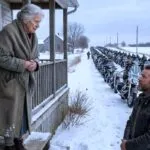
That was how it had always been, as long as Agrippina could remember. But this time nobody came to Agrippina’s. She watched the neighbors move from yard to yard. Five houses on her road, one after another, and nobody came to hers.
Agrippina dug potatoes herself, the four of them together with the three men. Tikhon dug in straight rows and didn’t slice a single tuber. Grisha followed behind, picking from the furrows and missing nothing. Semyon carried baskets to the cellar, counted, and stacked.
They finished in two days what a ten-person crew would have done in half a day. Agrippina looked at the cleared garden and thought that the village had stepped back from her. It wasn’t a surprise. A village is a system; everything has its place, and when something falls outside the pattern, the system reacts.
Three outsiders with prison records living in a widow’s yard definitely fell outside the pattern. She took note of that without anger, simply took note. In mid-September something happened that turned the quiet standoff into a loud one. Mitrofan Yegorovich lost a chicken.
A red laying hen, one of fifteen, didn’t come back to roost. Mitrofan looked for a day and didn’t find it, and on the second day he came to Agrippina’s. Stood in the open gate where the whole road could see. Said loudly, “Your men took my chicken. I know it.”
Agrippina came out and asked, “Did you see it?” Mitrofan said no, but who else could it be. Agrippina asked, “There been foxes this year?” Mitrofan said people had mentioned one near Zakharovka.
Agrippina went on: “A hawk? Maybe. Could the hen have slipped through a hole in your fence? No? Then yes, she could have.”
“First be sure.” But Mitrofan dug in: “It was them. Who else?” Agrippina called Grisha out. He came over. She asked him directly, right in front of Mitrofan: “Did you take his chicken?”
Grisha looked Mitrofan straight in the face, no sidestepping. Said evenly, “No.” Agrippina turned to Mitrofan. Said, “If you didn’t see it, then you don’t know. Come back with proof and we’ll talk. Without proof, go look for your fox.”
Then she shut the gate. Outside there was some heavy breathing, then footsteps. He left. Grisha looked at Agrippina. She said nothing, just gave him a nod. He nodded back and went to the shed.
The chicken turned up four days later. It had settled under the lower beam of Mitrofan’s granary. Found a gap, squeezed in, laid four eggs, and decided to sit on them. Mitrofan had to drag it out by the legs.
He did not come to Agrippina’s and apologize. Agrippina hadn’t expected him to. The talk around the village now moved into the open: at the well, in line at the post office. People said Nosova had taken up with criminals and it wouldn’t end well.
They speculated about why a widow needed three men in her house and what exactly went on there at night. That part was said with a smirk. Agrippina heard it, and it angered her, though she didn’t show it. In October Fyodor Kuzmich came by a second time.
He came without uniform, without the satchel, in plain clothes. Knocked at the gate and sat down on the porch. Took a mug of tea and warmed his hands around it for a while. Said, “I’m not here officially. I’m talking to you as a person. The village is really looking sideways at this.”
“Lukyan Fyodorovich already asked me what exactly is going on at Nosova’s place.” Agrippina asked what he had told him. Fyodor Kuzmich said he told him everything was legal. The papers were in order, the men were working, and there had been no complaints.
He doesn’t like it, but there’s nothing to pin on them. He paused, then added quietly, “Just tell me honestly—how are you doing? They’re not pushing you around? Not mistreating you?” Agrippina said, “Fyodor, I’ve lived alone since 1941.”
“Nobody’s pushed me around all these years, because there was nobody to do it. And I won’t let these men start.” Fyodor Kuzmich looked at her for a second, then gave a small warm smile without saying anything. Finished his tea, stood, and for the first time in twenty years of knowing her, offered his hand.
Winter, Long Evenings, and Old Wounds
Agrippina shook it, and he left. That same evening something happened she later remembered more strongly than anything else from that first year. Semyon and Grisha had gone to bed early because they were tired. Agrippina sat alone in the kitchen by the lamp, darning a sock…
The house was quiet. Then Tikhon appeared in the doorway. Stopped on the threshold and asked softly, “Can I come in?” She nodded. He came in, sat on the bench across from her, and said nothing.
Agrippina kept darning and didn’t hurry him. Then he started talking, and he talked a long time. Longer than all the words he had spoken up to then put together. He told her about Masha, how they had met in the summer of 1939 in Chernihiv.
Masha was short, round-faced, laughed loudly. They married a year later, and in 1941 he went to war. Masha was pregnant then, almost eight months. Nina was born in September 1941, when he was already near Kyiv, and he learned it from a letter.
The letters took three months to arrive. Masha wrote in detail about how Nina was growing and what she could do. Nina crawled, walked, said her first word—“Papa”—though she had never seen her father. In February 1944 Masha fell through the ice on the river while carrying water.
They pulled her out, but she was soaked through in twenty-degree weather. She took to bed. There was no medic, and the road was snowed in. Seven days later she died. Nina was nine.
Tikhon wrote his request to his commander that same day, asking for ten days. He wanted to take his daughter to his sister in Chernihiv. The commander was a decent man, but pressure was coming from above. Desertion in the unit had increased, and they wanted strictness, so he didn’t sign.
He told Tikhon to wait two weeks and said he’d try. Tikhon waited another week, then another. A month passed, and Tikhon left at night. He made it to Chernihiv and found Nina with a neighbor.
Nina was thin and quiet. When she saw him, she didn’t cry. She just grabbed his sleeve and held on. He took her to his sister’s, stayed four days, made sure they would keep her and feed her. Nina asked when he would come back, and he said soon.
The trip back took sixteen days because the trains were stalled and the bridges were out. He returned to his unit and by then he had already been marked down. The commander received him looking at the desk. Said quietly, “There was nothing I could do.”
Tikhon said, “I understand.” He got ten years. Nina wrote for the first four years in a child’s hand, with drawings in the margins, then less often. In 1948 one letter came, and after that, nothing.
Tikhon spoke evenly, without tears. He had long since said all this to himself. But Agrippina heard, not in his voice but in something else—in the way he looked at his hands while he spoke—that the pain had not gone anywhere. He had only put it where he kept it.
When he stopped, Agrippina laid the sock down on the table. Got up, went into the other room, took a sheet of paper and a pencil from the dresser drawer. Set them in front of Tikhon and said, “Write.” His daughter’s name, year of birth, the last address for the sister, the sister’s name.
She said, “I know somebody in Mirgorod. He helped once with a search like this. We’ll see.” Tikhon looked at the paper for a long time. The way a person looks at something he doesn’t quite believe in yet.
Then he took the pencil. Agrippina went back to her darning and didn’t look at him. She listened to the pencil scratch over the paper. Thought to herself: that’s what it means to give a person not pity, but something to do.
He had had enough pity, his own and other people’s. What he hadn’t had was something practical. November arrived all at once: one evening there was bare ground, and by morning there was snow. It stayed that way till April, with short thaws when the roofs started dripping and then everything froze hard again.
The men had to be moved from the shed into the house. Without any long discussion Agrippina brought them bedding. She put a folding cot for Semyon against the wall in the main room. Grisha and Tikhon built sleeping platforms from boards and stuffed them with straw mattresses.
It was cramped, but warm. Tikhon, without a word, went and heated the room ahead of time, feeding the stove birch wood. By evening there was a dry, steady warmth. Winter rearranged life.
In summer the work kept people from thinking. In winter there was still work, but it moved slower. Livestock, firewood, water, snow—by noon, most days, the essentials were done. Then there were the evenings, long and dark, with night falling by five. They sat by the stove.
For the first few weeks they were quiet more than they talked. Agrippina darned or knitted. Semyon read, because she had let him take books from the shelf: Shevchenko, Franko, Kotsyubynsky. He took one at a time, read carefully, and put it back exactly where it belonged.
Grisha carved wooden spoons with patterned handles, bowls, a little horse with a cut mane. He set it on the windowsill and said nothing. Tikhon watched the fire through the stove opening and sometimes wouldn’t move for an hour. Then one evening Semyon started talking on his own.
He told them about the day in 1946. The break room by the second building. There were three of them: him, Vasya Ryabov from his section, and another man from the foundry. They were talking about ration cards, because the allotments had been cut again and there was less bread than in 1945. Semyon had said, tired and half to himself between drags on a cigarette: “Pretty soon there won’t be enough to eat at all, like in ’33.”
That was all. He wasn’t making a speech, just speaking out of fatigue. Two weeks later they came for him. Vasya had written a detailed denunciation with the date and the wording. Semyon told it without hatred.
At the end he said, “I thought a long time about why Vasya. He wasn’t a bad man, really. He had a little daughter, and his wife was sick. I think he got scared.”
“He decided to write first, show loyalty, insure himself. That doesn’t excuse it, but it explains it.” Agrippina listened and thought of Stepan. Stepan said too much sometimes too, but he had been lucky: in 1941 he went off to war.
A few evenings later Grisha talked. He remembered 1933. He had been seven when his father died in March—just lay down and didn’t get up. His mother lay there with legs swollen from hunger…