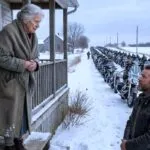

That she noticed: the ability to wait is not nothing. It tells you a lot about a person. Then she asked through the crack, “You got papers?” Semyon reached into his inside pocket without a word. Took out a folded document and passed it carefully through the gap with two fingers.
Agrippina took it and unfolded it. Certificate of release from a place of confinement, official form, stamp, signature. Genuine—she had seen such papers before. Klavdia’s nephew Alyosha had had one just like it the year before when he came back from near Zhytomyr.
Name, patronymic, article, sentence. Date of release: May 1954. She handed the paper back through the crack. Said nothing for a moment.
Then she asked, “You got something to sleep in? You won’t freeze?” Semyon said, “A hayloft would do, if you’d allow it. A roof over us is plenty.” Agrippina stood there a little longer and looked at each of them.
Then she said, “Go on back to the far shed. Wait there. I’ll bring you something to eat. Keep quiet so the neighbors don’t see. I don’t need talk.”
She opened not the gate but the narrow wicket, enough for one person at a time. She let them through one by one. Each man, passing her, nodded: Semyon briefly, Grisha without looking up, Tikhon barely at all. She set the shovel handle back by the shed wall. No longer needed, though she didn’t put it away. Let it stand.
Then she went into the house to heat the soup. As she walked she was thinking that three grown men meant three sets of hands. The fence needed raising, the firewood needed splitting, the roof leaked. That’s what she was thinking about, not whether she ought to be afraid. Fear is for when there’s no choice. She had a choice, and she had just made it.
The First Test: Work
She poured the soup into a pot, grabbed it with a rag, took half a loaf of yesterday’s bread and three spoons. Carried it out to the shed threshold and set it right on the ground. Said simply, “Eat.” Then went back inside.
She didn’t sleep. She lay on top of the blanket fully dressed and listened. The yard stayed quiet, except for Zorka shifting her weight now and then in the stall, a familiar sound, not a troubling one. Later she heard low voices from the shed. Sound carried well; the shed was only ten steps from the kitchen window.
The night was warm, and one pane in the frame sat loose and didn’t seal tight. Mostly it was Semyon talking, low and even. The voice of a man who knew how to keep his tone under control in any situation. Agrippina couldn’t make out every word, but she caught the sense.
He was saying they ought to move on in the morning, that they shouldn’t stay. The woman had let them in out of pity or awkwardness, and either one would run out fast. No sense taking advantage. Grisha gave a skeptical grunt, short and dry, and Tikhon said nothing. Then there was a long pause.
After that Semyon said something too soft for her to hear. She caught only the tone—calm, not complaining. Just stating a fact. Agrippina lay there thinking.
In 1941, when Stepan was taken in July, she had been left with Kolya and the farm and no man’s help. And almost no money, because what little they had had gone before the war. She had made it through the winter of ’41, bitter cold, near forty below, when there wasn’t enough firewood and they ate frozen potatoes. Then ’42, then ’43, when the death notice came.
She had survived and kept the place going, which meant she knew how. But now she was fifty-two, the roof leaked, and the firewood wasn’t split. And in the mornings her back needed three minutes of lying still before she could sit up, or she couldn’t straighten. She never said that out loud, not even in letters to Kolya.
In the notebook there’s only one line about it before she moves on, but it was true. Three men on the property: not family, not neighbors, not old friends. Men without a home, without work, without a past they could show. Men with nowhere to go, just as she had nowhere to turn with uncut firewood and a leaking roof.
At one in the morning she told herself: we’ll see in the morning. She turned on her side, closed her eyes, and three minutes later she was asleep. She knew how to do that—make a decision, set worry aside, and not torture herself till dawn. That too was a skill learned over years.
She got up at four as always, while it was still dark outside. The sky in the east was only beginning to pale, a faint pink strip above the woods. Zorka was already lowing in the stall; the cow knew the schedule better than any clock. The goats answered with bleats.
Agrippina dressed and went into the yard. Her first sideways glance went to the far shed. The door was shut from the inside with the latch. They had latched it themselves; she hadn’t asked them to, and she noticed that.
That meant they understood not to make noise and draw attention. That meant they were thinking. She milked Zorka—about two gallons that morning, less in the heat than in cool weather. Opened the chicken coop and the hens spilled into the yard, scattering at once to scratch for something. Gave the goats a bundle of dried clover.
Set millet porridge on the kitchen stove with a spoonful of butter, while there was still butter. Brought water from the well: two buckets, shoulder yoke across her back, all by habit. Her back complained on the first step, but she neither stopped nor slowed. The men came out of the shed when the sun had already lifted over the woods and the yard had turned gold in the morning light.
They came out almost together, one after another. Semyon looked around the yard first, his eyes measuring the gate, the fence, the roof. An engineer’s habit—look and assess. Then he came up to Agrippina, who was sitting on the porch sorting yarn.
He asked politely, “Good morning. May we wash up?” She nodded toward the well. While they washed, she watched without seeming to, out of the corner of her eye but carefully. That matters: how a man washes in the morning, especially in somebody else’s yard, tells you more than words do.
Grisha washed fast, splashed water from the dipper over his face and neck, shook himself off, and stepped aside. Rolled a cigarette, thin one, his tobacco clearly running low. He smoked facing away from the yard so the smoke wouldn’t drift into the house. Semyon washed neatly and thoroughly.
He soaped his hands with his own sliver of soap, rubbed well, rinsed, and dried them with a rag he took from his jacket pocket. The rag was clean. Tikhon came to the well last, drew a full bucket, set it on the curb, and took off his shirt.
Then he dumped the whole bucket over himself, head and all, though the morning was still cool and the dew hadn’t dried yet. He shook his head, snorted, and put the shirt back on. All of it done silently, calmly, matter-of-factly. Army habit, Agrippina thought….