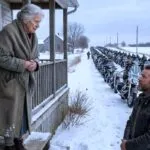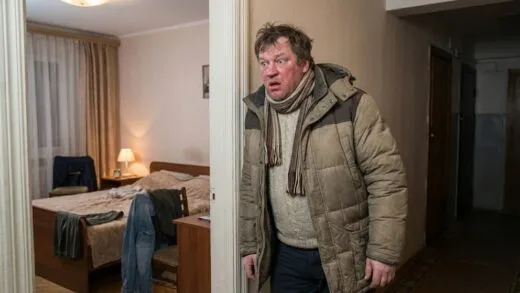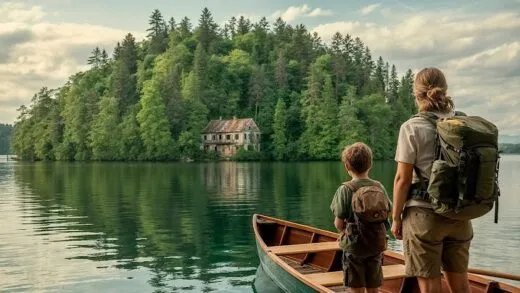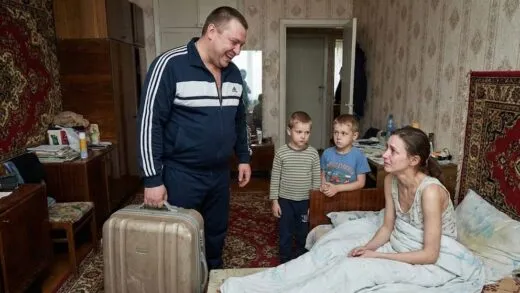

if you want a house to stand a hundred years, cut the timber in winter, in a hard freeze. Then the wood is dry and won’t split. And that’s how he built it. Thick walls, tight corner joints, not a single rotten log in twenty years. The plank floor in the entryway didn’t creak underfoot.
There was a big masonry stove in the main room and a smaller one in the kitchen. The windows were small, but double-framed, so the wind stayed out in winter. By 1954 the roof had started to give. One side, the north side, had shifted after a heavy winter.
That was where it leaked in spring, in the kitchen corner over the stove. Agrippina set a basin under it, but that wasn’t a fix, just a delay. The real fix was to relay the shingles and check the rafters. She couldn’t do that alone, and she didn’t have the money to hire help.
Her garden was about half an acre. Big by village standards, just right by hers. The rows were straight as string. The soil was loose, no hard crust on top, because she loosened it after every rain and never let it set.
She grew tomatoes, cucumbers, onions, carrots, beets, and three kinds of cabbage. Potatoes were the main crop, two varieties: early and late. Zucchini and pumpkins by the fence. Sunflowers along the lane for the chickens and for oil.
She had a cow named Zorka, three years old, red with a white patch on her forehead, a good milker. In a strong season she gave around three gallons a day. Agrippina sold or traded half and kept the rest. Two goats: Masha, spotted and mean-tempered, and the other one, nameless, calm and easy, whom Agrippina simply called Second.
About twenty chickens. One young rooster, loud as a siren, crowing at three in the morning. The root cellar was packed full. Pickles, dried and canned mushrooms, sauerkraut in two barrels, potatoes in piles, beets and carrots in sand, apples soaking in a wooden tub with oak leaves.
Everything homegrown, everything made by hand. Nothing store-bought that could be raised or put up at home. Agrippina was short, broad, and solidly built. She had been that way since youth, and the years hadn’t dried her out or bent her over, only added weight to her movements, made them slower and more deliberate.
Dark hair touched with gray at the temples, always tucked under a headscarf. She didn’t take it off even indoors, only at night. Working hands, broad palms, strong fingers with nails always broken short, skin tough and cracked across the knuckles from water, dirt, and cold. The kind of hands that could knead dough smooth, lift a cast-iron pot off the stove barehanded, and hold a shovel for eight hours without blistering.
The blisters had long since turned to callus. Her face was stern, the lines in it deep, but not old-lady lines—earned lines, every one of them. This one from one year, that one from another. Her lips were usually pressed together, not from displeasure, just the way her face was made. They softened only when she smiled, and she didn’t smile often.
She looked straight at people, never dropped her eyes—not to the local officer, not to the farm chairman, Lukyan Fyodorovich. He was a sly man who liked to lean on his authority, but that didn’t work on Agrippina. She didn’t lower her eyes before God either. She believed quietly, without church, in her own plain way. She talked to Him without candles or a prayer book, just to herself in the evening, after the work was done and she could finally sit down.
War and Solitude
The war took her husband Stepan in 1941, in July, twenty-two days after it began. He left on the third day of mobilization. Agrippina walked him to the gate, no farther—he wouldn’t let her. He said Kolya was still little, and there was no reason for a child to watch his father walk off to war and not turn around.
Stepan said, “I’ll be back.” He didn’t promise when, didn’t name a date, just said it the way a man says something he believes to be true. He hugged her and little Kolya and left. Fourteen letters came over the next two years, and she knew every one of them by heart, down to the punctuation.
In 1943 they stopped coming. First there was just a long silence, then the death notice arrived. Killed in action near Kharkiv in July of ’43. Agrippina read it, folded it neatly in fourths, put it in the dresser drawer under the bundle of letters, and shut the drawer. Then she went out into the yard.
She fed hay to the goats, milked the cow, and put potatoes on to boil. She didn’t cry after that. Not because she hadn’t loved him—she had, and that love didn’t go anywhere. It just moved inward and became part of how she walked and breathed.
But there wasn’t time for tears. Kolya was seven, the farm was on her shoulders, and the war was still on. Letting herself sob into a pillow at night was a luxury she couldn’t afford. Kolya grew up ordinary in the best sense—no prodigy, no troublemaker, just decent, hardworking, not foolish. In 1952 he turned eighteen, got his papers, packed one suitcase, and left for Kharkiv.
There was a machine plant there offering a dorm room and decent pay. He had written ahead and gotten a reply; everything had been arranged. Agrippina packed food for the trip, saw him to the bus, and waved him off. He wrote rarely: postcards on holidays, May Day and November Seventh, and a couple of letters a year.
He came home even less often. Once a year in summer, for a few days. He helped some around the place, ate her cooking, slept in his old room, and left again. Agrippina never complained out loud. Once she told her neighbor Klavdia that she had raised her son for life, not for herself. Let him live.
That meant she had done it right. Klavdia nodded sympathetically. Agrippina didn’t explain further, and there wasn’t much to explain. She wasn’t afraid of being alone.
She was afraid of something else: that her strength would go before she got everything done. The garden, the livestock, the firewood, the roof—everything needed hands, and there were never enough hands. Some jobs one woman simply could not do. You can’t lift a log for repairs alone, can’t cut fence posts alone, can’t reshingle a roof without another person on the ladder.
She did what she could, and the rest piled up. That summer of 1954 it all came at once, as if it had waited until things were especially hard and then arrived together. The roof started leaking in the kitchen after the winter, when the snow had lain heavy for a long time. The garden fence fell after the May rains.
The ground turned soft, and the posts, already rotting at the bottom from winter, simply gave way. She had less than half the firewood she needed for winter. In spring one thing had gone wrong, then her back had been bad for a week, then something else, then something else. Agrippina looked at all of it and did the math in her head: what she could manage herself and what she couldn’t. What it would cost to hire a man from Mirgorod—there was one there, Prokhor, who took on all kinds of farm jobs.
She figured it out and saw she didn’t have the money for Prokhor. She had money set aside for winter, for kerosene and salt and whatever else might come up. She didn’t want to touch it. More exactly, she had money, but not the kind you spend.
A Brutal August and Unexpected Visitors
August came in hot and mean. The kind of August that hits that part of the country once every few years. The heat settles in by mid-July and hangs on with a dead grip until September, without a single real rain. The ground cracked open, gaps two fingers wide and a hand deep.
The grass dried out and yellowed back in July. The burdock by the fence, usually lush and dark green, curled up and turned brown. She had to water the garden twice a day, once before the heat and once after. Otherwise the tomatoes scorched right on the vine, and the cucumbers turned bitter and twisted.
She carried water from the well in buckets on a shoulder yoke. The well was thirty steps from the house. Two buckets each trip—about eight gallons. One full watering of the garden took eight or ten trips. In a day, fifteen or twenty.
By evening her back wouldn’t straighten…