He didn’t shout. He didn’t justify himself. He didn’t beg. He simply told the story.
He told about the mess hall. About being denied water. About the beating with the keys. About the burns on his feet.
And about what had happened in the bathroom. He spoke in a flat, steady voice, staring at one point on the wall. And that calm unnerved the investigator.
He had seen killers. Seen drunken fights, accidents, all kinds of violence. But this was different.
What sat before him did not look like a criminal so much as the end product of some inhuman machine. And that result was more frightening than the crime itself. When Mike finished, a heavy silence settled over the room.
The investigator sat quiet for a long time, then let out a tired breath and wrote in the report:
“Committed irreversible actions against four fellow servicemen on the basis of non-regulation relations.”
A dry bureaucratic phrase that didn’t begin to describe the hell this young man had lived through.
The machinery of justice was now in motion. News of the killings in the prison car tore through every level of the military chain of command and reached the top. This was a major state-level incident.
A commission from the capital arrived at the post immediately. High-ranking generals and special investigators. Men with stone faces for whom what had happened was not a tragedy but an embarrassing stain on the Army’s reputation.
They weren’t interested in truth. They wanted a version. A convenient, usable version that could be presented in court and reported upward. The unit was turned upside down.
Everyone who had served with Mike was questioned. The company was locked down. The barracks, which had lived by their own brutal unwritten rules, now sat in panicked silence.
The soldiers who had watched the abuse—or joined in—now sat under the cold eyes of investigators. Pale, nervous, unable to hold a gaze, they all said the same thing: they hadn’t seen anything, didn’t know anything, Sokolov had been odd, withdrawn, unstable. The system’s oldest rule had kicked in—fear and mutual protection.
No one wanted to be next. No one wanted to share the blame. To admit everyone knew about the hazing would have meant condemning not just themselves but the officers too.
The investigators didn’t push. They didn’t want details about gas masks and burned feet. That spoiled the picture.
The official version came together quickly and cleanly. Private Sokolov, with previously hidden psychological problems, on the basis of personal hostility and a sudden psychotic break, seized weapons and committed an especially grave crime. He was the monster.
A psychopath. A deviant. And Voronov, Gafurov, and the others were victims who had died in the line of duty.
As always, the institution’s honor mattered more than the life or truth of one ordinary soldier. Meanwhile, back in his family’s apartment, life had gone on in ordinary ignorance. His mother worked in the kitchen. His father read the paper.
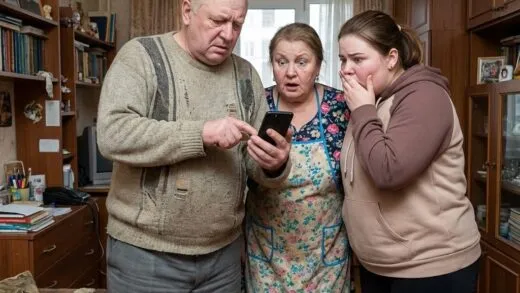
They were waiting for another letter from their son, one that would say, as always, that everything was fine. Then the doorbell rang. Short. Insistent.
At the door stood two officers and a man in plain clothes. Their faces were serious, flat, almost carved from gray stone. They did not meet anyone’s eyes.
The words they spoke were dry and official, but in that quiet apartment they landed like a bomb:
— Your son, Private Anton Sokolov, while escorting a secure prisoner transport, committed a grave crime against four fellow servicemen and is now under arrest. An investigation is underway.
The world gave way. His father, who had always said the Army made men out of boys, went white. The newspaper slipped from his hands.
He tried to say something, to object, to insist there had to be some terrible mistake, that his Anton—his quiet, decent son—couldn’t have done such a thing. But the words caught in his throat. His strong working hands, hands that had spent a lifetime on the job, now shook helplessly.
His mother said nothing. She didn’t cry. She didn’t scream. She just stared at one point, her face drained of color.
Then her knees gave way and she started to sink to the floor. His father barely caught her. The mother’s fear she’d carried since the day of the send-off had been right.
Only the truth was worse than anything she had imagined. The news spread through their small city fast, gathering ugly rumors as it went. It reached Susan too.
She didn’t believe it. Wouldn’t believe it. She took out his last letter, the one he had mailed just before the assignment.
She read the strained, lying lines about how everything was fine. And she cried. Her small, comfortable world—walks in the park, thoughts of marriage, dreams of a future—collapsed in a single moment under the weight of one official phrase: “committed a crime.”
The trial was swift, closed, and predictable. A military tribunal. Not really a courtroom so much as a large office with a portrait on the wall and heavy curtains that blocked the daylight.
At a long table covered in green felt sat three men—a judge and two assessors. Men in uniform with stone, expressionless faces. They were not judges in any meaningful sense…
They were a function of the system. Their task was not to understand the tragedy but to close an embarrassing case quickly and decisively. Across from them, on a hard bench, sat Mike.
Beside him sat a court-appointed attorney, an older, tired man who understood perfectly well how pointless and predetermined the whole proceeding was. He said a few things about hazing, about extreme emotional strain, about mercy. But his words disappeared into the dead silence of the room, bouncing off indifferent faces.
Witnesses were called. Warrant Officer Belov, who had somehow avoided facing charges himself for losing control of weapons and drinking on duty, spoke in memorized phrases. He lied.
He lied while staring at the floor, afraid to meet Mike’s eyes. He said Private Sokolov had been withdrawn, had shown aggression, that there had been no abuse in the guard detail. The rail car attendant, shaking, confirmed every word.
And Mike stayed silent. He sat straight, looking ahead, as if none of it concerned him. He didn’t listen to the lies, or his lawyer’s weak defense, or the prosecutor’s speech painting him as a cold-blooded monster.
He had already made peace with everything in that rail car. This trial was just procedure, the last act in a play whose ending had been written in advance. He was calm.
It was the calm of a man with nothing left to lose. He had accepted his fate. At last came the sentence.
The judge, without changing expression, read in a dry, colorless voice from a long text full of legal language. He spoke of “attempt on the lives of servicemen,” of “particular cruelty,” of “undermining military readiness.” The word “hazing” never appeared. Neither did “abuse.”
In the official world, those words did not exist.
— In the name of the state, — the judge droned, — the military tribunal finds Private Anton Dmitrievich Sokolov, born 1967, guilty under Article 102 of the Criminal Code and sentences him to…
The judge paused briefly, almost theatrically.
— the exceptional measure of punishment: death by firing squad.
Dead silence filled the room. Even the attorney seemed to stop breathing. Only Mike did not move.
He slowly raised his eyes and looked directly at the judges. There was no fear in his face. No despair. Only cold, endless contempt.
— The sentence is final and not subject to appeal, — the judge concluded, and closed the file.
It was over. The machinery of justice had finished its work. It had ground up a man driven past the limit and produced a dry official formula.
Execution. Period. They led him out of the room.
Two guards escorted him down a long echoing corridor. He did not resist. He walked steadily, head high.
At the end of the corridor stood his parents. His father, aged twenty years in a matter of months, gray at the temples, eyes emptied out. And his mother. Small, bent, in a dark headscarf, looking at her son while tears ran soundlessly down her face.
They were given one minute to say goodbye. His mother rushed to him and clutched at his uniform.
She didn’t wail. She didn’t make a scene. She just held on to him and whispered through tears:
— Son… my boy… why?
His father stood beside them in silence. He looked at his son with such pain and helplessness in his eyes that it seemed he might collapse right there. Then he placed his rough, work-worn hand on Mike’s shoulder.
— I’m sorry, son. — It was all he could manage.
Mike held his mother close. He breathed in the familiar scent he had almost forgotten.
— Mom, it’s all right, — he said quietly.
Then he looked his father in the eye. For the first time in all those months, his face changed. The corners of his mouth lifted in the faintest, saddest smile.
— Don’t cry. I don’t regret it.
The guards pulled his mother away. The minute was over. They led Mike down the corridor and into the dark toward what waited for him.
And his parents were left standing there alone in that echoing government hallway with a grief too large for words. The sentence was carried out three months later in the basement of a prison in the capital. A short shot to the back of the head.
His parents received an official notice stating that he had died of acute heart failure. No burial place was given. Warrant Officer Belov was discharged from the Army on medical grounds.
He drank himself into the ground and died a few years later of cirrhosis, poor and forgotten. The company commander—the captain who had thrown away Mike’s request for transfer—received a formal reprimand and was reassigned to another post, away from the scandal. His career continued upward.
Susan waited for him. She never believed the official version. She wrote letters to every office she could think of, but all she got back were form responses.
A few years later she married someone else. She had children. She lived an ordinary life. But sometimes, when she saw soldiers walking by, she would stiffen and look away. The case of the killings in the prison car was classified and buried in the archives under “Top Secret.”
The system did everything it could to make sure people forgot Private Anton Sokolov. To make his story dissolve and disappear as if it had never happened. But can memory really be killed? Can people be made to forget what breaks lives and damages souls?
The system managed to kill the man, but it could not kill the question his story leaves behind. The question of what a human life is worth—and where the final line lies, the one beyond which endurance ends. The system was never truly held to account. But remembering men like Anton Sokolov is one thing still within our power.
It is a reminder of what absolute indifference can do to a person. Every story like this deserves to be heard.