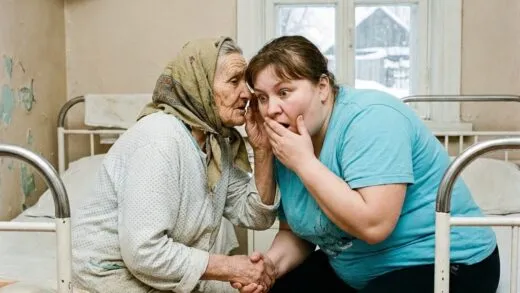
“I know. I’m not going to apologize—it’s too late, and it wouldn’t change anything. But I want you to know: I regret it. I regret it every single day.”
Molly didn’t know what to say. It was so unexpected, here in a hospital, after all these years.
“My husband now, he’s a good man,” Kira continued. “Better than I deserve. And when I saw him on that gurney… I realized I could lose him. And it was so terrifying. I remembered how scared your mother must have been. When she was sick. And how I didn’t help her. How I only made things worse.”
“That was a long time ago,” Molly said. “It’s over.”
“For you, maybe. Not for me.”
They sat in silence. The hallway was quiet, except for the distant beep of a machine.
“Your husband will recover,” Molly said at last. “He’s young, his heart is strong. The doctors say he should be able to go home in a week.”
“Thank you.” Kira looked at her directly for the first time. “Thank you for telling me. And thank you for… not being angry.”
“I’m a doctor,” Molly replied. “Almost. We’re not supposed to be angry at patients. Or their families.”
She turned and walked down the hall, feeling Kira’s eyes on her back. It was a strange feeling, as if a door that had been ajar for years had finally clicked shut. That evening, she called her mom and told her everything. Vera listened in silence, sighing occasionally.
“And how do you feel?” she asked when Molly finished.
“I don’t know.”
“Strange. Like… forgiveness?”
“I don’t know if you can call it that.”
“You can. Forgiveness is when you stop carrying the weight. When you let go. I didn’t forgive her on purpose. I just stopped being angry.”
“That’s what forgiveness is, sweetie. It’s not always loud and dramatic. Sometimes you just stop holding on.”
Molly thought about that late into the night. About forgiveness, about anger, about how people change and how they don’t. About how Kira was probably just an unhappy woman who didn’t know how to love properly. And about how her own life—with her mom, with David, with Mikey—would have been completely different if not for that day on the ice.
She graduated from medical school with honors. Her whole family came to the ceremony. Vera, beaming with pride; David, taking pictures of everything; and Mikey, now a teenager pretending to be bored but secretly proud, too.
“To you!” David said, raising his glass at the restaurant after the ceremony. “To Dr. Molly Thompson. Or…” he paused, “maybe Dr. Molly Vance?”
Molly looked at him. They had never discussed it—changing her last name. She had always been a Thompson, like her mother before she married.
“I thought about it,” she said slowly. “But I decided to stay Thompson. Not because I don’t want to be part of the family—I already am. But this name… it reminds me of where I came from. Of who I was when all this started.”
David nodded.
“I understand. And I respect that.”
“But,” Molly added with a smile, “when I fill out forms, in the space for ‘Father,’ I’ll write your name. If you don’t mind.”
She saw his eyes glisten. David—a big, strong, successful man—looked at her and could barely hold back tears.
“I don’t mind,” he said, his voice thick. “Of course, I don’t mind. I… Thank you, Molly. For everything.”
She worked at the hospital, the same one where her mother had been a patient years ago. She started as a general practitioner, though she planned to specialize in cardiology. Her patients loved her—for her honesty, her attentiveness, for the way she always found time to talk, even when there was no time. Her colleagues respected her—for her professionalism, her willingness to help, for never complaining about the difficult work.
“You’re a natural-born doctor,” the head nurse told her one day. It was the same nurse who had sat with her mother all those years ago. “That’s a rare quality.”
“Thank you.”
“No, really. I’ve seen a lot of young doctors. Most of them are here for the money or the status. But you’re here for something else. For meaning, maybe?”
Molly didn’t know what to say. Meaning was a big word. She was just doing what felt right. Like on the ice. Like always.
She was twenty-five when she met Adam. He was a surgeon at the same hospital, young and promising. Tall, dark-haired, with a smile that made his face look almost boyish. They literally ran into each other—in a hallway, when they were both rushing to an emergency call.
“Sorry!” he said, grabbing her elbow to keep her from falling.
“It’s okay. I wasn’t looking.”
“Are you headed to the third floor?”
“Yes.”
“Me too. Let’s run together?”