The ice cracked with a sound so loud, Molly didn’t immediately realize what it was. Not a falling branch. Something worse.
She was standing on the shore of the town pond, holding a grocery bag with two loaves of bread and a box of store-brand cookies. Her mom had promised to bake an apple pie if Molly got back before dark. The December sun was already setting, painting the snow pink, and the little girl was hurrying. But that sound made her freeze.
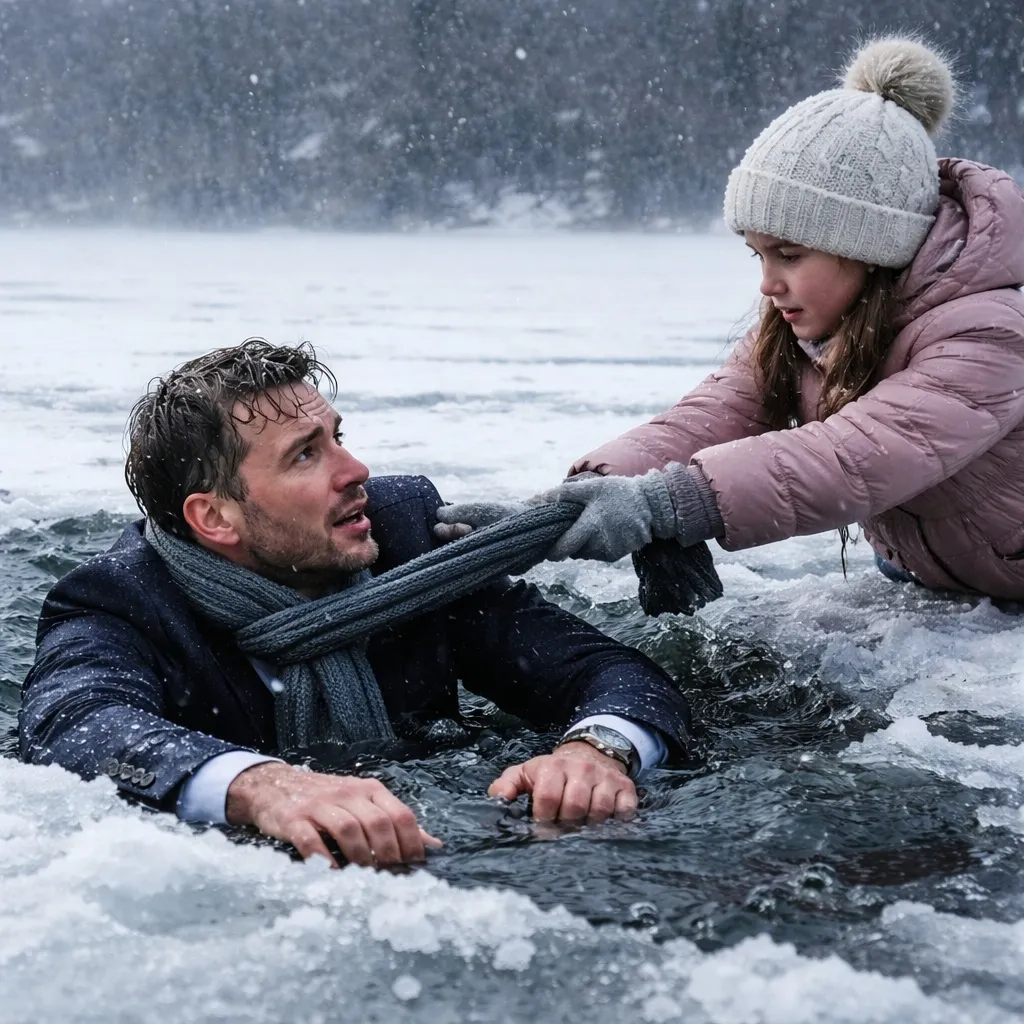
And then she saw it. In the middle of the pond, where the ice was thinnest, a person was struggling. A black coat, expensive-looking like in the movies, thrashed in the hole. Hands grabbed at the edges of the ice, which crumbled away instantly.
“Help!” the man shouted, but his voice was strangely quiet, as if he’d already been yelling for a long time.
Molly looked around. There were people on the path. A woman in a fur coat stood watching, a gloved hand pressed to her chest, but she didn’t move. A man in a tracksuit pulled out his phone—maybe to film, maybe to call, it was hard to tell. A pair of college kids exchanged a look and walked away faster, almost at a run.
“Somebody call 911!” the woman in the fur coat yelled, but she stayed right where she was.
Molly looked at the drowning man and thought about how her mom always told her never to go out on the ice. Her mom told her a lot of things: don’t talk to strangers, don’t take candy from anyone, be careful because you, Molly, are the only thing I have left. But her mom also said that people have to help each other, because otherwise the world becomes a cold place where it’s every man for himself.
Molly glanced at her bag of groceries, then at the hole in the ice, then at the people who were still just standing and watching. The man in the water had almost stopped shouting. He was just clinging to the edge of the ice, his eyes fixed on the shore. Even from this distance, Molly could see the fear in them.
She didn’t remember deciding to run. Suddenly she was on the ice, her snow boots slipping, her heart pounding so loud it drowned out everything else.
“Kid, what are you doing?” someone yelled from the shore, but Molly wasn’t listening anymore.
She knew you weren’t supposed to get close to a hole in the ice—they’d shown them pictures at school. So she dropped to her stomach about ten feet from the opening and started to crawl. Her bright red scarf came unwound and slithered beside her like a snake.
“Get out of here!” the man rasped when he saw her. His teeth were chattering, his lips were blue, but his eyes were fierce. “Go back, kid, you’ll fall in!”
Molly didn’t answer. She looked at him, at the ice around the hole, then at her scarf. It was long. Her grandma had knitted it before she passed away, and Mom said it was a keepsake that she had to take care of. But Grandma had also said that things were just things, and people were what mattered.
Molly took off the scarf and tossed one end toward the man. It landed in the water near his hand.
“Grab on!” she said, her voice sounding strange to her own ears.
“I can’t let you pull me out,” the man replied, but he grabbed the scarf anyway.
“You have to do it yourself. I’ll hold on, and you pull. Just don’t jerk it, or you’ll pull me in with you.”
She had no idea where the words came from. Maybe a movie, or a book her mom had read to her. The man stared at her for a second, then two, then nodded. He began to pull himself up, and Molly felt the scarf go taut, felt herself being dragged forward. She dug her boots into the ice, but they just slipped. So she rolled onto her back, wrapped the scarf around her wrist, and dug in with her heels. That was better. She barely moved.
Slowly, so slowly, the man hauled himself out of the water. The ice groaned under his weight, and with every crack Molly thought he was going to fall back in, but he didn’t. He crawled toward her, leaving a dark, wet trail behind him. His expensive coat was a ruined mess. When he was finally next to her, Molly saw he wasn’t that old, maybe the age of that actor on Mom’s favorite TV show. He had a handsome face, but right now it was gray and terrifying.
“Crawl to the shore,” she said. “Slowly. Don’t stand up.”
It felt like it took them an eternity to crawl back. Molly could hear shouting from the shore and the wail of a siren—someone had finally called for help. She thought about how her mom was going to be mad, how her scarf was now soaked and dirty, and how the bread in the bag she’d dropped on the bank was probably squashed.
When they finally reached solid ground, Molly sat down in the snow and started to cry. Not from fear—the fear would come later, at night, when she was lying in bed remembering the sound of the cracking ice. She was crying now simply because it was over, because she was freezing, and because the man next to her was crying, too, even though grown men weren’t supposed to.
People were bustling around them now, appearing out of nowhere like roaches when you flip on a light. The woman in the fur coat was trying to wrap her own scarf around Molly. Some guy was on the phone. Paramedics were running toward them with a stretcher.
“What’s your name?” the wet man asked, his teeth chattering so hard his words came out in bursts.
“Molly. Molly Thompson.”
“I’m David. Thank you, Molly Thompson.”
The paramedics were already helping him toward the ambulance, wrapping him in a blanket, but he kept looking back at her. Molly watched the ambulance drive away, then picked up her grocery bag—the bread was a little squashed, but not too bad—and walked home.
Her mom, Vera, met her with a cry. Not an angry one, but a terrified one. One of the neighbors had already called and told her they’d seen Molly on the ice. Vera Thompson, 29 years old and beautiful even with her face pale with horror, grabbed her daughter by the shoulders and shook her, asking what happened, why would she do such a thing.
Molly told her everything: the crack, the man, the scarf. Vera listened, and her expression changed from fear to disbelief, then to a strange kind of pride, and then back to fear again.
“You could have drowned,” she said finally.
“I know.”
“Don’t you ever do that again.”
“But what if he had died?”