
Greg gathered the men. He explained: a riot is a dead end. The tactical teams will just crush us. We have to do it differently. They declared a hunger strike. 100 men out of 300 refused to eat. Greg fasted with them.
After ten days, the administration blinked. The lockdown was lifted. After that, ‘The Ghost’s’ authority was ironclad. Even those who had doubted him before recognized him. He was the real deal. He stood for his people. He couldn’t be bought.
But that status is a sacrifice. Greg understood: as long as he held this title, he’d never have a family. Kids were out of the question. Working a regular job was a taboo. His whole life was dedicated to one thing—the rules.
Others could afford compromises. A Chairman never could. 1995. A new batch of inmates arrived. Among them was ‘Andy the Roach.’ Young, 23, in for a violent assault. On the outside, he’d been a low-level enforcer for a street gang.
Inside, he immediately started acting like he owned the place. Greg didn’t interfere until Roach tried to dip into the Common Fund. He demanded money for a lawyer, saying the ‘system’ owed him. Greg called him in. The talk was short. Greg explained: the Fund isn’t a bank or a charity.
It’s a reserve for those who live with dignity. Roach didn’t qualify. On the outside, he’d worked for guys who cooperated with the feds. In here, he was a nobody. Roach tried to argue. Greg didn’t raise his voice. He just looked at him. Roach went silent. He left.
A week later, Roach tried to set up one of the guys, telling a guard where some contraband was hidden. Greg found out. They gathered the men. Roach was judged by the laws of the block. Found to be a snitch. He lost his status.
He tried to fight back, but he was quickly neutralized. The last time Greg saw him was in the mess hall, sitting at the lowest table. Roach never looked anyone in the eye again. ’96, ’97, ’98 passed in a blur. Prison life went on.
Greg kept order, managed the kitty, and settled beefs. His word was law. But he didn’t enjoy the power. He understood: it wasn’t power; it was service. The code was a duty, not a privilege. In 1999, some people from the city came to visit.
Beefs between rival crews on the outside were spilling into the prison. They wanted Greg to pick a side. He refused. He said the prison was neutral ground; city politics stayed at the gate. The visitors were unhappy, but they didn’t push. The Ghost’s reputation was too big.
The 2000s brought changes. The prison system was being overhauled. They started cracking down on the old-school leaders, putting them in solitary, moving them to ‘Control Units.’ They tried to break Greg several times. They kept him in the hole for 15 days at a time.
One meal a day, cold, damp. He endured it; he didn’t bend. In 2002, the administration tried to transfer Greg to a facility where the guards had total control. Greg filed a grievance through a lawyer. The grievance actually made it to the state board, and the transfer was blocked.
Greg stayed at Stateville. The years crawled by. Greg was in his 40s now. His health started to slip; his back ached from the dampness, his teeth were failing. But he held himself together, never showing weakness. Leaders don’t get to be sick in public. It’s a sign of vulnerability.
In 2004, he was called to the Warden’s office. Warden Miller, a new guy, had been there a year. He offered a deal. Greg gets early parole, but in exchange, he has to provide info on the syndicate’s offshore accounts. Greg looked him in the eye and said one word: “No.”
Miller tried to pressure him, threatened him with new charges, a frame-up. Greg didn’t flinch; he walked out. He didn’t get early parole. But a year later, his time was served. December 2005. He’d done the full 20 years. Greg was 46.
Gray-haired, wrinkled, with a bad back, but alive and free. On the day he left, half the block came to say goodbye. Greg didn’t give a speech; he just shook hands and hugged his brothers. At the gate, two guys from the old neighborhood were waiting—’Monty’ and ‘Razor.’
They brought clothes, cash, a phone, and put him in the car. Greg turned back and looked at the towers one last time. Prison was behind him. The city felt like a foreign country to Greg. 20 years is a long time for everything to change. The buildings were different, the cars were different, the people were different.
Monty drove him through downtown, showing him around. This used to be a market; now it’s a luxury condo. This was a theater—torn down for a bank. Greg looked out the window and stayed silent. The city he was born in had become a movie set. They stopped at a small apartment on the outskirts.
Monty had rented a room for him. 150 square feet, a bed, a table, a fridge. Greg nodded; it was enough. Monty left him some cash and said, “If you need anything, call.” He gave him an old flip phone. Greg put it in his pocket. He was alone.
For the first week, he just walked the city. Getting used to it. The fact that there was no wake-up call, that he could walk into a store and buy anything, that people didn’t look you in the eye—they just rushed past. In prison, everyone knew everyone. Here, it was a sea of strangers.
After two weeks, Greg realized: he didn’t belong here. Almost no friends were left. Monty and Razor, maybe two or three others from the old days. The rest were either locked up, dead, or gone. The new generation didn’t know Greg, and he didn’t want anything to do with their business.
The underworld had changed. Now people bought their status with money and connections. The code had eroded. Greg saw it and pulled away. One evening in late May, he was sitting on a bench outside his building. He was drinking coffee from a thermos and smoking. He remembered his grandmother, Martha.
She’d died when he was 15. She lived in a small town called Oak Ridge, about 60 miles away. An old house, a garden, a well. Greg used to spend his summers there as a kid. It was quiet. It didn’t have the city noise, the hustle, the fake faces. The next morning, he called Monty.
He asked if it was possible to buy a house out in the country. Monty was surprised but didn’t try to talk him out of it. He said he’d look. A week later, he found one. A house in Oak Ridge—old, but solid. The owner had passed away two years ago. The heirs were selling. Twenty thousand dollars. Greg agreed.
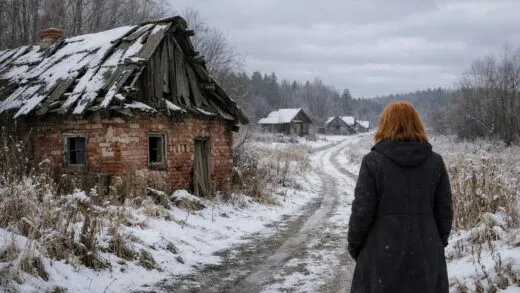
The money came from the ‘Common Fund’—the brothers take care of their own. In June 2005, Greg moved to Oak Ridge. The town was nearly empty. Maybe 30 residents, mostly seniors. The young people had moved to the cities. The house sat on the edge of town, near the woods…