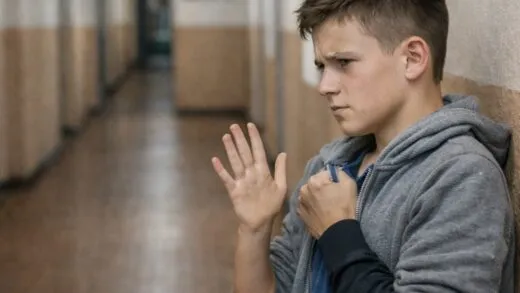
Michael emerged from his room, drawn by the unfamiliar voices, and froze in the doorway of the living room.
A deafening silence fell over the room. The three main actors in this drama stood frozen, like figures in a painting.
Michael stared at Daniel, his face a mask of pure, childlike astonishment mixed with fear. He was looking at his own reflection, a living double, and couldn’t tell if he was dreaming. Daniel stared back at Michael, his initial hostility giving way to the same bewilderment. He had been prepared to see anyone—a frightened, sickly recluse—but not this young man who looked so painfully like himself.
And Peter Wallace looked at them both, at the two brothers separated by eighteen years, and felt his heart tear apart with pain and tenderness. The moment he had dreaded most in the world had finally arrived.
The silence in the living room was so thick you could almost touch it. It pressed on the eardrums, making the ticking of the old clock deafeningly loud. Michael and Daniel remained standing opposite each other—two reflections separated by the space of the room, yet connected by an invisible thread of blood. Their faces displayed a whole spectrum of emotions: shock, disbelief, fear, and a dawning, unconscious curiosity.
George Coleman was the first to break the spell. He sank heavily into an old wingback chair, which creaked under his weight, and fixed his hard gaze on Peter.
“Well, Doctor?” His voice was as cold and sharp as a shard of ice. “I believe it’s time for an explanation.”
Peter swallowed the lump in his throat. He looked at Michael, who still couldn’t take his eyes off his double, and knew he couldn’t lie anymore. Not in front of him.
“Michael, son,” he said, his voice trembling. “Please, go to your room. We need to talk.”
“But, Dad, who is this?” Michael whispered, not turning around. “Why does he look just like me?”
“I’ll explain everything. Later. I promise.”
Peter walked over to his son and gently turned him toward the hallway.
“Just give us a little time.”
Michael cast one last bewildered glance at the strangers and, obeying his father, slowly left the room. But Peter knew he wouldn’t go far. He would be standing behind the door, listening, trying to understand. And that thought made the coming conversation even more unbearable.
When the door closed behind Michael, Peter turned to face his guests. He felt like a defendant in a terrible trial where the verdict had already been decided.
“How… how did you find me?” he asked, just to break the oppressive silence.
George pulled a worn leather wallet from his jacket pocket, and from it, a small, yellowed photograph.
“My wife, Eleanor, passed away six months ago,” he began in a hollow, colorless voice. “Before she died, she called me to her side and confessed what had been tormenting her for eighteen years. That night at the hospital, when you brought us Daniel, she had a moment of clarity through the sedatives and saw a nurse carrying a second baby down the hall. She was sure it was ours. But you said he had died, and she…”
“She thought she had imagined it in her grief. She was afraid to tell me, afraid to reopen the wound. All these years, she lived with that image, never knowing if it was real or a trick of her tormented mind.”
He paused, taking a heavy breath.
“As she was dying, she asked me to find the truth. She gave me this.”
He handed the photograph to Peter. It showed a young nurse holding a tiny infant wrapped in a standard-issue hospital blanket.
“Linda, a nurse from your shift,” George explained. “Eleanor knew her; they were from the same small town. After that night, Linda quit and moved away. We spent six months looking for her. Found her in a little town up north. At first, she denied everything, she was scared. But when I showed her a picture of Daniel and told her we weren’t looking for blame, but for family, she told us everything. How you took the second boy, how you filed the death certificate, how you later visited her and asked her to keep quiet, giving her money for her sick mother’s treatment.”
Peter listened, and scenes from the past flashed before his eyes. There he was, younger, forty-seven, standing before that same Linda, a terrified young woman, begging her to be silent. There he was, giving her his life savings so she could save her mother. He hadn’t done it out of malice, not to buy her silence, but out of compassion. He had saved her mother, just as he was saving his adopted son.
“She gave us your name and address,” George finished. “And here we are.”
He fell silent, and in the ensuing quiet, Peter felt two pairs of eyes on him. One was heavy, judgmental, belonging to the old man. The other was full of youthful, implacable hatred, belonging to Daniel.
“So it’s true?” Daniel asked, his voice cracking. “You stole him. You stole my brother and lied to all of us for eighteen years?”
Peter looked up at him. He could make excuses, talk about the baby’s condition, about his desperation. But all he saw was the pain of this young man who had just discovered he had a brother and that this brother had been taken from him.
“Yes,” he said quietly. “It’s true.”
Daniel shot up from the couch, his fists clenched.
“I… I could kill you for this,” he seethed, taking a step toward Peter.
“Daniel, sit down!” George commanded. “Not now. First, we’ll hear him out.” He turned back to Peter. “I want to hear everything, Doctor, from the beginning, with no omissions. Why did you do it?”
Peter took a deep breath, gathering his thoughts. He knew this was the most important conversation of his life. Everything depended on his words, on his sincerity. His future, Michael’s future, and whether these two boys, separated by him, could ever become true brothers. He had to tell them the truth, no matter how ugly and painful it was. It was his duty to them, to the deceased Anna, and to himself.
Peter rose from his chair and walked to the window. Outside, the March sky was high and piercingly blue. Spring was asserting its rights, and nature was preparing to awaken, oblivious to the dramas unfolding in human souls. He stared at the bare branches of the old maple tree in the yard, trying to find the right words to explain the inexplicable.
How could he explain the motives for his actions to these people whose lives he had so crudely and irreversibly altered? Any words seemed false, any excuses pathetic. He could feel the tense gazes of George and Daniel at his back. They were waiting, judging. He, Dr. Peter Wallace, who had spent his life saving lives, delivering verdicts on health and illness, was now on the stand himself. And his judges were the very people against whom his guilt was the greatest.
And behind the door, he knew, stood another, his most important judge—his son. He remembered Michael’s face when he saw Daniel. Astonishment, fear, confusion. In his pure, sheltered world, where his father was the sole and infallible authority, a crack had suddenly appeared. And Peter knew that this crack could turn into a chasm that would separate them forever. He couldn’t let that happen. He had to try, at least try, to build a bridge across that chasm. A bridge made of truth.
“I understand your anger,” he began, without turning around. His voice sounded muffled, as if coming from a deep well. “And I’m not asking for forgiveness, because I know there is no forgiveness for what I did. I can only tell you how it happened, and why.”
He slowly turned and met George’s gaze first, then Daniel’s.
“The night your daughter, your mother…” he looked at Daniel, “…passed away, I did everything I could. We all did. But we lost. When I came out to you in the hallway, I saw your grief. And I couldn’t. I couldn’t tell you that one of your grandsons, one of Anna’s sons, was also dying.”
He paused, letting the words sink in.
“The second boy…” he couldn’t bring himself to say the name Michael; it felt too intimate, too much his own, “…had a severe congenital heart defect. Transposition of the great arteries. Without immediate and very complex surgery, he was doomed. The chances of survival, even with surgery, were minimal. One in a hundred.”
Daniel listened, and his face, previously angry and tense, began to change. Hatred gave way to confusion. He tried to imagine the scene: his mother’s death, followed immediately by the news that one of her children was also at death’s door.
“I’m a doctor,” Peter continued. “All my life, I’ve fought for human life. And I couldn’t just stand by and watch that tiny flame flicker out. I couldn’t sign his death warrant by simply stating a fact. And I couldn’t place that unbearable burden on you. You had just lost your daughter. The thought of you having to bury a grandson as well was more than I could bear.”
He walked to his desk and pulled out the bottom drawer. From it, he took a thick file tied with a ribbon.
“This is his medical history.” He placed the file on the desk. “All eighteen years. Every consultation, every test, every surgery. There were three of them. Three major open-heart surgeries.”
George picked up the file. His hands, accustomed to military discipline, trembled slightly. He opened it and began to flip through the pages, filled with medical terms, charts, and scans.
“I’m not justifying my deception,” Peter said, looking at the old man. “I committed a professional crime. I forged documents. I lied to you for all these years. But I didn’t do it for personal gain. I just wanted to give him a chance. A chance to live. I thought that if he died, he would die in my care, and that pain would be mine alone. And if… if a miracle happened and he survived, then I…”