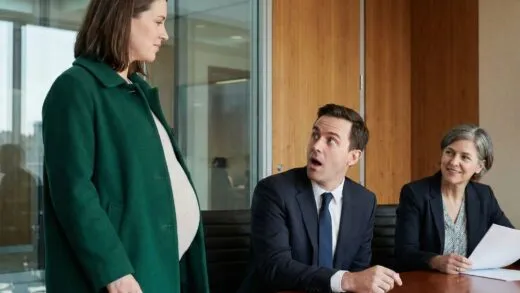

Then it becomes clear—it isn’t indifference. It’s patience. The kind you see in someone who knows how to wait for the right moment. She had worked with spreadsheets and reports for five straight years, could spot an error in a hundred-page document in 15 minutes, and never raised her voice in meetings, even when coworkers were clearly talking nonsense. Management valued her for her cool head.

Her husband seemed to value it too, though lately Eleanor had started to notice that his idea of “valuing” her had quietly shifted into “using” her. He just hadn’t said it out loud yet. They had been married seven years. The first three were good. Then they coasted. Then even the coasting started to slow, but Eleanor kept telling herself it was just a rough patch. Mike’s business wasn’t going the way he’d hoped. He was under pressure. It would pass.
She had a habit of explaining other people’s weaknesses away as circumstances. That was part of her nature—and probably the most vulnerable part. Mike Lawson was seven years older than she was. He owned a small chain of home goods stores: four locations in different parts of town, a warehouse on the edge of the city, two managers, and about a dozen sales associates. On the surface, he carried himself with confidence. Nice suits. A habit of talking about plans as if they were already done. A way of walking into any room like he owned it.
In public, it worked. Eleanor knew the backside of it—late-night talks about loans, dark silences after calls from the bank, the irritation he disguised as exhaustion. But knowing something isn’t the same as fully understanding it.
Tuesday morning began with a text from her mother. Susan had written the night before: “Honey, your dad and I decided to come up for a few days. We miss you. Your father says he hasn’t been in town in ages and wants to see some of the old places.” Eleanor read the message twice, set her phone on the charger, and stared at the bedroom ceiling for a long time. She’d been sleeping alone for several nights already.
Mike was supposedly on a business trip. Her parents didn’t visit often. After her father retired, they sold their condo, moved south, and bought a small place near the coast—the kind of life they’d talked about for years. Her father didn’t like the hassle of long trips, and her mother hated imposing. If they’d decided to come, they really must have missed her. Or maybe they’d picked up on something.
Susan had that practical maternal radar that works across distance and silence. Eleanor had never once complained to her parents about her marriage—not in seven years. Not out of pride, exactly, but out of conviction. Family business stays in the family. You don’t drag it out into the street. Now she was starting to think that principle had cost her more than she realized. Mike had left for his “business trip” with a large suitcase and a polished, professional air.
He said he was meeting suppliers in a neighboring state, negotiating a new shipment, maybe gone three days, maybe a week. He kissed her on the cheek—quick, routine, like touching the doorknob on the way out—and left in a rideshare. Eleanor watched from the window as the car disappeared around the corner. She felt nothing unusual. That alone should have warned her. But she’d gotten used to calling the absence of feeling “fatigue.”
She texted her mother that she’d pick them up herself. Their flight landed at 6:40 p.m., and she left early to allow for traffic and parking. The airport at that hour was busy and loud, smelling of coffee from the cafés near the entrance and something faintly uneasy, the way all places do where people are saying hello and goodbye at the same time.
Eleanor got a coffee to go, stood by the glass doors outside arrivals, and waited. The board showed the flight had landed. In about 20 minutes, passengers would start coming out.
For the first few minutes, she just watched the stream of people with suitcases. Tired faces. Happy hugs. Kids being scooped up into arms. Older couples walking slowly and quietly because they didn’t need to say anything. She was scanning for her mother—a neat, small woman in beige—and her father, tall and straight-backed, with that unmistakable bearing of a man who had spent years in public office and never quite lost it.
But they weren’t the first people she saw. First she noticed a familiar line of shoulders. Then the turn of a head she knew by heart. Then the face. Mike was standing near the edge of the arrivals hall, a little apart from the main crowd where it was less busy. He wasn’t looking around.
He was looking at the young woman beside him—a blonde in a short leather jacket with a travel bag over one shoulder. Tall, striking, carrying herself with the kind of confidence that comes either naturally or from being used to attention and liking it. Eleanor didn’t know her. Had never seen her before. But one glance was enough to understand: this woman was not a coworker, and she was not a business partner. The coffee in Eleanor’s hand went untouched.
She stood there and watched as the husband who supposedly loved her—and had supposedly been negotiating with suppliers in another city for days—took a strange woman by the hand and led her toward the exit. They walked side by side, shoulder to shoulder, with the easy rhythm of people who had been close for a while. That kind of ease doesn’t happen overnight.
He carried the woman’s bag. It was a small thing. But that small thing hit the hardest, because Mike hadn’t carried Eleanor’s bag—or much of anything for her—in a very long time. Something shifted in her chest. Not pain at first. More like a dull physical jolt. As if the floor had tipped under her feet and then righted itself, but something in the balance had changed for good. Eleanor took a step forward.
And at that moment, a heavy, warm hand rested on her shoulder.
“Honey,” said her father in a calm, low voice, without a wasted note…