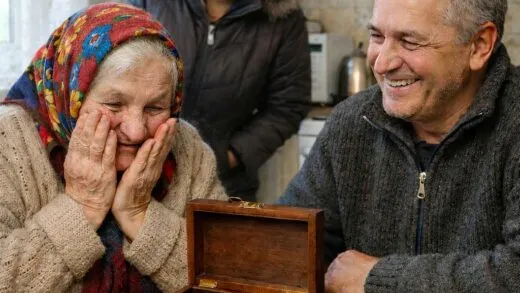
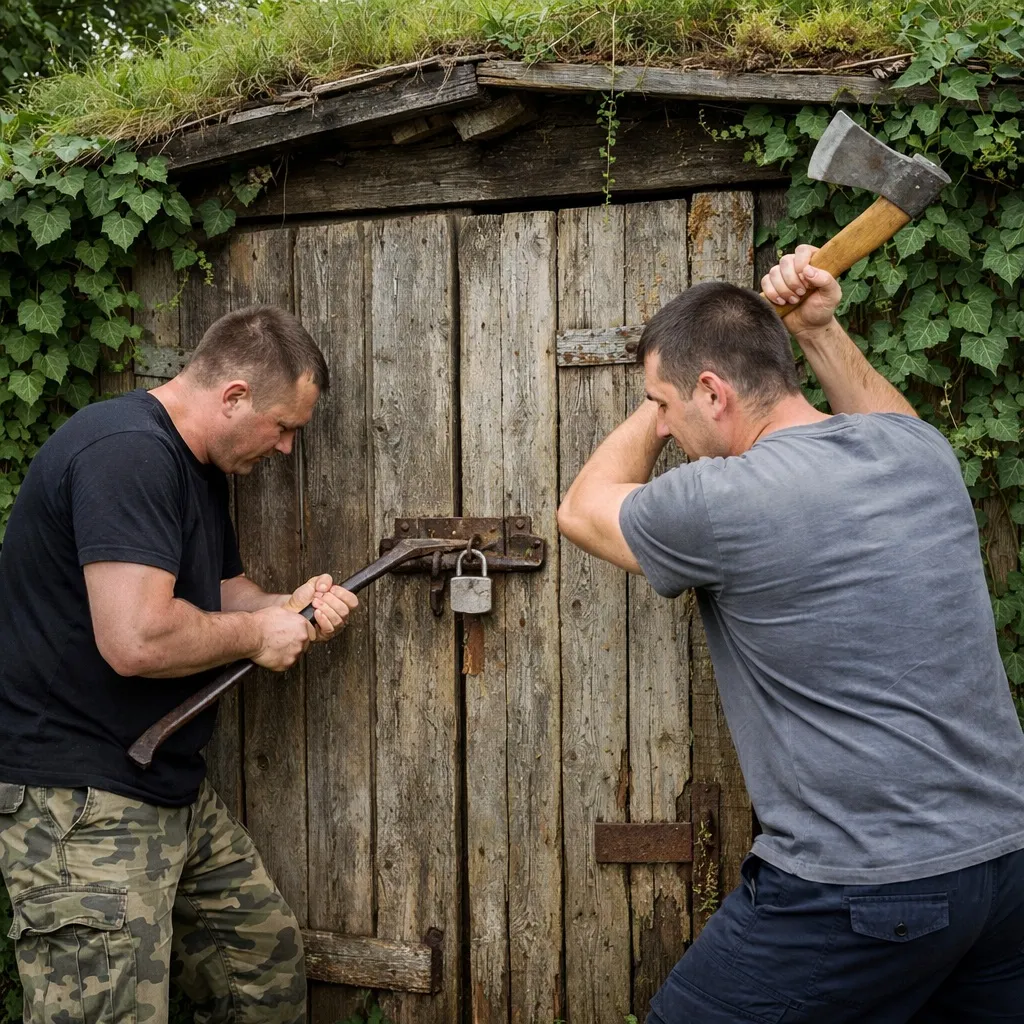
They returned to the old farmhouse in the Appalachian foothills just three months after the funeral. The detached garage behind the main house had stood locked for decades, a structure Grandpa Elias had strictly forbidden them from ever approaching. As children, they obeyed without question, but as adults, the mystery had grown too large to ignore. When the rusty chain, stamped with the mark of a defunct steel mill, finally hit the ground, they expected to find hoarding, old tools, or perhaps just empty space. But what lay inside made them freeze in their tracks.
Moments later, tears were streaming down their faces. They thought they knew their grandfather, but they realized they had only known half a life. Fog clung low to the gravel driveway, and the surrounding pine forest seemed endless, as if time itself slowed down in this valley. The car moved cautiously, tires crunching over gravel and mud left by the recent heavy rains. The drive to the property, located miles outside of town, had never been easy, but today it felt like an eternity.
The trip felt like a test of their resolve to face the past. Behind the wheel sat Arthur Saville, a thirty-two-year-old structural engineer from Chicago. He had sharp features, short dark hair, and the kind of pragmatic demeanor that comes from a career built on precise calculations and load-bearing walls. He was used to blueprints, clear answers, and problems that could be solved with math.
But staring down that driveway, Arthur felt an unfamiliar hesitation. It felt like entering a space where his usual logic wouldn’t apply. Beside him sat his cousin, Melanie, a year younger and softer in appearance, with light brown hair pulled back in a loose braid. She was shorter than Arthur but possessed a quiet, resilient strength.
It was a trait she’d honed as a high school literature teacher. Her gray eyes, usually calm, betrayed a flicker of anxiety today. Melanie looked as though she was bracing herself not for a house, but for a memory that might weigh heavier than the reality. It had been exactly three months since they buried their grandfather, Elias Zorin. Three months of finding excuses to delay this trip.
Work, paperwork, winter weather—they used every reason in the book. But the truth was simpler. The farmhouse wasn’t just real estate; it was the backdrop of their childhood. Returning meant accepting that Elias would never again be waiting on the porch, nodding silently as they pulled in, or hanging their coats by the door.
When the car finally stopped by the leaning gate, the air felt heavy. The yard was overgrown, weeds reaching past their knees. The wooden fence, once painted a crisp hunter green, was peeling and listing to one side. The house, a sturdy timber-frame build, stood as it always had, but without Elias, it felt hollow, like a shell waiting for a spirit that had already departed.
Arthur stepped out first, inhaling the cool mountain air. The scent of damp earth mixed with something familiar—dried herbs. Elias used to dry them in the attic every summer. Melanie lingered in the passenger seat for a moment before opening her door. Her palms were sweating, a reaction she couldn’t quite explain.
She wasn’t sure if it was the chill or the tension. She noted quietly that everything looked exactly the same, as if she were afraid to break the silence. The key turned in the lock with a stubborn grind, and the door creaked open. Inside, the house greeted them with a cool stillness and the scent of old pine. On the wall, the pendulum clock had stopped, its hands frozen in time.
The brass pendulum hung motionless in the dim light. On the kitchen table sat an old percolator, darkened by years of use, next to a neatly folded newspaper dated three months prior. It looked as though the owner had just stepped out for a walk. Melanie ran a hand along the back of the armchair by the window.
Her fingers left a faint trail in the dust on the faded upholstery. This was where Elias spent his evenings, staring out at the garden. He was a man of few words, with thick eyebrows and a posture that remained upright even in his eighties. His hands—broad, calloused, with prominent knuckles—always seemed invincible. Only in the last few years had a tremor appeared, one he tried desperately to hide.
As kids, they never noticed his weariness. To them, Grandpa was eternal. The kitchen was organized with military precision. Jars of tea and spices were labeled in his steady handwriting, spoons aligned as if by a ruler. Arthur felt a sudden spike of irritation, not at the house, but at himself.
He was trying to treat this like a project—inventory, probate, logistics. But every detail pulled him back to being a ten-year-old boy. He cleared his throat, remarking that they needed to find the paperwork, trying to impose order on the emotional chaos. In the drawer of the solid oak dresser, they found the folder right where it was supposed to be.