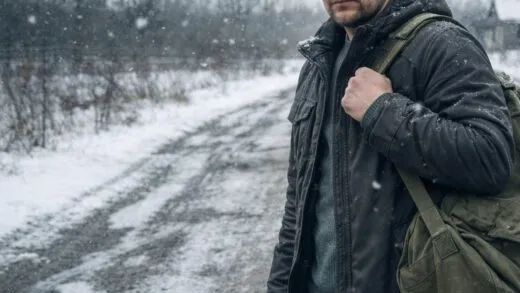
Her head slightly down. Not hiding, just watching her step, like someone who didn’t have time to look around. Or didn’t want to.
Something about that figure—small, quick, tense—held his attention a second longer than it should have. He stepped away from the window. Sat at his desk.
Opened a folder of reports. Before lunch he held two meetings and signed six documents. At one-thirty Susan came in with another note.
— Kazakova is asking for an hour. Says it’s urgent.
Mike looked up from the papers. Looked at his assistant. Said nothing for a moment.
— Has she already left?
— No, she’s waiting for an answer.
— Tell her yes, — he said. Pause. — And send Frank in.
Susan disappeared. Three minutes later Frank Palmer came into the office. He was Mike’s driver, fifty-two years old, and had been with him four years. Mike trusted him exactly as much as his natural distrust of everyone allowed. Frank was short, solidly built, with the face of a man who had seen plenty and didn’t waste words.
Former security work, then private driving for serious people. Careful, quiet, dependable.
— Frank, — Mike said without preamble. — A woman is about to leave the office. Dark coat, brown hair, short. Follow her. Where she goes, what she does, where she’s been going. I need to know where she keeps running off to every day.
Frank didn’t ask why. He never asked why.
— I’ll handle it, — he said. — I’ll report back tonight.
Mike nodded and dropped his gaze back to the papers. The day moved along. Negotiations with a contractor, a conflict in the Indianapolis office he had to settle by phone, a long conversation with legal.
By six in the evening he felt the familiar fatigue. Not the kind that made him sleepy, the kind that settled in his shoulders and behind his eyes. The kind coffee and a walk didn’t fix.
At 7:20 his phone vibrated. Frank.
— Mike. — Frank’s voice was level as always, but there was something in it. A note Mike hadn’t heard before. — You need to see this yourself. Come out here.
Mike straightened in his chair.
— What happened?
— Nothing bad. Just… you need to see it. I’ll text the address.
The message came a minute later. A street on the south side. Mike didn’t recognize the name. An unfamiliar neighborhood.
He grabbed his coat, let Susan know—she was already packing up to leave—and headed down to the car.
He drove himself. Frank was already there on site, so he’d taken his own car.
As Mike drove through the city at night, he figured he’d probably find something ordinary. A boyfriend. Some side arrangement. Anything.
But something specific. Something he could write down and close the file on. Fire her with a clean conscience and no loose doubts. He didn’t like doubts.
Doubts were inefficient. But something in him—that instinct he rarely relied on and that rarely failed him—said he wasn’t about to see anything ordinary. He turned onto the unfamiliar street.
Parked behind Frank’s car. Got out. And stopped cold.
The streetlight on the pole flickered unevenly. Blinked at steady intervals, as if someone were measuring out the seconds on purpose. The cold November air smelled like wet pavement and something bitter, maybe smoke, maybe just fall itself, which in the Midwest always carried a little bit of goodbye in it.
Mike stood by his car and looked. The building was two stories, old, with peeling stucco and a small sign over the entrance. He didn’t make out the words right away.
“Crisis Center for Women and Children.” The sign was modest, almost easy to miss, as if the people who came here already knew where they were going. Alina stood on the front steps.
She didn’t see him. He had parked off to the side, in the shadow between streetlights. She stood half-turned, shoulder against the wall, holding an infant in her arms—a tiny baby in a white snowsuit with little ears on the hood, wrapped inside her open coat.
She was breastfeeding right there outside, shielding the baby from the wind with one side of her coat. Not because it wasn’t cold, but because there was nowhere else. On the steps beside her sat a little girl, maybe four years old, in a pink jacket and a knit hat with a pom-pom. She had a sketchpad on her lap and was drawing something with total concentration, tongue peeking out, paying no attention to the cold or the dark.
Alina said something softly to her. Mike was too far away to hear, but he saw the girl look up, smile, and bend back over the sketchpad. And then he saw her wrist.
Alina shifted the baby and her sleeve slid back. In the flicker of the streetlight there was a bruise on her wrist. Yellow-green, old, almost faded, but not gone. Two, maybe three weeks old.
Big. Not from bumping into a desk. Mike looked at it for three seconds.
Then he looked at her face. He had never seen her like this, stripped of the office composure she always wore through the front door. Here she was different.
Truly exhausted, all the way down, the kind of exhaustion sleep doesn’t fix because it lives deeper than the body. And at the same time alive. She looked at her daughter, and he saw something hard and tender at once. The thing that keeps a person standing when everything else should have broken them already.
She smiled at the little girl. The smile was worn out and real at the same time. Mike felt something uncomfortable in his chest—not pity.
He didn’t like pity. Something else, something without a ready name. Frank appeared beside him soundlessly, the way people do when they’re used to not announcing themselves.
— She’s been out here over an hour, — he said quietly. — Came straight from work. Went inside, then came back out with the kids.
— She lives here?