“He wanted total obedience,” Anna went on. “He wanted to break me. Wanted me informing on other women, wanted me crawling for favors. Every time I refused, he cut my food, put me on the hardest jobs. I got down to ninety pounds. I started forgetting words. I realized if I stayed there another month, I’d lose my mind. And a mother who’s lost her mind is no use to her daughter.”
Anna looked up at Mike. “In December they loaded us onto a covered truck and took us out for work detail in a neighboring county. The truck stalled on a mountain pass. The guards stepped out to smoke and dropped the rear gate. I didn’t think. I just jumped into the snow and ran for the trees. They fired after me, but a storm came in, and they didn’t follow into the timber.”
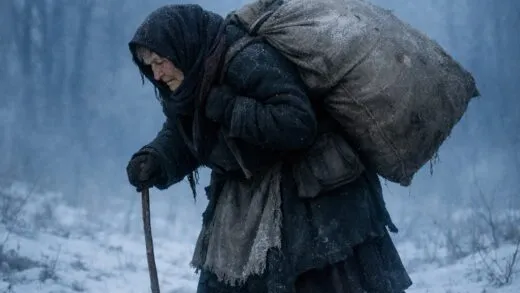
She gave a tired, humorless smile. “I walked for three weeks. Ate bark. Ate snow. When the prison boots fell apart, I wrapped my feet in rags, but those wore through too. I knew I was going to die out there. But freezing to death as a free person, knowing Saveliev wouldn’t get to write that letter about my daughter, felt easier than rotting in that place. Then I ran out of strength. I fell. You know the rest.”
The cabin went quiet again. The wood in the stove had burned down to red coals. Wind threw another handful of snow against the window. Anna folded the shirt she had been mending and set it beside her. Her hands trembled. Telling it had drained what little strength she had left. She felt hollowed out.
She lowered her head and looked at her damaged feet in wool socks. “Now you know,” she said in a flat, lifeless voice. “I was convicted on a serious charge. I’m a fugitive. I’ve put your life at risk. If they find out you hid me, you’ll do real time. Tomorrow morning I’ll pack up. I’m strong enough now. I’ll head farther north. I won’t drag you down with me.”
She expected him to nod. To agree. It would have been logical. Fair, even. No sane person would risk prison for a strange woman with a prison number on her back.
But Mike didn’t answer. He rose slowly from the stool and stood to his full height, blocking the stove light. He walked to the bunk. Anna pressed back against the wall, bracing herself for him to point to the door.
Instead, Mike reached out and set his big rough hand on her shoulder. His palm was heavy, warm, and steady.
“You’re a mother,” he said in that low, calm voice, without a trace of doubt or fear. “A mother who stepped in front of danger for her child. You spent your life saving people on an operating table.”
He gave her shoulder a small squeeze, making her look up at him. “As for courts and paperwork?” Mike jerked his head toward the window where the storm still blew. “Out here, that stuff doesn’t run the show. Different rules in these woods. You’re not going anywhere, Anna. Not tomorrow. Not next year.”
He took his hand away, went back to the stool, picked up the harness and awl, and said, “This is your home now. Get some sleep. We’ve got wood to split tomorrow, and the weather’s turning.”
Anna sat on the edge of the bunk and stared at his broad back. The hard knot that had lived in her throat for two months finally gave way. She covered her face with both hands and let out a long, silent breath. For the first time in years, she did not have to run. She did not have to defend herself. She had a home again.
May 1975 came fast. A week earlier the snow had still lain in a gray crust. Now it had shrunk, darkened, and run off in loud, quick streams. The air smelled of wet earth, old pine needles, and swelling buds.
Anna changed. The beaten, starved woman with the hunted look gradually became the true keeper of the cabin. Her hands grew rough from ash, cold water, and firewood. But her back straightened. Her movements took on the smooth efficiency of someone doing necessary work every day.
She baked bread in a cast-iron pan, washed clothes in the creek, and learned to dress game Mike brought in. Between them grew a deep, quiet understanding. They didn’t need to discuss who did what. Mike brought water; Anna took the buckets. Anna set hot stew on the table; Mike nodded and picked up his spoon. There was more care in that simple routine than in a thousand speeches.
But with the warm weather came a new tension in Mike. One evening, as the sun touched the tops of the old trees, he pushed back his empty mug, stood up, and went to the corner where a heavy storage chest sat.
He shoved the chest aside, slipped the tip of his knife under a floorboard, and lifted it. Beneath the boards was a deep root cellar dug into dry ground. Cold damp air rose out of it.
“Get down,” Mike said.
Anna looked at him, puzzled, but didn’t argue. She stepped over, braced her hands on the rough boards, and climbed down.
The cellar was narrow, too low to stand up straight. Mike began lowering heavy canvas sacks after her. “Take these. Stack them against the far wall.”
She did as he said. When they were done, the sacks of flour and grain formed a solid wall with a narrow hidden space behind them. From above, the cellar looked full.
Mike crouched by the open hatch. “District people will be making the spring rounds soon. Routine inspection.” His voice was even, but she heard the hard edge in it. “Could be any day now. Roads are drying out. If you hear an engine, you come straight here. Get behind the sacks and stay still. I’ll close the hatch, slide the board back, and put the chest over it. No matter what you hear upstairs, you stay quiet. Understand?”
Anna nodded slowly. The cold air from the cellar chilled her back. The reminder that she was still a hunted fugitive shattered the comfort of the evening in an instant.
They waited a week. The woods came alive with birdsong and the rustle of small animals. Then one early morning, while Anna wiped down the table after breakfast, a sound drifted through the open window. It did not belong in those woods. The low, straining growl of a heavy engine.
The sound grew louder, bouncing off the trees. Mike, who had been sharpening an ax by the door, straightened at once. “Engine. Big one.” He stepped into the cabin, tossing the ax aside. “Under the floor. Now.”
Anna dropped the rag. Her hands turned cold and clumsy. She ran to the corner. Mike already had the boards up. She climbed down into the pit, squeezed behind the sacks of flour, and crouched there with her arms around her knees.
Above her, the boards dropped back into place with a dull thud. Dry dirt sifted through the cracks. Then came the scrape of the heavy chest being shoved back over the hatch. At once there was total darkness, broken only by a few thin slivers of light…