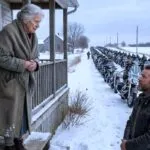

“I don’t know how my girl is doing,” Anna said quietly, speaking to her husband. The wind stirred her fully white hair. “But I know she grew into a good woman. I believe that.”
At that same time, thousands of miles away from the northern woods, ceremonial music filled the auditorium of a medical school. The hall was packed. The air smelled of floor wax and perfume. On the stage, draped in red, stood the graduating class. Among them was Eleanor. She was twenty-four. Tall, straight-backed, with serious dark eyes, she looked strikingly like her mother. Over her dress she wore a spotless white medical coat.
The dean called names. Students stepped forward, took diplomas, shook hands. Applause rolled through the hall. Camera flashes popped. Parents smiled proudly at their children. Mothers dabbed at tears. Fathers nodded approval.
“Eleanor Sokolova!” the dean called. “Graduating with honors!”
Eleanor stepped forward. She took the red diploma folder from his hand. Thanked him. Then she turned toward the audience. She looked over the rows of seats, over the smiling faces of other people’s families. In the fourth row, near the aisle, there was one empty seat. In her mind, she had always left that seat open for this day. The letters from Mr. Peterson had stopped many years earlier. At first she had hoped, written inquiries, waited. Then understanding came. Remote wilderness does not forgive much. If no word came, then her mother was gone.
She gripped the diploma so tightly her knuckles turned white. For a moment it was hard to breathe, but Eleanor straightened her back even more. One tear slid slowly down her cheek. She did not wipe it away. She kept looking at the empty seat in the fourth row.
I didn’t let you down, Mom, she thought. And in her eyes was the same steel that had once helped Anna survive in a snow cave. I did it. I became a doctor. I’ll save people the way you did.
Life moved on. Two years later Eleanor married a fellow medical student—a steady, dependable man who knew the truth about her past and never asked needless questions. A year after that they had a son. A strong, fair-haired boy with a serious expression. Eleanor named him Michael. After the man whose face she had never seen, but who had once given her hope by helping a scrap of paper reach her in an envelope.
And far to the north, in a hidden valley among the rocks, an old woman with a weathered face sat by a warm stove. Anna was sixty now. Her hands were lined with deep wrinkles, her back slightly bent from years of labor, but her eyes remained clear. She watched the fire and turned the smooth wooden ring on the cord around her neck.
She knew nothing of the honors diploma, nothing of her daughter’s marriage, nothing of little Michael running through a city apartment. She simply kept living in defiance of everything. She had kept her inner freedom, her memory, and her love clean and intact—beyond the reach of any institution on earth.
July 1998 came hot in the foothills. The air hung thick with the smell of warm pine resin, blooming fireweed, and wet moss. Anna was sixty. Her once-dark hair had gone completely white, like first snow, and she wore it in a short tight braid. Her face was lined deeply by wind and cold, but her back was still surprisingly straight. She moved more slowly now, but every motion remained efficient and sure.
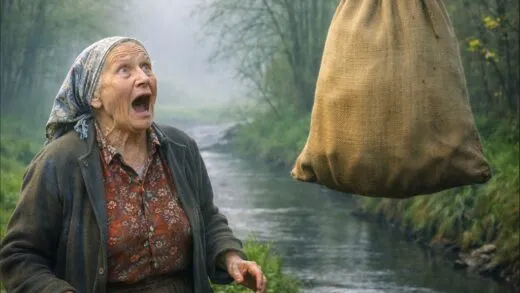
Early one morning she went down to the creek. The water, fed by underground springs, was icy even in midsummer. Anna knelt on a flat stone covered in green lichen and began washing clothes. She rubbed a coarse work shirt against the rock, paying no mind to the cold biting into her joints. The woods lived their usual measured life. A woodpecker tapped. Birds fussed in the branches.
Then that familiar rhythm broke. From the steep slope thick with raspberry canes came a sound. Not the light rustle of a small animal. Not the heavy, deliberate tread of a moose. Someone was forcing a way through the brush clumsily, breathing hard, snapping dry branches. The crack of stems sounded unnaturally loud.
Anna dropped the wet shirt into the water at once. Her hands, red from the cold, moved by habit to her shoulder. She took up Mike’s old double-barreled shotgun, which she never left behind, not even for a trip to the creek. She rose without a sound. With her thumb she cocked the right hammer without a click. The stock settled into her shoulder. The barrels pointed straight at the center of the raspberry thicket.
The bushes shook. Branches parted. Out onto the stony bank stepped a young woman. Anna did not lower the gun, but her finger stilled on the trigger. The stranger was young and striking, dressed in practical modern hiking clothes—sturdy jacket, solid boots—with a large backpack on her shoulders. She was breathing hard, trying to catch her breath. Dark hair had come loose from under her hood, and a fresh scratch marked one cheek.
She took one more step toward the creek and looked up—and stopped. She saw before her a white-haired old woman, weathered and strong, holding a shotgun. For several long seconds they stared at each other in complete silence, broken only by the water running over stone. Then the younger woman’s eyes moved over Anna’s face, over the deep lines in it, and then lower.
The collar of Anna’s faded flannel shirt was open. Around her neck, on a worn dark cord, hung a smooth wooden ring. The same ring the younger woman had once read about in tiny notes hidden inside official letters from the children’s home more than twenty years earlier…