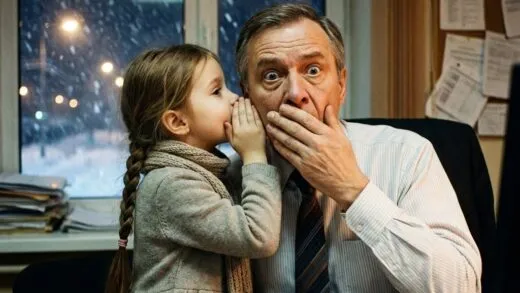

— he asked in the tone people use when they already know the answer and don’t like it.
— I do, — Eleanor said.
Mike, apparently, was waiting for more. Eleanor added nothing. He began explaining, thoroughly, item by item: wild animals are unpredictable, wolves carry disease, in six months they’ll be grown, then what? Eleanor listened and thought that his voice was the same one he used when he said, “Sell the house, move closer, you can’t manage out there alone.” The arguments changed. The tone did not.
— Mike, I’m managing, — Eleanor said when he paused.
— You’re not sleeping, — Mike said. — Daniel says you called him yourself.
— And? — Eleanor asked. It came out sharper than she intended, short as a door shutting.
Mike went quiet. Eleanor could hear him breathing on the line and knew that “And?” had landed like an accusation, though she had not meant it as one. Or maybe she had. At that moment she couldn’t sort it out.
— Mom, — Mike said after a pause, — I’m not against the wolves. I’m against you being out there alone and me not knowing how you are.
— You didn’t call Wednesday, — Eleanor said.
The silence that followed was dense and separate.
— Work blew up, — Mike said finally.
— I’m not blaming you, — Eleanor said. — I’m just saying it.
But she was blaming him, and they both knew it. She knew it too, even as she said the words, hearing herself from a short distance away and not stopping. The conversation hung there like a door swollen in its frame: won’t close, won’t stay open comfortably either. Both of them breathed into the phone and waited to see who would move first. Mike did.
— What are their names? — he asked. Eleanor didn’t immediately understand what he meant. Then she did.
— Gray and Quiet, — she said.
— Which one’s Quiet? — Mike asked. Unexpectedly, as if that detail mattered.
— The smaller one, — Eleanor said. — Cautious. At first he wouldn’t take milk at all, only from my finger.
— I didn’t eat much as a kid either, — Mike said.
Eleanor didn’t answer right away. Gray was rustling in the crate, and she glanced over automatically to make sure he hadn’t gotten out.
— I remember, — she said at last.
That small exchange settled between them and did not disappear the way words usually disappear in phone calls. It simply stayed there.
— Susan says to ask if you need anything, — Mike said suddenly, not covering the phone well enough. Eleanor could hear a woman’s voice in the background, not the words, just the questioning concern in the tone.
Mike came back on the line.
— Susan wants to know if you need help.
— No, — Eleanor said. It came out on its own, without thought, the old answer to the old question, polished by years of use. The silence after that word lasted a little longer than usual.
— Unless maybe milk, — she said. — Frank’s cow is sick again. No milk, and they still need it.
— We’ll find some, — Mike said. Not “we’ll see” or “we’ll try.” Just “we’ll find some,” the way a man signs his name to something.
Eleanor pulled the phone away from her ear and brought it back, as if to make sure she had heard correctly.
After the call she stood at the window for a long time. Outside, the hollow was all May green now, the birches fully leafed out, the chokecherry finished blooming, the grass by the fence knee-high. She thought about Mike—not the conversation that had just ended, and not about him as a son exactly. She thought about herself as a mother.
“Not a bad mother” was too easy a phrase, too tidy. It put a period where there wasn’t one. But “not a good one” didn’t fit either, because that wasn’t quite what she felt. Just: what kind?