Artyom took it, flipped through it, then looked up. “Will you read it to me?” Victor had never read aloud to children in his life.
He sat down on the bench, opened to the first page, and began. His voice wasn’t loud, and there was no performance in it, just words. Artyom listened, leaning against his shoulder, not on purpose, it just happened.
Victor read and tried not to think about how the court might end. In September the notice came. First hearing set for October 23.
He told Barsukov. The lawyer nodded. “We’ll be ready.”
That evening Victor took out the folder and checked every page against the list he had written for himself on a sheet of notebook paper. Everything was there. Nina Stepanovna, having heard about the court case from Petrovich, sent over a jar of jam and a note on a scrap of paper.
“Hang in there, Vitya. You’re a decent man.” Victor read it, folded it into quarters, and put it in the desk drawer beside the folder. On October 23 he put on his only suit jacket, tied the necktie he had last bought for his wedding in 1984, and left the house at eight-thirty.
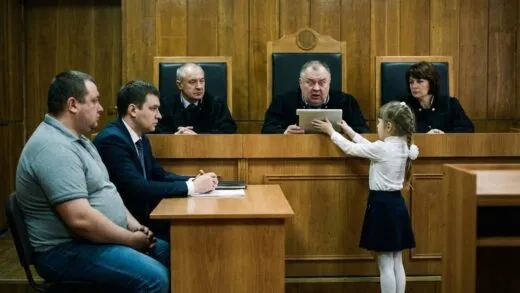
The first hearing lasted less than an hour. Barsukov spoke calmly and precisely, read the statute aloud, pointed out the contradiction in child services’ denial, and asked the court to order the county office to consider Savelly’s application on the merits. Cherepnova sat across from them in a dark coat, a folder on her lap.
When it was her turn, she opened the folder and read her response in an even voice, without emotion, the way people read instructions. It was long. Cherepnova did not argue the legal point directly. That would have been a losing move.
Instead she listed everything Victor did not have. No home of his own, no income cushion, no experience raising children, no relatives able to provide support. And most important, the child was seriously ill, his condition required specialized medical supervision, and a single man without the proper circumstances could not provide it.
Each point was framed without personal attack. Cherepnova did not say Victor was a bad man. She said he was an unsuitable adoptive parent. That was smarter.
The judge, an older woman with a tired face, listened to both sides, made notes, and announced that the hearing would be continued for a month pending additional documents from both parties. Victor walked out of the courtroom, took off his tie in the hallway, and folded it into his pocket.
Barsukov walked beside him. “This isn’t a denial,” he said quietly. “It’s procedure.”
“We need to shore up housing and income. Six months of income records, and extend the lease to two years.” Victor nodded.
All of that was manageable. He spent November the same way he had spent the months before. Worked, gathered papers, visited the children’s home.
The landlord agreed to extend the lease without objection. Payroll issued the income statement. Barsukov prepared a detailed response to Cherepnova’s filing.
Methodical, point by point. Artyom, meanwhile, was getting worse. Victor noticed not because anyone told him, but because of small things.
The boy tired more quickly. Sometimes in the middle of a conversation he would go quiet and close his eyes for a few seconds.
As if listening to something inside himself. Sometimes his lips turned faintly blue, barely enough to notice unless you knew what to look for. Victor knew. During one of his last visits in November, Artyom asked him not to leave right away.
“Stay a little longer,” he said, without explaining why. Victor stayed another hour. They sat in silence.
Artyom looked out at the bare branches of the poplar tree. Victor looked at Artyom. When it was time to go, the boy didn’t turn around. He just said quietly toward the window, “Come tomorrow.”
Victor came. The second hearing was held on November 22. Barsukov submitted the updated packet of documents.
Cherepnova submitted a new response. And this time she made a move Barsukov had not expected.
In the new filing she didn’t argue the adoption statute. Instead she cited an internal regional regulation setting housing requirements for adoptive parents receiving a child with a chronic illness. Under that regulation, a child with a cardiac diagnosis could be placed only with a family where the adoptive parent had permanent registration and documented ability to reach a medical facility within thirty minutes.
The apartment met the square footage requirement. But Victor had no permanent registration. After prison he was still listed at his old address, which no longer even existed as an administrative unit.
This wasn’t the main law. It was a regional regulation, issued quietly, without much notice. Cherepnova knew about it.
Barsukov didn’t. The judge continued the hearing until January. Barsukov left the courtroom with his lips pressed tight.
In the hallway he said the regulation was questionable, but challenging it would take time, and they urgently needed to solve the registration issue. Victor didn’t answer. He stood looking out the hallway window at the snow-covered yard.
That same evening Marina Sergeyevna called. Her voice was steady, but there was something in it. That particular tone people use when they’re trying not to alarm you but can’t stay silent either.
“Victor Nikolaevich, Artyom was taken by ambulance today. Heart flare-up. They brought him to the children’s hospital, cardiology.”
Victor thanked her and hung up. Put on his coat and went outside. It was about fifteen degrees below freezing…