
A relentless downpour hammered the concrete of the airport drop-off zone, turning the pavement into a shimmering mirror of distorted lights. The red streaks of taxi taillights smeared into the wet darkness, competing with the rhythmic sweeping of wipers. Overhead, a loudspeaker’s mechanical voice announced yet another flight delay, the sound echoing hollowly against the metal overhangs.
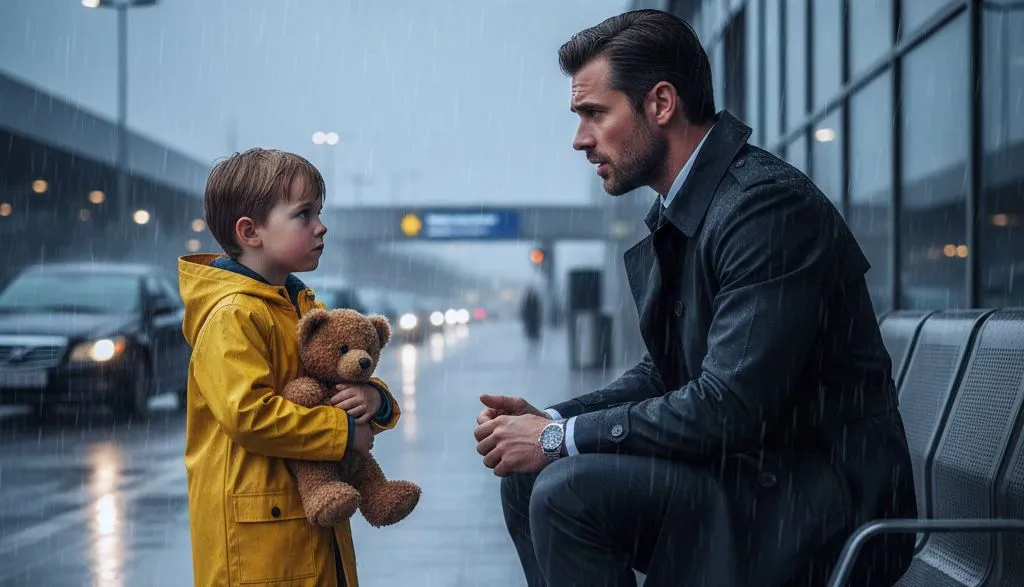
Most of the benches lining the pickup area were empty, slick with moisture. A handful of travelers huddled beneath the awnings, their faces illuminated by the pale glow of their smartphones as they paced impatiently. Gabriel sat alone on the farthest bench, the collar of his expensive trench coat turned up against the biting chill. At his feet rested a leather briefcase, and tucked securely under his arm was a small, understated gift bag.
The rain left dark, damp spots on his tailored suit, yet he remained perfectly still. Water droplets slid silently across the crystal face of his Rolex, marking time that seemed to have lost its meaning. He had just arrived from a global finance conference, an event defined by keynote speeches, flashing cameras, and polite champagne toasts.
By all professional metrics, it had been a triumph. It was just another victory in a career built on them. And yet, staring out into the gray curtain of rain, Gabriel felt a profound hollowness. There was no one waiting for him at the arrivals gate. No missed calls on his phone, no eager welcome home.
His driver was running late, but that wasn’t the source of the heaviness pressing down on him. It was the rain. It always did this to him. It dredged up memories of something he had tried to bury years ago.
He remembered a night from his childhood, the sound of his younger brother, Lucas, crying in the dark while a storm raged outside—the night their parents left and simply never returned. Gabriel released a slow, shaky breath and lifted his gaze, trying to dislodge the tightness in his chest. through the glass wall of the terminal, he spotted a small boy sitting near the window, his forehead pressed against the cold pane.
The child looked to be about six years old. He was named Finn. He wore a yellow raincoat with a noticeable tear near the zipper and clutched a fraying stuffed bear that had clearly seen better days. His gaze was still and watchful, lacking the restless energy typical of boys his age.
Finn’s mother was working the night shift, cleaning the terminal floors. She had instructed him to wait quietly until she finished her last hallway, and he always obeyed. He knew how tired she was.
Sometimes, late at night, she would cough when she thought he was asleep, trying to muffle the sound. Tonight, the rain was far too heavy to walk to the bus stop. A few days prior, a classmate had cruel words for him: “You don’t have a dad. That’s why no one picks you up.”
Finn hadn’t replied to the bully. But the words had taken root, staying with him like a bruise. Now, he watched the rain intensify, his eyes fixing on the solitary man outside—well-dressed, composed, and alone. He looked like the kind of man who would own a large, warm car. The kind of man who might take someone home.
Finn stood up, adjusting his hood over his head. He squeezed Mr. Buttons tight against his chest and pushed through the automatic doors. The rain hit him instantly, soaking through his thin canvas shoes, but he didn’t falter.
He walked in a straight line toward the bench. Gabriel looked down, startled from his reverie. A boy stood before him, drenched to the bone but looking up with wide, calm eyes and a steady voice.
— My daddy is in heaven. Can you help us get home?
Gabriel froze. The words landed with the impact of a thunderclap. He blinked, momentarily stunned. No one had asked him for help—real help—in a very long time. And certainly, no one had looked at him with such implicit trust.
Before he could formulate an answer, a woman’s frantic voice cut through the noise of the storm.
— Finn!
A blonde woman sprinted toward them, her thin coat clinging to her skin, her hair plastered damply around her face. She dropped to her knees beside the boy, pulling him into a protective embrace. One of her hands still clutched a cleaning rag. Her fingers were trembling.
— I’m so sorry, — she said breathlessly, casting a worried glance at Gabriel. — He didn’t mean to bother you. He’s just trying to be polite.
Gabriel studied her for a moment. Her eyes were a pale, striking blue—exhausted, yes, but clear. There was no fear in her posture, only a mix of apology and quiet dignity. She offered no excuses, no begging.
She simply wiped the rain from Finn’s face and prepared to guide him away. Gabriel stood up abruptly.
— It’s okay, — he said, his voice softer than he expected. — I… have room in the car. Let me give you a ride.
The woman, Haley, froze in place. Finn looked up at her, then turned his gaze back to Gabriel.
— I told you he’s one of the good ones, — the boy whispered with a small, triumphant grin.
Haley didn’t reply immediately. Her expression shifted, calculating the risk against the cold reality of the storm. Finally, she nodded once. They began to walk toward the curb. Finn skipped slightly, Mr. Buttons bouncing in his grip.
He wasn’t smiling because of the car ride. He was smiling because, in his own small way, he had solved a problem for his mom. Gabriel followed a few steps behind them, a strange sensation tightening in his chest.
Had he just… cared about a stranger? He wasn’t entirely sure. But for the first time in what felt like a lifetime, he didn’t mind the rain.
Rain streaked down the tinted windows as Gabriel guided the sleek black sedan away from the airport curb. The windshield wipers moved in a hypnotic, rhythmic sweep, slicing through the storm. In the back seat, Finn sat snugly wedged between his damp backpack and a seatbelt that was slightly too big for him. He hummed a quiet tune to himself, hugging Mr. Buttons, seemingly unfazed by the wealthy stranger at the wheel.
Haley sat in the passenger seat beside Gabriel, still trying to catch her breath. Her blonde hair was beginning to dry in soft waves, clinging to the shoulders of her worn coat. She kept glancing back at Finn, then out the window, her hands clasped tightly in her lap until her knuckles turned white.
— You really didn’t have to do this, — she said quietly. — We would have managed.
Gabriel kept his eyes on the road and didn’t look over. He simply nodded once.
— I know.
The interior of the car was a sanctuary—warm and dry, filled with the faint, expensive scent of leather and something clean, like cedar or bergamot. It felt like an entirely different universe compared to the echoing, sterile halls of the airport or the dingy break room Haley had just vacated.
In the comfortable silence that followed, Finn’s voice piped up unexpectedly from the back seat.
— Mr. Gabriel, do you have kids?
Gabriel’s hands tightened briefly on the leather steering wheel.
— No, — he answered, his tone even but distant.
Finn accepted the answer without pressing for details. He leaned forward slightly against the seatbelt, his eyes full of innocent curiosity.
— Then why do you look sad sometimes? My teacher says people who are sad don’t always cry.
Haley turned around in her seat immediately.
— Finn, — she murmured, a gentle warning in her voice.
But Gabriel let out a breath that sounded almost like a laugh.
— Your teacher is right, — he said.
The rest of the ride passed in a quieter contemplation. Finn eventually curled up with Mr. Buttons, watching the raindrops race each other down the glass like it was a game. Haley kept her eyes fixed on the passing buildings, her fingers unconsciously brushing a tear in the fabric of her coat that she had been meaning to sew for weeks.
When they pulled up in front of a narrow, three-story building with faded brickwork and crooked gutters, Haley exhaled audibly, a sound of pure relief. A single porch light buzzed dimly above the entrance.
— This is us, — she said softly.
Gabriel looked at the building. It wasn’t run down, exactly, but it bore the distinct wear of a place held together by care rather than money.
— Thank you, — Haley added, her hand already on the buckle of her seatbelt. — For the ride. I mean it.
Gabriel reached toward the glovebox, hesitated for a fraction of a second, and then opened the center console instead. He pulled out a neatly wrapped umbrella. It was brand new, unused, with the store tag still dangling from the handle. He held it out to her.
— Your umbrella is broken, — he said simply. — Take this.
Haley blinked, stunned. For a second, she didn’t move. Her gaze flicked from his hand to the umbrella, then back to his face, searching for a catch.
— I… I can’t…
— You can, — he interrupted gently.
It was just an umbrella, a trivial object to a man like him, but it was more than that. It was the way he said it—like a man who didn’t often offer things that mattered, but meant it entirely when he did.