“I don’t mind.”
He sat down at the table. She set a plate in front of him: oatmeal, eggs, bread, tea. She moved easily, without fuss, like somebody who knew how to run a kitchen and didn’t need to think about it. He ate.
He hadn’t eaten like this in a long time—sitting at a table, hot food, properly. Usually he ate standing over the sink or straight from the pot. Now he sat and ate, and it felt strange. Not bad. Just strange, like something forgotten had quietly come back.
“My name’s Sarah,” she said, sitting down across from him, “and this is Sophie.”
“Mike,” he answered.
The little girl looked at him over the rim of her mug, very serious.
“Sophie,” he said to her. Not as a question. Just saying it.
She nodded. They sat in silence.
Mike finished the eggs and pushed the plate away.
“Where are you from?” he asked. Not from deep curiosity, exactly. It just seemed like something that had to be asked.
Sarah answered briefly, without self-pity, almost matter-of-factly, like she was laying out facts:
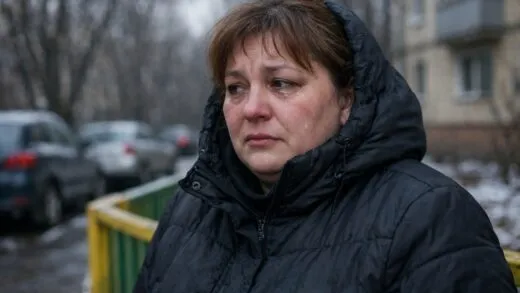
“My husband threw us out. On the highway. At night. In the storm. My phone and ID are still at the house. My mother died two years ago. There’s nowhere to go.”
Mike listened without looking at her. He stared into his mug. Then he asked:
“He throws kids out too?”
“He does,” she said simply.
He looked up. She didn’t look away. No drama in her face. No fishing for sympathy. Just the truth.
“Stay here for now,” Mike said. “Plenty of room.”
She nodded.
“Thank you.”
They didn’t say any more about it. After breakfast Sophie dozed off again. She hadn’t really slept, had gotten chilled through the night before, and her body was taking what it needed. Sarah tucked her in and went outside just to look around.
She had grown up in a small town farther north, where her mother kept a garden and a dozen chickens. So Sarah knew how these things worked—feeding, cleaning, getting the ground ready in spring. That knowledge hadn’t gone anywhere. It had just been sitting inside her, unused, like tools in a drawer. She walked the yard carefully.
The barns were big and solid, built of timber, not rotting. The chicken coop was empty but clean, which meant birds had been there not too long ago. The livestock shed was empty too, but the fence around it was sound, just needed the gate fixed.
Under the shed roof was the tractor. Old, but from the way it sat, not abandoned for good, just parked and left alone. Next to it was the tiller. The tools in the shed were rusty, but the full set was there.
She stood by the field beyond the gate. It wasn’t built over, still open, maybe seven or eight acres. Overgrown, probably, but the ground under the snow was still alive. She could feel that in the practical country way people do, not mystical, just knowing land when you’ve worked it. It was all still there. Neglected, but alive.
That evening, while Sophie played with some wooden blocks she’d found in a drawer and Mike sat at the table automatically reaching toward the bottle, Sarah pulled out an old half-used spiral notebook from the same drawer and a pencil.
“Mind if I use this?” she asked.
Mike shrugged.