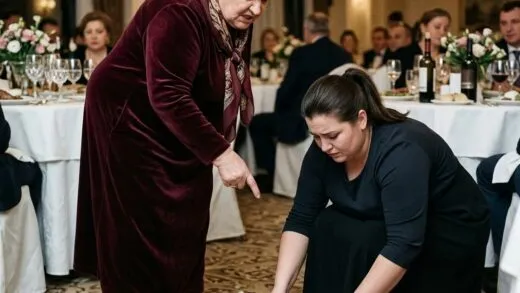

“You can get a tax deduction if you buy a house or have major medical expenses,” she answered slowly. “You don’t get one just for having a bank account.”
“Oh, really?” Eleanor tilted her head, feigning surprise. “Well, she told me you could. Maybe you could just show me your statement, and I’ll take it to my friend? She works for the IRS, she’ll figure it out.”
There it was. Susan felt something tighten in her gut. Her mother-in-law wanted to see her bank statement. She wanted to know how much money was in the account, where it was going, how much was left. This wasn’t a request anymore; it was an audit.
“Eleanor,” Susan said, setting her cup down. “I don’t think that’s necessary. Deductions are handled through your employer or a tax professional, not through friends. If you want, I can look into it myself and tell you the proper way to do it.”
Her mother-in-law’s face froze for a second. The smile remained, but her eyes turned hard.
“Well, suit yourself. I was just trying to help. I thought you could use the extra money.”
“Thank you, but I’ll handle it.”
A tense silence fell over the room. Mike shifted in his chair, clearly uncomfortable. Eleanor finished her tea and stood up.
“Well, I should be going. Finish the pie, I made it for you.”
She picked up her purse and headed for the door. At the threshold, she turned and gave Susan a long, appraising look.
“Mike, honey, walk your mother out.”
Mike jumped up and followed her. Susan stayed in the kitchen, listening to their muffled voices in the hallway. She couldn’t make out the words, but the tone was clearly one of displeasure. A minute later, the door closed. Mike came back and sat down across from her.
“Why’d you have to be like that with her?” he asked quietly.
“I wasn’t ‘like that.’ I just declined to show her my private bank statement.”
“She was just trying to help.”
“Mike,” Susan looked him in the eye, “why does your mother need to see my bank statement? What kind of deduction is she talking about? It’s nonsense.”
“I don’t know, maybe she really heard something.” He looked away. “You could have been a little nicer about it, not so blunt.”
“And you could have, for once, asked me why I don’t want to show my financial information to a third party.”
“She’s not a third party, she’s my mother!”
Susan stood up and gathered the plates. There was no point in arguing. Mike went to the living room, closing the door behind him. She stayed in the kitchen, methodically washing the dishes and thinking. Thinking about being pregnant. About the baby that would be in this home in a few months. About how Eleanor was already trying to control their money, and how it would only get worse. About how Mike didn’t see the problem. He didn’t understand that his mother was manipulating them. Or maybe he did, and just didn’t want to admit it.
That evening, Susan sat in the bedroom, browsing online stores for baby gear. Strollers, cribs, clothes. The prices were steep. A good stroller was at least $400. A crib, another $300. Clothes, diapers, bottles, pacifiers—another $500. Plus, the birth itself: if she chose a private hospital room, that could be another thousand. That was a minimum of $2,200, but it would be better to have $3,000, just in case.
After her paycheck, Susan had about $1,000 left in her account. The money that hadn’t gone to the mortgage and groceries. If she put aside $300 a month, she’d have about $1,800 by September, when the baby was due. Not enough. She needed more. She opened the calculator on her phone and started crunching numbers. If she withdrew that thousand dollars now and hid it, and then added at least two hundred every month, she’d have enough by the fall.
But to do that, Eleanor had to stop asking for money. Or at least, she couldn’t know the money was there. Susan thought for a moment. Withdraw it in cash. Hide it at home. Don’t tell anyone—not her mother-in-law, and not Mike. Not yet. Because as soon as she told Mike, he’d be overjoyed, tell his mother, and then it would start: “Honey, since you’re having a baby, you should help me with these plumbing repairs. Susan, can you just lend me a little? I’ll pay you back right away. I’ll give you everything back when my grandbaby is born.” And the money for the baby would be gone.
She picked up her phone, opened her banking app, and found the nearest ATM. Tomorrow, on her lunch break, she’d go and withdraw a thousand dollars in cash. She’d hide it at home. In a shoebox on the top shelf of the closet. No one ever looked up there. And she’d show Mike the account balance if he asked. See? Paycheck came in, part went to bills, part to groceries, the rest for household stuff. All above board.
Mike came into the bedroom and lay down next to her. Susan closed her phone and put it on the nightstand.
“Still mad?” he asked quietly.
“No.”
“I didn’t want to fight. It’s just, Mom…”
“I know. She’s your mother. It’s fine.”
He put his arm around her and pulled her close. Susan closed her eyes. She wanted to say, “I’m pregnant.” She wanted to share the joy, to hear his excitement. But she didn’t. Not yet. First, she had to secure the money. First, she had to make sure there was enough for the baby. Then she would tell him. She definitely would. But not now. She fell asleep, feeling his warmth, thinking that tomorrow, everything would change. Tomorrow, she would start protecting her child. He was still tiny, invisible, but he was already hers. Theirs. And no one was going to take his future away from him.
The next morning, Susan woke up with a heavy feeling in her stomach. Not pain, but an unfamiliar sense of fullness. She lay there, staring at the ceiling, thinking about the new life inside her. Tiny, the size of a grain of rice, but already there. Her baby. Mike had already left for work, leaving an empty coffee mug on the counter and a note: “Going to be late tonight, supervisor sent me to a site across town. Miss you.”
Susan crumpled the note and threw it away. She got ready, drinking tea with some crackers. Coffee suddenly made her feel queasy, though she used to drink it by the gallon. Her body was already changing.
The day at the office dragged on. Susan checked invoices, processed payments, and answered emails from suppliers. At lunch, she told her boss she needed to run an errand, got in her car, and drove to an ATM. She found one in a strip mall on the edge of town, where she wouldn’t run into anyone she knew. She inserted her card and typed in the amount: one thousand dollars. The machine whirred and dispensed a thick stack of twenties. Crisp and new. Susan stuffed them into her purse and zipped it shut. She glanced around—no one. She hurried back to her car and tossed her purse onto the passenger seat. Her heart was pounding as if she’d just robbed a bank.
On the way back to the office, she stopped at a baby store. Just to look, to get a feel for things. She walked down the aisles. Strollers. Huge, complicated contraptions with a million straps and adjustments. Cribs. White, beige, with canopies and without. And the clothes—tiny little onesies, sleepers, hats. Susan picked up a white onesie with embroidered bears on it. It was soft and warm. She imagined putting it on her baby. A saleswoman approached, smiling.
“Shopping for a gift?”
“No, for me.”
“Oh?”
“Yes, for me.”
“Congratulations! How far along are you?”
“Just three weeks.”
“Oh, you’ve got the whole journey ahead of you. These onesies are wonderful, one hundred percent cotton, they don’t shrink. You should get a few, they get dirty fast.”
Susan bought three onesies and a small package of newborn diapers. Just a trial size. The saleswoman bagged everything up and congratulated her again. Susan left the store, clutching the bag, and suddenly felt her eyes well up. She was really going to be a mother. Soon.
When she got home that evening, Mike wasn’t there yet. Susan took the money and the bag of baby things out of her purse. She got an old boot box from the hall closet, a sturdy one with a lid. She placed the cash inside, smoothing out the bills. On top, she put the onesies and diapers. She paused. Then she took a piece of paper and wrote in big, block letters: “I’M 3 MONTHS OLD. HI, DAD.” She placed the note on top and closed the box. She climbed onto a chair, opened the closet’s top shelf, and pushed the box to the very back, behind some old blankets and pillows. She got down and dusted off her hands. There. No one would find it. Even if Mike went up there, he wouldn’t pay any attention. Just an old shoebox.
She sat on the sofa and opened her phone. She scheduled her ultrasound for two weeks from now. She browsed forums for new moms: what to pack for the hospital, how to choose a doctor, what tests to expect. There was a sea of information; her head was spinning. Susan jotted down the important points in a notebook. First-trimester screening at 12 weeks, second at 20, third at 30. Monthly check-ups. Birthing classes, deciding on a birth plan, pre-registering at the hospital.
Mike got home around nine, tired and covered in dust from the site. He changed and went to take a shower. Susan reheated dinner—meatloaf and mashed potatoes. She set the table and sat down across from him. Mike ate silently, ravenously. She watched him and thought: Should I tell him? Should I not?
“How was your day?” she asked.
“Exhausting. The site is on the other side of the city, got stuck in traffic. The supervisor said we’ll be back at the local site tomorrow.”
“That’s good.”
A pause. Mike looked up at her.
“You seem quiet tonight.”
“Just tired, too.”
He nodded and went back to his food. Susan clasped her hands under the table. Not yet. It was too soon. She needed to wait until the box of money was a little fuller. Then she would tell him.
The next day, Saturday, Susan decided to stop by her mother-in-law’s. She’d bring some groceries and see for herself if the new refrigerator was real. In the morning, she packed a bag: milk, cottage cheese, bread, cold cuts, vegetables. She got in her car and drove over.
Eleanor lived in an old brick apartment building on the edge of town. A small one-bedroom, cramped and cluttered with furniture. Susan rang the bell. Her mother-in-law opened the door, a look of surprise on her face.
“Susan, dear, come in, come in. Is something wrong?”