“Maya asked me if you were a good man or a bad man.” Ellen’s voice was soft, reflective. “I didn’t know how to answer.” — “What did you tell her?” — “That you were the man who saved us. That sometimes, that’s all that matters.” Roman considered that. Good and bad were abstractions for people with the luxury of distance from violence. He had stopped believing in simple moral categories the day Sofia died. Now, he believed in actions and consequences, cause and effect.
“Your daughter is brave,” he finally said. “She ran toward danger to save you. That kind of courage is rare.” — “She shouldn’t have to be brave. She should be worrying about homework and friends and normal eight-year-old problems.” Ellen’s voice broke slightly. “I failed her.” — “You survived. That isn’t failure.” — “I put her in that position. My debt. My choice.” — “Kostas’s choice,” Roman corrected firmly.
“His decision to escalate. His order to make an example. You didn’t put yourself in that tree. You didn’t traumatize your daughter. He did.” Ellen absorbed those words, wanting to believe them, fighting the weight of maternal guilt that insisted she should have protected Maya from ever seeing such horror. “When do we leave?” she asked quietly. “When you’re ready. Another few days, maybe. The doctors want to be sure there’s no infection. That you can manage without daily monitoring. And then you just… vanish.
Start over as if none of this happened.” — “You don’t forget. You don’t pretend it didn’t happen, but you build something new anyway. That’s what survival looks like.” Maya’s laughter drifted in from the kitchen. Genuine, light. The sound of a child remembering how to be a child. Both adults turned toward it like plants reaching for the sun. “She likes Victor,” Ellen said with a ghost of a smile. “She follows him around asking questions.
He’s surprisingly patient with her.” — “Victor has kids, two daughters. He understands.” — “Does he understand what you do? Who you are?” Roman met her gaze. “He understands that there are shadows in the world. And sometimes the only thing that stops the monsters is someone willing to be even more formidable.” — “Is that who you are? A monster?” — “I’m whatever I need to be.” Ellen studied him. This enigmatic man who had crashed into her worst moment and somehow become the axis around which her survival turned.
She wanted to understand him, to categorize him, to make sense of someone who existed outside conventional morality. But perhaps understanding wasn’t necessary. Perhaps acceptance was enough. “Thank you,” she said simply. “Whoever you are, whatever happens next, thank you for stopping. Thank you for listening to my daughter when you could have just driven on.” Roman stood up, preparing to leave.
He had stayed longer than he intended, allowed more conversation than was prudent. Attachment complicated things; distance kept situations clean. “Maya ran to me because she didn’t have another choice,” he said. “But she was right to trust her instincts. Some people are worth saving, and some people are worth the risk of saving them.” Roman paused at the door. “Yes.” He left before Ellen could respond, before gratitude could turn into expectation, before mercy could transform into a relationship.
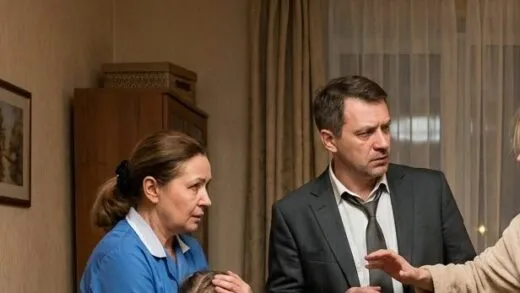
In the hallway, Maya nearly collided with him. Victor followed behind, an apologetic look on his face. “Roman!” Maya’s face lit up with uncomplicated joy. “Victor taught me a card game. I won three times.” — “He probably let you win.” — “No!” Maya protested, then looked uncertainly at Victor, who maintained perfect neutrality. Roman almost smiled. Almost.
Instead, he rested a hand briefly on Maya’s shoulder. The closest thing to a display of affection he could allow himself. “Take care of your mother,” he said. “I will.” — “Are you leaving now? Will you come back?” Roman looked down at this brave, traumatized child who had run through fog and terror to save her mother. Who had placed her faith in the mercy of a stranger and been proven right. “I’ll be around,” he promised.