

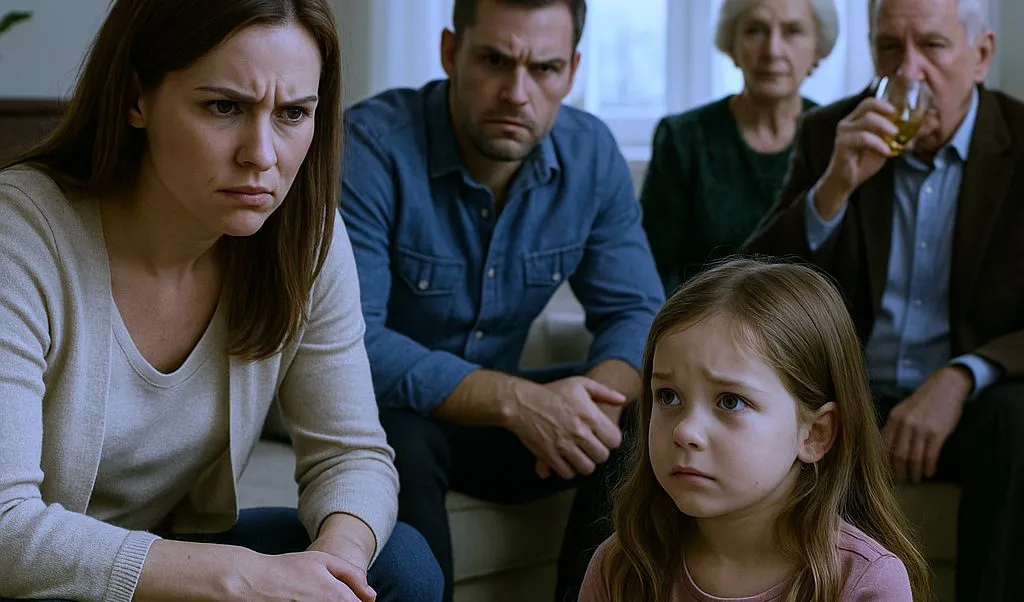
My seven-year-old daughter was perched on the thick, plush carpet of my parents’ living room on Christmas morning. The air buzzed with a manufactured holiday cheer that felt brittle and thin. Around her, a flurry of cousins were doing a triumphant jig, their hands waving crisp, white $5,000 checks in the air like celebratory flags. Willa, however, was in no rush. She unwrapped her own envelope with the same methodical, careful deliberation she applied to all her small tasks. Inside, she found a single, solitary dollar bill—and a note, scribbled in my mother’s familiar cursive: “Maybe next year you’ll deserve more.”
Willa lifted her gaze to mine, her huge, cocoa-brown eyes suddenly brimming, her little chin starting to wobble uncontrollably. The question that left her lips was a whisper, yet it tore through something vital in my chest: “Mommy, what did I do wrong?” The sound went out of the room. I felt myself seize up, my breath catching painfully in my throat. My vision swam and a tremor started in my hands, but it wasn’t the quiver of sorrow. It was the white-hot, years-suppressed vibration of pure, unadulterated rage.
I knew, with the chilling clarity of a breaking point, exactly what my next move would be. I pulled out my phone and placed one, final call. By the time New Year’s Eve rolled around, my parents were standing on my stoop, shivering in the biting cold, reduced to pleading for forgiveness. My name is Corrine, and this is the story of how I finally drew a line in the sand to protect my daughter from a family that insisted on treating her like she was nothing more than a ghost.
To grasp the magnitude of that morning’s devastation, you need a full picture of the people involved. My daughter, Willa, is a seven-year-old whirlwind of sunshine. Her naturally curly hair is a constant battle, refusing to stay contained in any ponytail, and her smile has the genuine power to illuminate any space she enters. She is obsessed with sketching pictures of our cat, sleeps soundly only when clutching her stuffed elephant, Buttons, and believes a perfect day involves making Saturday morning pancakes together. She is fundamentally kind, deeply gentle, and has never, in her short life, deserved the calculated cruelty my parents inflicted upon her.
Willa’s biological father, my first husband, passed away in a tragic car accident when she was just two. While she holds no memories of him, she knows he loved her fiercely. She also knows that my current husband, Denton, intentionally chose to adopt her and be her daddy because his love for her is just as absolute. Denton is a firefighter; he and I have been married for three years, and he treats Willa as if she were his own flesh and blood—because, in his heart, she is.
He never lets her feel like a stepchild, never makes her feel “less than.” He’s been a silent witness to my parents’ favoritism for years, and I’ve watched the simmering anger behind his eyes every time we leave their house. Yet, he always kept a respectful distance because I convinced him—wrongly, as it turned out—that my parents would eventually come around.
My mother, Harriet, is 63, a retired school administrator whose life has always centered on appearances above all else: the right social connections, the prestigious neighborhood, and, most importantly, the right grandchildren. She has been chilly toward Willa since the day she was born, but I always manufactured excuses for her. I told myself she just needed time to soften, that she was still mourning my first husband, and that she would surely recognize the wonderful child Willa is.
My father, Leonard, 66 and retired from insurance sales, comfortably finances his golden years with six rental properties. He rarely displays my mother’s open cruelty, but his role as the enabler is just as damaging. He quietly looks the other way, staying silent when he should have intervened, and his silence has always felt like a deeper cut than her sharpest words.
Then there is my older sister, Margo, 38, whose three children are, in my mother’s eyes, the epitome of perfection. Margo is fully aware of the obvious favoritism; she sees the disparity, but she has never breathed a word against it because she is the primary beneficiary. Her children are showered with the most expensive gifts, the most rapt attention, and the warmest smiles. Why would she ever jeopardize that privileged position? Finally, my younger brother, Nolan, 31, has two children of his own. He lives nearest to my parents and unquestioningly accepts their steady stream of financial aid. He deliberately steers clear of any family conflict, knowing that maintaining his silence is the surest way to keep the cash flowing his way.
These are the very individuals who sat in that brightly decorated living room on Christmas morning, silently watching my precious daughter open a devastating insult—a dollar bill and a note implying her unworthiness. They remained mute, complicit in allowing a seven-year-old to believe she was fundamentally flawed.
But there was one colossal detail none of them knew or factored into their arrogance. For eight years, I had been the operational backbone of my parents’ rental empire. I managed every tenant interaction, coordinated all necessary repairs, filed the taxes, handled the insurance, and reconciled the finances. I did this monumental, demanding work without ever accepting a penny in return, believing this was the silent transaction of a “good daughter.” I thought if I simply helped enough, gave enough, and sacrificed enough, they would eventually extend acceptance to my daughter.
They never did. And on that fateful Christmas morning, I finally ceased my futile waiting for them to change. The events of the next six days would successfully bring my parents to their knees, all set in motion by a single, determined phone call.
To fully grasp the force of my reaction that Christmas, you must understand the life I maintained outside of their gravitational pull. I work as a bookkeeper at a local accounting firm—stable, reliable work with hours that ensure I am always home when Willa steps off the school bus. Denton’s schedule involves intense 24-hour shifts at the firehouse, which means our staggered schedules ensure one of us is almost always available for her. We are far from rich, but we are comfortable. We own a lovely house in a quiet neighborhood, complete with a backyard ample enough for Willa and our cat to play. Life, for us, is genuinely good.
Yet, for the last eight years, I’ve been maintaining a shadow existence that only my immediate family knew about. When my father retired, he owned six rental properties—a mix of small duplexes and single-family homes scattered throughout the county. These investments were supposed to be the bedrock of his comfortable retirement, and they do, in fact, generate nearly $12,000 a month in steady rental income. The catch? My father has never managed a single one of them. That responsibility has been mine, entirely, since I was 26 years old. When a tenant’s fridge fails at 1 a.m., they call me.
When the roof develops a leak, I’m the one scrambling to find contractors and secure quotes. I collect the rent, ensure the property taxes are paid, handle the insurance documentation, coordinate mandatory inspections, and meticulously keep the books balanced to the last cent. My father is utterly clueless; he doesn’t even know the tenants’ names, and my mother has never once glanced at a lease agreement.
All of this, I performed for free. Not a dime. Not once. I rationalized it as helping my aging family, believing they needed my support. But the deep, painful truth I finally faced was that I was attempting to earn something that should have been freely bestowed: their love, their approval, and, most crucially, their acceptance of my daughter.