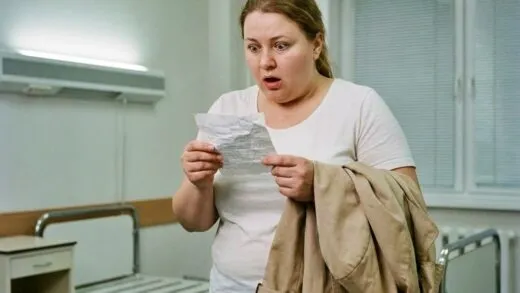
— Irina stood up, moved closer. — You wanted to leave me homeless. Make me a debtor for three million. And I wasn’t supposed to find out?
— I would have paid it back! I would have worked, paid it off!
He took a step towards her, extending his hands, but she stepped back.
— You work? — her voice dripped with sarcasm. — Andrey, you’ve been sitting at home for six months, taking on a project once a month. What were you going to use to pay back three million?
— I… I would have found a permanent job. Gotten hired somewhere.
— When? After they evicted me from the apartment?
He was silent, his head bowed. His shoulders slumped, his whole appearance was pitiful, crushed. Irina looked at him and felt the love, pity, even anger, drain away. All that was left was emptiness and cold clarity.
— Mr. Volkov, — the lawyer intervened, — do you admit that you attempted to secure a loan using forged documents?
Andrey nodded, without looking up.
— Do you understand that this is a criminal offense?
Another nod.
— We will call the police. I advise you not to leave the apartment until they arrive.
Andrey collapsed onto a chair, burying his face in his hands. His shoulders shook as he wept. Irina stood beside him, watching. This man, who just yesterday had been her husband, her family, had suddenly become a stranger. Weak, pathetic, dangerous. He had betrayed her. He was willing to destroy her life to cover his own debts.
— Why didn’t you tell me? — she asked quietly. — Why didn’t you ask for help? We could have figured something out together.
He raised his tear-stained face:
— I was afraid. You would have been angry, you would have left. You would have hated me.
— And you decided it was better to deceive me, forge documents, and risk my home?
Irina shook her head.
— You do realize that I hate you much more now than if you had just confessed to the debts?
He was silent. What could he say?
Twenty minutes later, the police arrived. Two officers in uniform, young, businesslike. They drew up a report, listened to everyone: Irina, the bank representatives, Andrey. They confiscated the papers from the study as evidence.
— We will open a criminal case under the article “Fraud,” — said the senior officer. — Mr. Volkov, you need to come with us to give a statement.
Andrey stood up, submissively. His face was gray, his eyes empty. He looked at Irina one last time.
— Forgive me. I ruined everything.
She didn’t answer. She just stood there and watched as they led him out of the apartment.
When the door closed, Irina was left alone. She sat on the living room sofa and covered her face with her hands. She wasn’t crying; there were no tears. Only a huge, crushing fatigue. Eighteen years. Her entire adult life with this man. And in one morning, it all collapsed, crumbled like a house of cards. No, not in one morning. It had been crumbling for a long time, she just hadn’t noticed. Or didn’t want to notice.
And what if it hadn’t been for that old woman? What if it hadn’t been for the strange prediction? Irina would have gone to work, Andrey would have completed his scam, and she would have found out about everything when it was too late. When the loan was approved, the money received and drunk away or gambled away. She would have become a debtor, the apartment would have been used as collateral.
“On Friday, you be the first to open the door.” Irina opened it first. And it saved her.
She stood up, went to the window. The rain had stopped, and a pale sun peeked out. In the courtyard, children were playing in the sandbox, a woman was walking her dog—life went on. And her life had just been turned upside down. Her husband turned out to be a fraud. Her family, an illusion. The future, a blank space. But the apartment remained. Her home remained. And, most importantly, she learned the truth. She learned it in time.
Irina took out her phone and dialed the old woman’s number—she had left it for her just in case. Long rings, then a hoarse voice:
— Hello, I’m listening.
— Hello, this is Irina. I helped you with your bags on Monday.
— Oh, dear… — the voice softened. — So, did you open it first?
— I did. You were right. People from the bank came. If my husband had opened the door, he would have forged documents, taken out a loan in my name. I would have been left with a three-million debt.
— It’s good that you listened, — the old woman said calmly. — I told you trouble was hanging over you. Now it has passed you by.
— Thank you. I don’t know how to thank you.
— It’s nothing, dear. Live now, be happy. You are free now. Freed from a traitor.
Irina hung up and looked out the window again. Free. Yes, probably so. It was painful, scary, lonely. But she was free.
The following days passed in a haze. Irina took a week of sick leave: she couldn’t bring herself to go to work, to interact with people, to pretend that everything was fine. She sat at home, drank tea, looked out the window, and tried to process what had happened.
Andrey was released from the police station the same day, but he didn’t come home. He called in the evening, his voice was quiet, hoarse:
— Ira, I’ll stay at Maxim’s for now. I don’t want to bother you.
— Okay, — was all she answered.
— I need my things. Can I come by?
— You can. I’ll pack you a bag and leave it by the door.
She packed his clothes, toiletries, laptop. Put everything in a large sports bag and left it in the hallway. When he came to pick it up, she didn’t go out to him. She just heard the door open, heard him stand in the hallway for a moment—perhaps hoping she would come out, say something. But Irina remained silent, sitting in the kitchen with a cup of cold tea in her hands. The door closed.
The next day, an investigator came. A woman in her fifties, with a tired face and attentive eyes. She sat opposite Irina at the kitchen table, took out a voice recorder.
— Tell me everything from the beginning, — she requested. — From the very start. When did you start noticing strange behavior in your husband?