
I simply told him that trust, once dismantled so methodically, could not be rebuilt with panic and empty words. I said I would not sell the house. I said I would not take responsibility for his debts. I said I would be filing for divorce immediately.
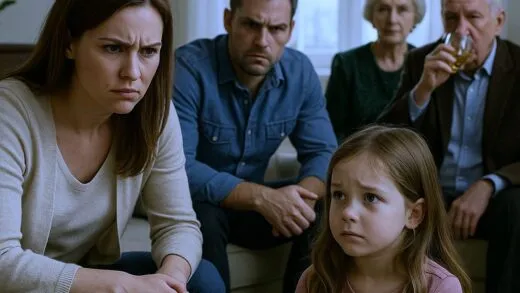
His mother cried openly, torn between fury and shame. Megan could not meet my eyes; she kept repeating that she was young, that she had been influenced, that she never meant for it to go this far.
I did not respond to her. I gathered my bags slowly, with the same methodical care I had used every night for weeks, but this time, my hands were steady. I did not look back at the bed, or the machines, or the man who had once occupied my future.
At the door, I paused.
“This isn’t punishment, Caleb,” I said. “It’s a consequence. And consequences don’t require cruelty to be effective.”
Then, I walked out of the hospital.
The night air outside was cold and sharp, biting at my skin. The city lights reflected off the wet pavement as cars whooshed past, oblivious to me. For the first time since the accident, I felt something akin to relief. I was no longer waiting in a chair beside someone else’s deception.
I was walking forward on my own terms, and I did not turn around.
After I left the hospital, events moved faster than I had anticipated. The divorce papers were filed within days; with the evidence I had gathered, there was zero room for negotiation.
Caleb’s debts were legally proven to be his alone. The house remained mine—clean, untouched, exactly as my parents had intended. Caleb’s world, conversely, began to implode.
Investigations followed. His health deteriorated genuinely once the performance ended; without an audience to manipulate, there was nothing left to sustain the lie. Megan vanished from my life entirely.
No calls, no messages, just absolute radio silence. I did not look for her. For a while, I lived a very quiet existence. I returned to work.
I focused on numbers, schedules, and projects that demanded nothing from my heart. In the evenings, I cooked simple meals and sat in rooms that finally felt honest. There was loneliness, certainly, but there was also peace.
It was during this period of reconstruction that I met Daniel Brooks. He was introduced through a work contact—calm, observant, a man who listened far more than he spoke. He never asked invasive questions, and when he noticed my boundaries, he respected them without comment.
We talked about ordinary things—careers, cities, small daily frustrations. There was no pressure to explain my history, no urgency to define what we were. That difference mattered. For the first time, I realized how exhausting it had been to live in a constant state of emotional defense.
With Daniel, I felt no need to perform or prove my worth. I was simply allowed to exist. Slowly, without drama or grand promises, I began to understand that rebuilding doesn’t require fireworks.
Sometimes, it starts with a silence that feels safe. Daniel didn’t arrive in my life like a rescue mission. There were no dramatic declarations, no insistence that he could fix what had been broken. He never spoke poorly of my past, and he never asked me to move faster than I was ready to go.
That alone felt unfamiliar. We spent time together in small, ordinary ways—coffee after work, short walks in the evening, conversations that ended naturally instead of being forced. When I hesitated, he noticed. When I needed space, he gave it without taking offense.
One evening, while we sat across from each other at a quiet corner table, Daniel said something that stayed with me.
“I believe trust isn’t something you demand,” he said softly. “It’s something you earn, slowly, through consistency.”
Those words settled somewhere deep in my chest. I realized that for years, I had mistaken intensity for commitment and endurance for love. I had believed that suffering quietly was the ultimate proof of loyalty. But with Daniel, there was no suffering to justify, no role to play.
I wasn’t careful because I was afraid. I was careful because I finally valued myself. We didn’t rush into labels or promise futures; what we built was slower and far steadier than anything I had known before.
And in that slowness, I felt something I hadn’t felt in a very long time: Safety. Not the fragile safety built on silence and sacrifice, but the kind that allows you to breathe without watching every word or step.
For the first time, I understood that love does not ask you to disappear. It asks you to arrive as you are.
Looking back now, I understand something I couldn’t see back then. This story was never really about revenge. It was about clarity.
For a long time, I believed love meant endurance. I believed loyalty meant silence. I believed that if I just gave a little more, waited a little longer, everything would eventually make sense.
But the truth is this: when respect disappears, patience does not save a relationship. It only delays the damage.
Caleb didn’t lose me because of one mistake. He lost me because he chose deception over honesty and convenience over character. And I didn’t walk away to punish him. I walked away because staying would have meant abandoning myself.
If you recognize pieces of your own life in mine, hear this clearly: You are not weak for trusting. You are not cruel for choosing yourself. Walking away from a toxic situation is not failure—it is responsibility. Sometimes the bravest thing you can do is stop explaining, stop sacrificing, and start protecting what matters most: your dignity, your peace, and your future. That is the art of revenge—not about anger, but about truth, timing, and reclaiming your life.