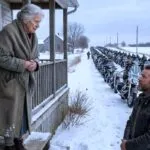

He offered to fix it while they were still there and asked permission. Agrippina was silent for a second, then asked where they were headed. Semyon paused and answered honestly: “Don’t know yet. We’ll try Poltava. Maybe a factory will take us.”
“Hard without residency papers, but they say in Mirgorod some places will hire you for certain work even without them.” Agrippina nodded, went into the house, and came back ten minutes later. In her hand was a torn sheet from a household notebook and a copying pencil. She laid it on the porch in front of Semyon.
“Write,” she said, “who you are, where you’re from, what you served time for, and how long. All of it straight.” Semyon looked up at her and asked, “Why?” Agrippina answered evenly: “If I know, I can decide whether to keep talking with you. If you won’t say, that’s your business, but then you leave in the morning.”
Semyon took the pencil, wrote several lines in a small clear hand, and passed it to Grisha. Grisha grimaced, like a man embarrassed not because he had something to hide but because he wasn’t used to putting himself on paper. He wrote and passed it to Tikhon. Tikhon took the sheet and looked at it for a long time, ten seconds maybe.
Then he wrote a few words, very brief, less than the others. He handed it back to Agrippina and, without waiting for her reaction, went to the shed. Agrippina read it, stood there with the paper in her hand, read it again, tucked it into her apron, and said nothing. Semyon fixed the hayloft too.
By evening the work was done: everything she had named that morning, plus a few things she hadn’t. Semyon replaced the left gate hinge, which had come loose and squeaked. Grisha repaired the wooden latch on the shed. Tikhon, without being asked, filled every empty barrel by the well.
That evening she set supper on the table: fried potatoes with onions and dill in a big cast-iron skillet, sauerkraut from the cellar, bread, and a pitcher of milk. And for the first time she sat down at the table with them. Before that she had set out food and left. This time she sat. They ate in silence, but it was a different silence from the morning—not wary, just quiet.
As she cleared the table she said, without turning around, “Stay the night. We’ll talk tomorrow.” Tikhon stood first, gave her a short nod without words, and went to the shed. Grisha lingered, picked up a spoon that had fallen from the table, and laid it carefully in the washbasin. Semyon said quietly, “Thank you, ma’am.”
The Agreement on the Porch
Agrippina didn’t answer. She stepped out onto the porch and looked at the darkening sky. The stars were large and close, the way they always are on a clear August night in that part of the country. She stood there a minute, went back inside, and thought about tomorrow. The next evening, when the sun was dropping behind the woods and the heat had eased a little, Semyon came to her.
The heat hadn’t gone away exactly. It had just settled down, the way something heavy settles when it finally stops pressing so hard. Semyon asked for fifteen minutes to talk, and she nodded. They went out to the porch and sat on the steps. Grisha and Tikhon stayed by the shed: Grisha smoking, Tikhon sharpening the kitchen knives he had found dull.
Both of them looked away from the porch on purpose. They were giving space, understanding the conversation wasn’t for them, not yet. Semyon spoke slowly, choosing his words. You could tell by the way he sometimes paused for a second before going on. Not because he didn’t know how to speak—he did—but because he wanted to say exactly what he meant, nothing extra, nothing missing.
He said the three of them understood they couldn’t keep taking advantage of her kindness for long, and that they would leave when she said so, no argument. But before they did, he wanted to tell her something he had been thinking over for the past two days. He paused, then said it plainly. They had nowhere to go, truly nowhere—not in the sense of lacking a road or legs, but in the sense that every road ended in a wall.
In town, without residency papers, nobody would hire them for decent work. They could get day labor, maybe, but then they’d be living in barracks with other men just like them, men with no future. And half of those men, sooner or later, broke again. Not because they wanted to, but because the whole environment pulled downward, and it’s hard to stop sliding when everything around you is the same old thing. Villages didn’t like outsiders, especially not men with records.
A release certificate instead of a passport was like a brand on your forehead. People saw that first, and only after that—if at all—the person behind it. Agrippina listened without interrupting. Semyon went on, saying she had a good place, a solid one, that much was obvious.
But one person couldn’t keep it all up alone, and that was obvious too. He wasn’t saying it to insult her. It was just a fact he had seen in two days. She needed hands. He had seen her carrying water in the morning, seen the stiffness in her back, the way she moved through it without complaint. That wasn’t weakness. That was fifty-two years old and nonstop work since 1941.
He wasn’t saying she couldn’t manage. He was saying two people manage easier than one, and four easier still. There was a pause, just long enough for the words to settle. Then he said, “Here’s what I’m proposing. We stay and work this place for real. Not pretend, not loaf.”
“Firewood, garden, livestock, repairs, whatever needs doing—what you tell us and what we see ourselves. In return, a roof and food. We’re not asking for money. We’re not asking for extras.”
“Your word is the rule. If you say leave, we leave that same day. If you say do this, we do it. No arguing, no hard feelings.” Agrippina sat there silent a long time, maybe a minute, though it felt longer.
Semyon didn’t rush her or add anything. He waited. She thought. Not about whether they could work—she had already seen that. And not about whether they were dangerous—she had already decided that for herself, reading each one over those two days.
She was thinking about something else. What did it mean to let three strange men stay on her property for good? What would the village say? What would the local officer say?