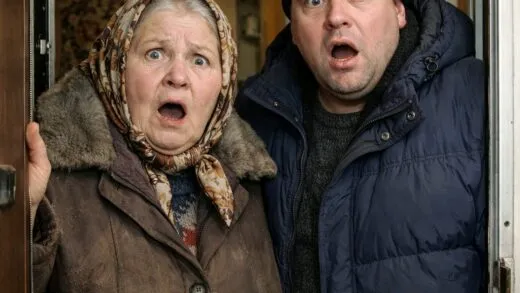
He sat there looking at her. Agrippina went back to the stove. They never returned to that conversation. A week later Nikolai came again.
Grisha went out to him himself. The conversation was short. Grisha shook his head. Nikolai pressed him. Grisha shook his head again, turned, and walked back to the house.
Nikolai stood there a moment, spat into the snow, and left. He never came back. In March two important things happened. Semyon wrote a letter to the rehabilitation commission.
He asked Agrippina for paper and an envelope and explained why. She gave them to him without comment. The letter went off to the regional office, but there was no answer in March, or April, or May. Every week Semyon walked to Zakharovka to the post office.
Three miles there, three miles back. Every time he came home without a letter. Said briefly, “Nothing yet.” Then went back to work.
Agrippina watched him and thought: that’s what real patience looks like. Not suffering while you wait, but waiting while you keep living as if the answer will come when it comes. And that same March, Tikhon spoke up again. They were alone in the kitchen late one evening.
Agrippina was baking bread. Tikhon was weaving a basket from willow rods. Suddenly he said, without lifting his head, “I know where Nina is.” Agrippina stopped with dough on her hands. Tikhon explained that he had written through an acquaintance back in December, after she had given him the paper.
The acquaintance had made inquiries through contacts in Chernihiv. The answer came in March to the post office in Zakharovka. “Nina lives in Chernihiv. Married since ’52. Husband’s an army lieutenant. Exact address.”
Agrippina asked, “Did you write to her?” Tikhon said, “No.” Agrippina asked, “Why not?” Tikhon looked at the willow rods.
Said slowly, “She lived without me for eleven years. Grew up, got married, has her own life. What does she need with me, a man carrying papers like mine? I’d only get in the way.”
Agrippina wiped her hands on her apron, came to the table, and stood across from him. Said, “Tikhon, she doesn’t owe you acceptance. She doesn’t owe you a reunion. That’s her right, and you can’t take it from her.”
“But you also don’t get to decide for her that she won’t want it. That decision is hers, not yours. Your job is to write. Give her the chance to decide for herself. So write.”
Tikhon sat silent a long time, looking at the basket in his hands. Then he stood up, went into the main room, and came back with the crumpled sheet Agrippina had given him in November, the one with the notes on it.
He sat at the table, took the pencil, laid the paper in front of him. Looked at Agrippina. She nodded. And he began to write.
Twenty Years Later
Here’s what matters before I tell you how it all turned out. This did not become a fairy tale. Nobody got rich. Nobody moved off to a big city and started a shiny new life. There was no grand moment when goodness won and everything snapped into place. There was just life.
Slow, ordinary life. But different from what had come before. Nina answered Tikhon two months later. The envelope came to the post office in Zakharovka. Semyon brought it back on his way home.
Tikhon took the envelope and held it unopened. Agrippina saw him standing by the window with it for five minutes. Then he went into the other room and shut the door. Came out an hour later.
He said nothing at supper, but Agrippina noticed. He ate a little faster. And once he lifted his eyes from his plate and looked out the window. The letter was short.
A few careful lines. Nina wrote that she had received his letter. She was doing well, had a daughter named Tanya, three years old. Her husband was a good man. At the end there was one question: “Are you in good health?”
Tikhon read that letter many times. Agrippina saw him take it out in the evenings. Spread it on his knees and look at it. Not reread it line by line, just look at it.
The way a person looks at something he had not believed in for a long time, and then it turns out to be real. They began writing each other rarely, once every two or three months. Nina wrote cautiously, with questions. Tikhon answered even more cautiously, briefly, but he answered every time.
In 1958 Nina came. She wrote ahead: “I’ll be there at the end of May for three days, if that’s all right.” Tikhon brought the letter to Agrippina. She read it and nodded. “Let her come. We’ll get the room ready.”
Nina arrived by bus. Tall, dark-haired, straight-backed, around twenty-three. She looked like Tikhon: same wiry build, same dark attentive eyes, same way of looking at people. Directly, without dodging, without pushing…