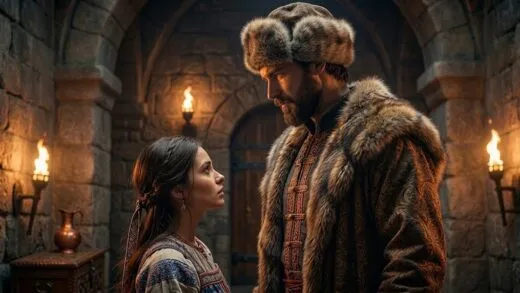
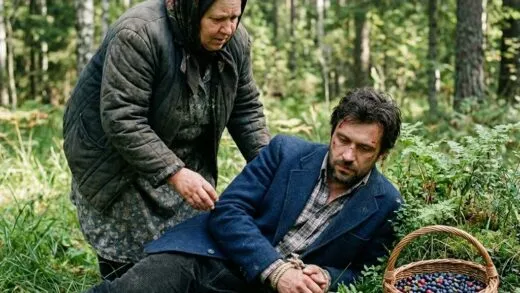
They had driven him into a narrow rock cut. Four women in weathered hides and thick felted wool, carrying heavy crossbows and spears tipped with bone. They breathed hard through their noses, sure the outsider was cornered.
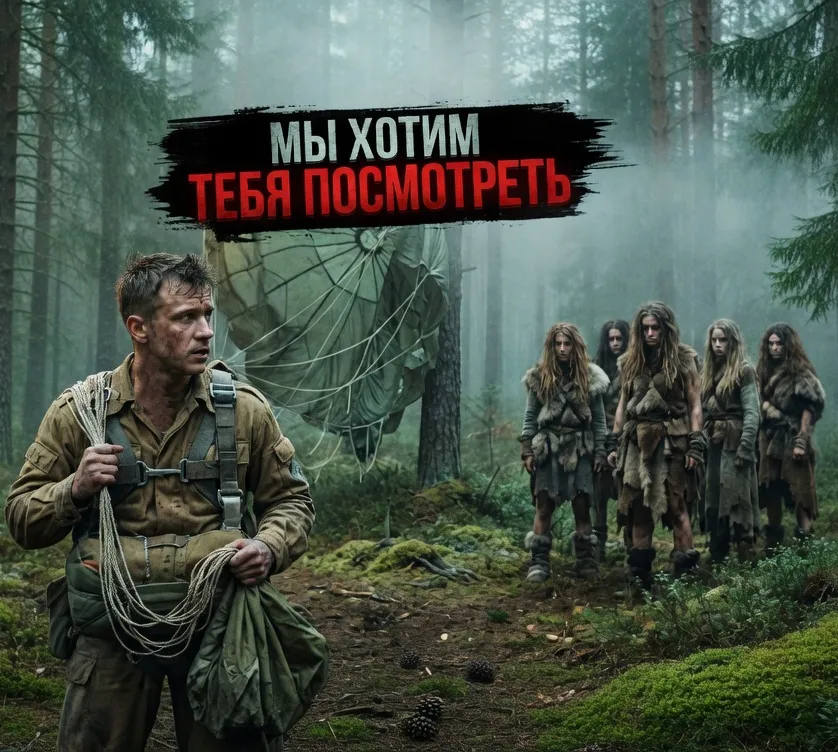
Their faces, smeared with ash and clay, showed grim satisfaction. They knew this forest. Knew every stone in it. But they did not know the man they were hunting.
The oldest stepped forward, raising her weapon. At that moment, a drop of icy rain slipped from a cedar branch and struck a nearly invisible nylon line stretched low to the ground. The line trembled.
The outsider was not hiding behind the rocks in the dead end. He was three yards above them, flattened along a thick branch, blended into bark, shadow, and rain. His breathing was steady. His pulse was slow.
No firearm in his hands. Just a long military knife. The hunters still had not realized the prey had switched places with them a long time ago.
They were standing exactly where he wanted them. They thought they had trapped an animal. Instead, they had walked into a professional’s setup.
It was late October, 1987. The military transport plane shook so hard it felt less like flying through clouds and more like punching through broken concrete. The cargo bay smelled of jet fuel, ozone, wet canvas, and that sour edge of adrenaline that always hangs around people before a jump.
First Lieutenant Max Odell sat on a fold-down seat, staring straight ahead. He was twenty-eight years old. He commanded a reconnaissance airborne team and specialized in survival under extreme conditions.
His face stayed calm, cut in hard, sharp lines, and his eyes were the color of dark steel. He made no wasted movements. His hands, working off muscle memory, checked his parachute rig for the tenth time, the rifle strapped to his chest, his magazines, and his med kit.
Outside, the storm howled. The weather briefing had called for heavy cloud cover and strong winds. But what they flew into over that endless stretch of wild timberland was more than bad weather.
It was a full-blown anomaly. A wall of black rotating air was laced with violet streaks of lightning. The aircraft dropped through air pockets by dozens of feet at a time. The metal skin groaned. Rivets squealed.
The red light over the ramp flashed, washing the paratroopers’ faces in a pulsing warning glow. The pilot tried to hold course to the drop point, but nature was winning. Then the green light came on.
The siren wailed through the engine roar. The jumpmaster gave a sharp signal and ordered them out. Max stepped into the void first.
The blast of air nearly knocked the breath out of him. Around him was roaring, freezing darkness. Rain hit his face like birdshot.
Max tucked in, counting seconds with practiced calm. Three, four, five. Pull. Then a hard jerk.
The canopy started to open, but a crosswind slammed into it from the side. The lines snapped tight, twisting dangerously. His body spun on its axis.
Instead of a smooth deceleration, he got a choking, violent loop. He could not deploy the reserve or the canopies would foul each other. He was dropping into the black depth of untouched forest.
The wind tossed him around like a rag doll. Below him there were no lights, no landmarks. Just one solid, impenetrable sea of pine and cedar.
The ground came up too fast. Max instinctively tucked his chin and covered his face with his gloved hands.
The impact was brutal. He crashed into the crown of a giant cedar. Branches as thick as a man’s arm snapped with dry cracks, whipped across his body, and tore his jumpsuit.
The chute snagged in the top of the tree, stretched tight, and shuddered, but held. The jolt was so hard something popped loudly in his shoulder joint. Pain flashed white behind his eyes.
Max hung four yards above the ground, swaying on the lines in total darkness. Rain poured in a solid sheet. Wind moaned high in the treetops.
He stayed motionless for about a minute. No groaning. No thrashing. He just breathed slowly and deeply, taking inventory.
His left arm was useless. The shoulder was dislocated. Pain pounded up into his neck. But his right leg and ribs were intact, and his head was clear.
He opened his eyes and saw nothing but black. Around him was only the rising noise of the storm. With his right hand he reached for the line cutter on his chest and drew the blade.
One precise motion was enough. The taut suspension lines snapped. Max dropped, landing hard on a thick bed of wet moss and needles. He rolled to bleed off the impact and ended up flat on his back.
Rain washed over his face. He had to reset the shoulder now, before the muscles locked down and shock made it worse.
He rolled onto his stomach, breathing hard. Felt around in the dark until he found a thick exposed root and crawled to it. He braced his left armpit against the wood and bit down on the collar of his jumpsuit.
With his right hand he grabbed his left wrist. Then came one hard, merciless pull, down and back. A dull click sounded.
The shoulder went back into place. Max let out a long breath through clenched teeth. Sweat mixed with cold rain on his face.
He lay there another minute, letting the pain shift from sharp to dull and throbbing. Then he sat up slowly. Time for a gear check.
The rifle was still there, but the barrel was packed with mud. The sidearm was secure in its holster. Knife and compass were still with him.
He pulled out the compass, shielded it from the rain, and clicked on the light. The needle spun wildly and never settled. Strong magnetic interference. The radio was dead too, giving him nothing but flat static.
He was in what pilots called a dead zone. A huge blank spot on the map where radios failed and survey crews stayed out. Local stories said the forest swallowed anyone who pushed too far in.
Max got to his feet. Cold crept under his soaked clothes and clung to him like something alive. He needed shelter and he needed to make it to daylight.
He moved blind, right hand out in front, feet testing each step. The old-growth forest stood so tight a man could barely squeeze between trunks. Underfoot, giant fallen logs rotted where they had lain for decades.
Half an hour later he found what he needed—a small rock overhang hidden behind thick brush. There was a dry patch of ground about six feet by six feet. Max crawled inside and took off his soaked load-bearing vest.
From a waterproof pouch he pulled matches and a piece of plexiglass. He gathered dry twigs from the back of the shelter. The fire caught reluctantly, but soon a small smokeless flame lit the stone ceiling.
Max started cleaning his weapon, methodically field-stripping the rifle by touch. His fingers moved fast, clearing mud and checking the action. In a place like this, a working weapon was your only real argument.
When the barrel was clear and the magazine back in, he leaned against the rock and closed his eyes. Sleeping was out of the question. At best, he could drift on the edge of it and keep listening to the woods.
Every rustle and every snap of a twig ran through the filter of his training. Dawn came in gray and bitter cold. The rain stopped, leaving behind a heavy fog that crawled along the ground in pale ribbons.
Max smothered the last of the fire, covered the ash with dirt, and carefully hid any trace of his camp. Then he stepped out from under the overhang and looked around. In daylight the forest looked even worse.
Huge trunks draped in gray lichen rose into a blank, overcast sky. The silence was complete. No birds. No small animals moving in the brush.
Only big drops of water fell from branches and thudded into the moss. Max headed east, using the heavy moss growth on the trees as a rough guide. He moved heel to toe, shifting his weight carefully so not a single stick would crack.
He had been walking three hours when his reflexes fired before his mind caught up. He stopped dead. Became a statue.
Something had changed. Not a sound. A smell.
Mixed in with the usual wet rot and evergreen was a new note. Faint, but there. Wood smoke. Tar. Well-tanned leather.
Max lowered himself slowly to one knee. He studied the ground in front of him. Two yards away, in the wet moss, was a fresh print.
Not bear. Not wolf. Human. The track looked odd—soft, without the tread pattern of a boot, like a foot wrapped in leather. And whoever made it had not been alone.
The tracks fanned out in different directions. Max lifted his eyes carefully. His gaze moved over trunks and brush shadows.
He started reading the terrain the way special operations had taught him. He was not looking for a person. He was looking for a break in symmetry. A straight line where nature should not have one.
There—a dark patch against pale bark to the left, maybe fifteen yards away behind a fir. A slight movement to the right, twenty yards out in thick fern. Another presence behind him, up in a branch.
They had taken him in a silent, professional ring. If not for the smell of tar, he would have walked right into it. Max did not snap his rifle up. Any sudden move could trigger an attack.
He rose slowly to full height. Took his finger off the trigger but kept the weapon at chest level. “Come out,” he said calmly….