
It was the question Mike had been asking himself for months. Bo was Zoe’s guardian. The thought of him not being there in a crisis was terrifying.
Despite his fears, Mike knew the opportunity was too good to pass up. Zoe’s medical expenses were rising, and a consultation with a top pediatric neurologist in Charlotte—their best hope for better seizure control—wasn’t covered by their insurance. The K-9 stipend could make that a reality. After a long discussion, they agreed to a trial period.
Bo began training three mornings a week. He was an exceptional student, mastering commands and complex scenarios faster than any dog the department had seen. The trainers were amazed at how he could switch from “work mode” to “gentle companion” the moment Zoe appeared.
“He knows the difference between his jobs,” Officer Miller explained. “It’s like he has two personalities, and both are perfectly suited for what he needs to do.”
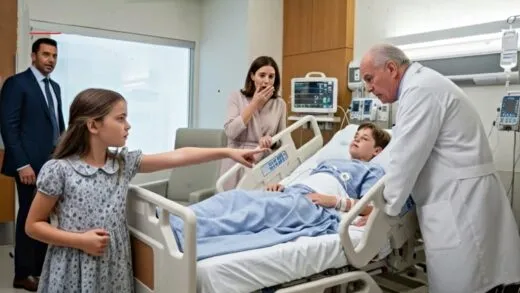
But as Bo thrived, Zoe’s health took a turn. The seizures, which had been manageable, began to intensify. They were longer, harder, and more resistant to her usual meds. Mike found himself in the ER weekly, holding his daughter’s hand while doctors administered heavy doses of Valium to stop the clusters.
“We need to change the plan,” Dr. Sarah Collins, Zoe’s neurologist, said during a follow-up. “The EEGs show dangerously high activity. I want to refer her to Dr. Olga Vance at the Children’s Medical Center in Charlotte. She specializes in refractory pediatric epilepsy.”
Mike’s heart sank. Charlotte was a four-hour drive, and Dr. Vance was out of network. A single consultation would cost more than his monthly mortgage payment.
“Is there any other way?” Mike asked, hating the desperation in his voice.
Dr. Collins looked genuinely sorry. “For standard cases, yes. But Zoe’s case is becoming complex. Dr. Vance has a diagnostic protocol specifically for cases where standard meds fail. I wouldn’t suggest it if I didn’t think it was vital.”
That night, Mike sat at the kitchen table surrounded by bills and insurance denials. The house he and Eleanor had bought with such hope felt like it was crumbling. The roof needed work, the furnace was acting up, and now Zoe needed care he couldn’t afford. The K-9 stipend helped, but it wasn’t enough for this.
In a moment of vulnerability, he called Natalie at the shelter. She listened with empathy and then made a suggestion.
“The K-9 graduation is next month, and it’s a big community event. Local businesses make donations to the program. With your permission, I could talk to the Chief about highlighting Zoe and Bo’s story. A fundraiser tied to the ceremony could raise enough for her treatment in Charlotte.”
Mike hesitated. Eleanor had always been private about Zoe’s health. But faced with the alternative, he agreed.
The weeks leading up to the graduation were a whirlwind. Local news picked up the story of the rescue dog turned K-9 hero and his little girl. Zoe gave a shy interview to the local paper, explaining how Bo could “smell” a seizure coming. Officer Miller arranged for Zoe to personally present Bo with his official K-9 vest during the ceremony.
The day of the ceremony was bright and sunny. The police training field was packed with chairs, a podium, and a display of the K-9 graduates. Zoe wore her favorite blue dress. Bo was groomed to a shine, his coat gleaming in the sun as he went through his final drills.
The ceremony began with a speech from the Chief, followed by a demonstration. When it was Bo’s turn, he performed flawlessly, finding hidden items and responding to commands with precision. Mike sat in the front row with Zoe, his chest tight with pride and anxiety.
When the demo ended, Officer Miller called Zoe up. she walked forward carefully, carrying the custom K-9 vest with “BO” embroidered next to a badge. The crowd went silent as the little girl solemnly handed the vest to the officer, who helped her drape it over the dog. Bo stood perfectly still, radiating dignity despite the camera flashes…