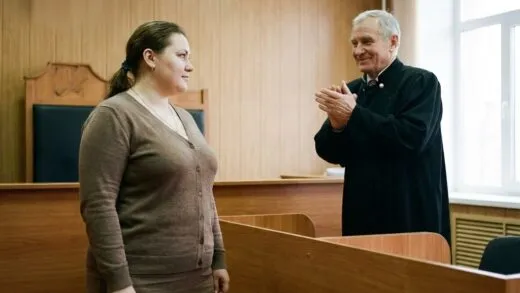

Ellen tried to speak as gently as possible.
“Did you see anyone follow her? Or maybe a car pull up?”
The girl hesitated. She shot a quick, frightened look at her mother, then back at Ellen.
“A car… a Cadillac pulled up,” she whispered. “A black one. Vance Taylor’s. He, Sterling, and Thompson got out. Vance said something to Sarah, offered her a ride. They… they all walked toward the park together.”
Ellen’s heart stopped. There it was. Real evidence. Not just a mother’s intuition, but a witness.
“Lily! This is so important!” Ellen took the girl’s hands. Her palms were icy. “Can you tell this to the detective? Please, honey. It’s our only chance!”
“Of course I can!” Lily said fiercely. Her cheeks flushed with anger. “Those jerks! Everyone in school knows what they’re like. I’ll tell them everything. They have to pay for what they did to Sarah!”
Hope flared up in Ellen again—bright and strong. It wasn’t for nothing. There was a witness. Now they couldn’t hide. She agreed with Lily and her mother to go to Detective Miller’s office the next morning.
Ellen left feeling lighter. It felt like her back had straightened, and the weight on her shoulders had eased. But she didn’t know that the system has long arms and very good hearing. She didn’t know that every neighborhood has eyes and ears. And the news that Sarah’s mother had found a witness reached the wrong office faster than the sun could set.
That evening, an unmarked gray car pulled up to Lily’s building. Two men got out. Not in uniform. They wore plain gray suits and had identical, expressionless faces. They didn’t introduce themselves. They just showed Lily’s mother a badge and asked to speak with her daughter. Alone.
The conversation lasted no more than fifteen minutes. No one heard what was said in Lily’s room. When they left, her mother found her daughter sitting on the bed. Lily was white as a sheet. She stared at a spot on the wall, shaking, her arms wrapped around herself. To all her mother’s questions, she just shook her head and repeated the same thing: “I didn’t see anything. Mom, I don’t remember anything.”
The next morning, when Ellen arrived to pick up Lily, her mother opened the door again. But today there was no sympathy. There was only fear. Raw, primal fear for her child.
“Ellen! I’m sorry!” she stammered, blocking the doorway. “Lily isn’t going anywhere. She… she got it all mixed up yesterday. She was tired from graduation. She made it up. She didn’t see anyone. No car. No Vance Taylor. Sarah left alone, and that’s it.”
Ellen looked at her and understood everything. She saw the woman’s forced smile, her darting eyes, her shaking hands. She saw the fear. And she understood the reason.
“Can I talk to Lily?” she asked quietly, though she already knew the answer.
“She’s not here!” the woman said too quickly. “She went to stay with her grandmother. In the country. For the whole summer.”
It was a lie. A blatant, pathetic lie. Ellen knew Lily was standing right behind the door in the hallway, listening. The betrayal was so thick she could almost touch it.
Ellen didn’t say another word. She just looked into the frightened eyes of Lily’s mother. In that moment, the last ember of hope in her soul went out. Crushed by someone else’s fear.
She was alone. Absolutely, totally alone. Against all of them. Against their power. Their money. Their connections. Against their ability to break not just bodies, but souls, forcing people to betray their friends, the truth, and themselves.
She turned and walked down the stairs. Every step echoed in her head like a hammer blow. This was the end. The end of her faith in people. The end of her hope for justice. And the beginning of something else. Something cold, dark, and merciless.
Back home, Ellen didn’t turn on the lights. She went into Sarah’s room and sat on the edge of the bed. It still smelled like her—the faint scent of her shampoo, her perfume, her youth. On the desk sat her biology and chemistry textbooks, neatly stacked.
On the wall was a poster of a famous surgeon. Her girl’s world, so clean and full of hope, now felt like an artifact from a past life. It was here, but it no longer existed.
Ellen sat in the dark, motionless. One hour, then two. She wasn’t thinking about anything specific. Her mind was a ringing, deafening void. Every emotion—grief, fear, anger, despair—had burned out, leaving only cold, hard ash.
She replayed the last few days in her head. Commissioner Sterling’s face. The lines in the medical report. Lily’s mother’s eyes. It all formed one simple, ugly picture. They didn’t just want to escape punishment. They wanted to humiliate her. To trample her grief.
To make her daughter the guilty one, and her the “crazy mother” making up stories. They had stolen Sarah’s future. Now they were stealing her honor.
Suddenly, she stood up. Her movements were sharp, mechanical. She went to the tall wardrobe, stood on a chair, and pulled a dusty, heavy toolbox down from the top shelf.
It had belonged to her late husband, who had also worked at the plant, but in the machine shop. He’d died five years ago of a heart attack, leaving behind only a few photos and this box. Ellen had never touched it.
She put the box on the floor and snapped the rusted latches. She lifted the lid. The smell of old metal and machine oil hit her. Inside, in custom slots, lay his tools. Not a simple home-repair kit. These were the tools of a professional. A man who knew and respected metal.
Heavy vises. A set of perfectly sharpened chisels. Massive wrenches. A hacksaw with a thin, predatory blade. Large bolt cutters he’d brought home from the plant years ago.
Ellen ran her fingers over the cold, smooth steel. These objects were part of another world. Her husband’s world. A world of male strength and hard labor. She’d always seen them as foreign. Но now, in the silence and the dark, she saw them differently.
She didn’t see tools. She saw weapons. Retribution. The only language left to her, the only one that could be understood by those who didn’t speak the language of humanity.
She pulled the heavy bolt cutters from the box. She pulled the long handles apart. The steel jaws opened with a quiet, ominous creak. There was no anger or hatred in the sound. Only cold, merciless mechanics. The logic of a machine performing its function.
In that moment, something changed in the apartment. It was as if the last bit of warmth had left the air. The space filled with an arctic chill.
The woman who had been sitting on her daughter’s bed thirty minutes ago, quietly mourning her ruined life, was gone. In her place, something else was born. A creature without tears, fear, or doubt. A creature with only one goal. One program. One function. From that day on, her life became a hunt.
During the day, she went to the hospital as before. She cared for Sarah. She spoke mechanically to the doctors. She became an invisible, gray shadow, blending into the hospital walls. Но when night fell, a different life began.
She went out and walked. Not to her house, but to the upscale part of town where *they* lived. To the expensive homes with high ceilings, where those who were allowed everything resided. She didn’t get close. She watched. From a park bench across the street, from around a corner, from the shadows of an alley.
She became eyes and ears. She studied them like an entomologist studies insects. What time they came home. Where they drove their cars in the evening. Who they met. She listened to snippets of neighborly gossip. She lingered near open windows. She memorized everything. Routes. Habits. Schedules.
First on her list was Paul Thompson. The youngest, the most cowardly. She saw that he, unlike his friends, didn’t flaunt himself around town; he stayed close to home. She saw that in the evenings, he went alone to a garage complex on the edge of town where he and his father kept their cars. This garage complex, a maze of hundreds of identical metal boxes lit by a single dim bulb at the entrance, was the perfect place.
She began to prepare. For a week, she went there every evening, studying the layout, finding the darkest, most secluded corners. She knew where the gate creaked, where the light was out, where there was a hole in the fence to slip through unnoticed. She didn’t rush. There was no emotion in her actions. Only cold, mathematical calculation. The machine of retribution was tuning its gears for the first strike.
The garage complex was a rotting tooth on the edge of town. A rusted, half-abandoned labyrinth where only the most dedicated car enthusiasts or those looking to hide from the world gathered at night. Ellen knew that Paul Thompson was one of them. His old Chevy was his sanctuary, and the garage was his cell. The perfect place.
She didn’t hide. She followed him in like a shadow he didn’t notice. He entered his garage, leaving the door slightly ajar, and turned on a dim light. He walked to the back, toward the workbench, and in that moment, she stepped inside, picking up a heavy tire iron someone had left by the door.
He heard the crunch of gravel under her foot and started to turn. He only had time to catch a glimpse of a dark silhouette. The strike was short, precise, and merciless. Right to the back of the head. There was a dull thud, and the world went black for Paul Thompson. His body slumped onto the dirty concrete floor.
Consciousness returned slowly, in painful jerks. First came the pain—dull and pulsing in the back of his head. Then the cold, seeping from the concrete through his thin slacks. He tried to move his hands to touch his head, but he couldn’t. His hands were tied behind the back of a chair. Tight. His fingers were numb. He struggled to open his eyes.
He was sitting on a plain wooden chair in the middle of his own garage. His legs were tied to the chair legs. Opposite him, a few feet away, she stood. A dark female figure in a work coat and a scarf that kept her face in shadow. She just stood there, watching him in silence.
“Who are you?” he croaked, his mouth dry with fear. “What do you want? Money?”