
More clearly the second time. Ethan was just learning to walk then. Round-cheeked and funny, he’d fall down and get back up with the serious expression of a little businessman.
He wasn’t afraid of his grandfather at all. He’d go into the room without knocking, climb into the chair beside him, and show him things: a toy car, a picture book. Once he brought in a shiny rock from outside and solemnly placed it in Harold’s good hand.
Harold held that rock and looked at his grandson with an expression I never saw anywhere else. Soft. Open. Completely different. Sometimes I took pictures of them quietly on my phone.
Ethan looking out the window and explaining something to Grandpa, and Grandpa listening with the seriousness adults reserve for important conversations. Or Ethan asleep on his lap, head tilted against the armrest, and Harold sitting perfectly still, looking down with the kind of care people use around sleeping children. I kept those photos in a separate folder.
I didn’t know why. I just felt they mattered. David lived with us in the sense that he slept in our bedroom, ate at our table, and sometimes went into his father’s room to talk. The talks were short.
David got tense in his father’s room, rushed his words, then left. Harold watched him go. I didn’t know how to read that look then. Later I learned.
One evening David left his phone in the kitchen. He’d gone to take a shower. The phone was on the table, screen up, and when I walked by it buzzed.
A message came in. I didn’t read it. I only saw the sender’s name before the screen went dark: “Vicky” and a simple smiley face. I stood over the phone for a few seconds, then picked it up and turned it face down.
Then I went to put Ethan to bed. Maybe it was a coworker. Maybe I was tired and imagining things.
Maybe it was just a name. I was still good at talking myself out of things back then. The guests left late.
Linda lingered longest at the mirror in the entryway, fixing her hair, talking about what a lovely evening it had been while not looking at me. Regina left with one hand on her necklace like she was afraid she might lose it. Kevin shook my hand on the way out, firm and businesslike, and said “Happy birthday” the way people say “Take care.”
David said he was going out to get bread. It was around eleven at night. I didn’t say anything.
Ethan was asleep. Harold was in his room. I looked in on him.
He wasn’t asleep. He was staring at the ceiling, but when I came in he turned his head and looked at me for a long time. I told him good night and closed the door. The kitchen had that usual after-party mess: glasses, plates, somebody’s forgotten napkins.
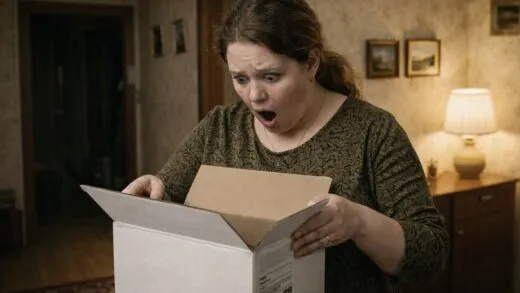
I was gathering dishes when I noticed the box still sitting on the shelf where I’d put it at the beginning of the evening. I picked it up to put it away in a cabinet. And suddenly I felt that it was heavier than it should have been. Noticeably heavier.
I gave it a little shake. Something inside made a soft rustling sound. I took the lid off.
The pot was inside, packed in cardboard. It was an ordinary heavy-bottomed stockpot, good quality, expensive. I lifted it and saw a thick cardboard insert underneath.
I lifted the insert. There were two envelopes under it. One was plain white, sealed.
My name was written on it in a crooked, unfamiliar hand: “For Kate.” The second one, larger, was stiff and formal. On it, in neat professional handwriting, were the words: “Notary Susan Whitaker, copy.”
And just below that was a date. But it had been blacked out with marker, deliberately, so it couldn’t be read. I stood there over that box in the empty kitchen, the wall clock showing almost midnight, and somewhere out in town my husband was supposedly getting bread.
I had two envelopes in my hand and understood absolutely nothing. I didn’t open them that night. I stood there holding the papers and at some point realized I simply wasn’t ready.
Not physically. Emotionally. It was like some inner voice said, Not now. Not on a night when my husband had disappeared for bread at eleven p.m. and the kitchen still smelled faintly of other people and a celebration that hadn’t felt much like one.
I put the envelopes back under the cardboard insert. Closed the box. Took it into the bedroom, put it on the top shelf of the closet, and covered it with a stack of old magazines I’d been meaning to throw out.
Never had gotten around to it, and now they came in handy. Then I lay down. Stared at the ceiling.
David came back around one in the morning. Without bread. I didn’t ask.
He lay down beside me, turned toward the wall, and a few minutes later his breathing evened out—or he pretended it did. I lay there listening to him breathe and thinking. Maybe they were just old papers: property documents Harold had kept and decided to pass along.
Maybe I was making too much of it. Maybe I was just tired, and tired people turn ordinary things into mysteries. I was still good at talking myself into that then.
The tablet came in the second year of caregiving. I bought it in March, one of those rainy, slushy months when the snow is no longer white but gray and heavy like wet cotton. Harold asked for it in writing.
On a sheet of paper, with his left hand, slowly, letter by letter, he wrote: “T.B.L.T.” Then underneath: “B.G. B.T.T.N.S.” I didn’t get it at first.
I asked him again. He repeated it patiently, with the expression patient people use when explaining obvious things to impatient ones. “A tablet with big buttons?” I guessed.
He closed his eyes slowly. That was his yes. By then we had a whole system.
A quick blink meant no. A slow close of the eyes meant yes. We’d worked it out in the first weeks, when I realized how exhausting it was for him to nod all the time. His neck got tired, and it felt demeaning—like being made to answer like a child.
When I told David what his father wanted, he snorted. “What for, Dad? You can’t really type anyway.” I bought the tablet the next day.
A good one, large screen, big-font settings. I found an app with oversized keys, almost palm-sized. Brought it home, turned it on, showed him how to use it.
Harold looked at the screen for a long time. Then he started typing. Slowly.
His left hand worked better than before, but not by much. One letter, pause, another letter, typo, correction, another letter. I sat beside him and waited.
Finally he turned the tablet toward me. On the screen it said: “THX.” I didn’t get it for a second.
I stared. Then he slowly and precisely tapped a finger toward me. “Thank you?” I asked…