Linda asked. “My birthday gift,” I said. I opened the box, took out the pot, lifted the cardboard insert, and pulled out the first document: the notarized will.
I laid it on the table. Then the second: the deed transfer for the condo. Then the third: the deed transfer for the lake cabin.
The fourth: bank account documents. The fifth: the psychiatrist’s competency evaluation for Harold Bennett, dated six months before his death. I laid them out slowly, one by one, like cards.
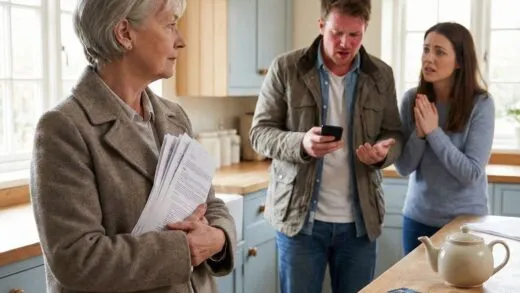
The room was very quiet. Kevin took the will and read it slowly, then read it again. His face changed gradually, the way an intelligent person’s face changes when he realizes something has gone wrong but doesn’t accept it all at once.
First disbelief. Then tension. Then a kind of drained paleness. Regina leaned over his shoulder, opened her mouth, then shut it. Nick jumped up so fast his chair scraped.
“This is fake. He couldn’t have done this,” he shouted in a voice too high to sound like his own. “He didn’t write it,” I said calmly. “He typed it on the tablet.”
“The notary came to the house in person. Her statement is attached,” I added. “He wasn’t competent, Linda, this is legally worthless, any court will throw it out,” Nick said, still pushing. I set the competency evaluation on the table.
“The exam was done at the rehab center by a psychiatrist as part of a formal evaluation. Conclusion: competent, clear expression of intent, no evidence of dementia. It is signed and certified.”
Then I took out a flash drive and set it on the table. “There’s a video on this. Harold speaking on camera—slowly, by syllables, but clearly. The notary is in the frame.”
The attorney picked up the flash drive, looked at it, then at Kevin. “There’s something else I want to say,” I said. “Not for the legal record. Just so you understand why he made this decision.”
I took out printed screenshots of the messages Harold had forwarded to my email a month before he died. He had sent them quietly, without explanation, just an email attachment with one line: “In case needed.” “Your brother cheated on me for four years,” I said.
“Harold knew because he accidentally saw the messages. That was the reason for his decision. Not because I took care of him for seven years, but because he believed a man who betrays his family does not deserve what comes to him. He believed it would be undeserved.”
David didn’t move. He sat straight, hands on the table, looking at no one. Kevin looked at his brother for a long time, then looked away. Nick stared out the window while the attorney studied the documents, turning pages, checking dates, rereading.
The attorney was quiet for a long time. It was the professional silence of a man looking for loopholes. Then he closed the folder. “Technically, this is very clean. The will was executed properly, competency was documented, the notary is licensed, and the deed transfers were recorded,” he said, looking at Kevin.
“It would be very difficult to challenge.” “We’ll file anyway,” Kevin said in an even voice, though something in him had changed. Colder now. Quieter. “Go ahead,” I said, and stood up.
“I have seven years of caregiving notes, kept from day one. That’s a professional habit. Receipts for medications, equipment, therapy, everything saved. I also have the notary’s testimony, the rehab nurse’s testimony, the video, the psychiatric evaluation, and the messages your brother exchanged for four years.”
I put the documents back in the box and closed it. “I’m ready for court. File whatever you want.” They left. The attorney first, briskly, taking his folder.
Linda got up and walked out without saying goodbye. Nick followed her. Regina put on her coat at the mirror with the air of someone trying not to make her exit look like retreat. She adjusted her scarf and left without looking back.
Kevin lingered. Stood by the door and looked not at me but somewhere past me. “Dad always knew how to surprise people,” he said. I didn’t answer.
“Kate,” he said after a pause. “You understand we may not win in court, but we can drag this out.” “I understand.”
“You ready for that?” “Yes.” He looked at me differently then, as if seeing something he hadn’t noticed before, and finally nodded.
Then he left. David stayed at the table alone while I put away the cups I’d set out for the meeting. He sat there without moving. “Kate,” he said finally.
“Wait,” I said. “Not now.” I put away the cups, wiped the table, set the box in the corner, and went to Ethan.
He was in his room playing. He hadn’t come out all evening, sensing something with that child’s radar kids have. I sat down beside him. “Everything’s okay. We’ll have dinner soon.”
“Did they leave?” he asked. “They left.” “Were they mad?” I looked at this six-year-old person with his serious face.
“A little,” I said honestly. “But that’s not our problem.” He nodded and went back to his toy cars.
I returned to the kitchen, where David was still sitting. “Now talk,” I said. He talked for a long time. His excuses weren’t loud or angry this time, not like that morning in the kitchen when I’d first asked.
Now he spoke quietly, with the tired look of a man who knows his words won’t change anything but talks because silence is unbearable. He said Vicky had been a long time ago, that it was almost over, that he’d meant to tell me but didn’t know how. He said I had always been busy with his father, that we had grown apart, that he had been lonely, and while that wasn’t an excuse, he wanted me to know.
I listened without interrupting. Let him finish. Then I said, “David, I don’t want explanations.” He went quiet.
“I heard enough. I understand enough. Explanations don’t change anything. I want a divorce.” There was a long silence.
“Ethan stays with me,” I said. “You can see him. I won’t stand in the way of that. You’re his father. We’ll work out a schedule that makes sense. But he lives with me.”
“Are you sure?”