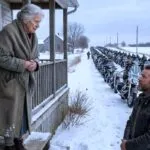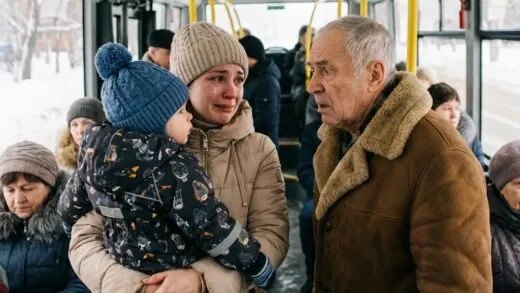

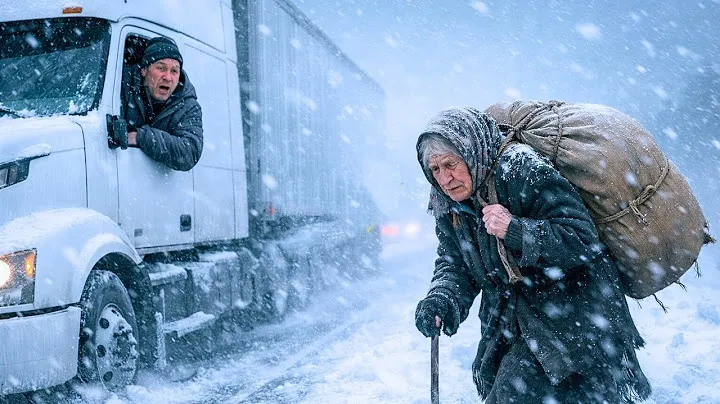
No one in their right mind would have stopped in a blizzard like that, but the headlights caught something impossible: in the middle of a deserted highway, a hunched-over elderly woman was dragging a heavy sled. A burlap sack on the sled clinked with a heavy, metallic sound, like she was hauling old iron chains. When she asked to be dropped off at the old forest cemetery—miles from the nearest house, surrounded only by timber and headstones—the trucker felt a chill run down his spine, but he couldn’t bring himself to say no.
She vanished into the snow as suddenly as she had appeared, leaving nothing behind but a worn, tattered envelope on the passenger seat. “Read this when I’m gone,” she had whispered before stepping out. The man opened the letter, expecting a thank-you note or a request for money, but the very first line made him slam on the brakes and swing his eighteen-wheeler around in the middle of the road.
The wipers groaned like rusty swings on a playground, smearing the wet snow across the windshield. Nick Miller gripped the steering wheel until his knuckles turned white. Forty-five years old, twenty of them behind the wheel, and a winter storm on the interstate still made his stomach churn.
Truth be told, he was already on edge. That morning, his wife, Nancy, had shoved a grocery receipt under his nose, complaining about the price of milk and the fact that his holiday bonus had been cut. Nick had just waved her off and slammed the door because he was on a tight schedule.
The dispatcher had called three times already, barking about deadlines and late fees. Back home, there were car payments, a mortgage, and the constant friction of never having quite enough. It was January 6th, the night before the old-fashioned Orthodox Christmas some folks in his town still kept, but Nick felt nothing but a dull, sticky resentment.
The road was nearly empty—just a white wall of snow, the hum of the engine, and the thud of his own pulse. Nick lit a cigarette, taking a long drag, the smoke mixing with the smell of diesel and old upholstery. Then, his high beams caught a figure on the shoulder: an elderly woman in a dark, threadbare overcoat.
Behind her, like a loyal dog, she pulled a faded red plastic sled. A lumpy sack, tied tight with twine, sat on top. Nick slowed down, squinting. Who in their right mind would be out here on foot with a sled in a Nor’easter?
The woman raised a hand—a slow, almost dignified gesture. “What the hell?” Nick muttered, pulling over. He rolled down the window, and the freezing air hit him like a physical blow, smelling of pine and wet earth.
“You need a lift?” he shouted over the wind. The woman stepped closer. In the glow of the dash lights, he saw a face etched with deep lines but possessing a strange, quiet intelligence. Her eyes were clear and bright, filled with a piercing sadness. She looked eighty, at least.
Her coat was mended in several places, and her headscarf was faded to a dull grey. “Forgive me,” she said, her voice soft but steady. “Could you take me as far as the cemetery?” Her accent was refined, the kind of old-school East Coast lilt you don’t hear much anymore.
“The cemetery?” Nick asked, incredulous. “In this weather?” “Oak Ridge,” she replied, adjusting her scarf. “It’s about twelve miles up, right off the main road.” Nick looked at the sled. The sack looked heavy, the twine biting into the fabric, and something inside clinked—metal on stone.
“Alright, hop in,” he sighed. “But what about the sled? Can I put it in the back?” Nick climbed out and helped hoist the sled into the trailer. The sack was surprisingly heavy—twenty pounds or more—and the woman watched his every move as if he were handling fine china.
“Careful, please,” she whispered. “It’s very important.” Once they were settled in the warm cab, Nick felt the woman’s tension ease slightly. She smelled of mothballs, old books, and a faint bitterness he couldn’t quite place.
“Eleanor Thompson,” she introduced herself, tucking her hands under her wrap. “Nick Miller,” he grunted, pulling back onto the road. They sat in silence for five minutes, the headlights cutting through the white void while the wipers kept up their rhythmic scratching.
“You visiting someone?” Nick finally asked, mostly to be polite. “My daughter,” Eleanor said quietly, staring out the window. “Today is her birthday. I have to make it.” Nick nodded, assuming the daughter lived in a house near the cemetery. Folks in the rural parts of the state often lived close to the old family plots.
“Are we close?” she asked twenty minutes later, her hands folded in her lap. “You are very kind to do this,” she added. Nick shrugged it off. It wasn’t kindness; it was just common decency. You don’t leave an old lady on the shoulder in a blizzard.
“About another ten miles,” he answered. The storm wasn’t letting up, and he noticed Eleanor sitting perfectly still, like a statue. Occasionally her lips moved—maybe a prayer, maybe she was just talking to herself.