
He fell silent, unable to continue. What had he thought back then? What would he do if the boy survived? He hadn’t thought that far ahead. He had simply acted, driven by his medical duty and some irrational paternal instinct that had awakened in him, a lonely and childless widower, at the sight of that helpless, dying creature.
“You could have told us later,” George said in a low voice, not looking up from the papers, “when he got better.”
“I could have,” Peter nodded, “but I couldn’t. He became my son, the sole purpose of my life. I was afraid you would take him away, afraid I couldn’t live without him. That was my weakness, my selfishness.”
He glanced at the door behind which Michael was hiding.
“He knows nothing,” he whispered. “He believes I’m his father and that his mother was an artist who died after childbirth. He doesn’t know he has a brother, that he has a grandfather.”
The words were difficult to get out. Each one felt like a shard of glass in his throat. He was exposing himself, destroying the world he had so carefully built for eighteen years. He knew that after this conversation, nothing would ever be the same. He faced either contempt and revenge or, at best, a cold, condescending forgiveness.
“So what do you propose now?” George asked, closing the file. His voice was level, and that levelness was more terrifying than any shout.
Peter straightened up. He looked the old colonel directly in the eye.
“I will accept any decision you make,” he said firmly. “If you want to report me to the police, I’m ready. If you want to take him…” His voice broke, but he regained control. “I won’t stand in your way. He’s your grandson; he has the right to know his family. The only thing I ask is that you let me be the one to explain everything to him.”
At that moment, the living room door swung open. Michael stood on the threshold. His face was as pale as a sheet, and his storm-gray eyes were filled with tears.
“I heard everything,” he said quietly, his voice cracking. “I’m… I’m not your son?”
Peter’s world collapsed in an instant. The sound of his son’s quiet, broken voice was worse than any verdict. He turned and saw Michael standing in the doorway. Fragile, bewildered, his face frozen with the expression of a wounded, confused child.
All the fears that had tormented the old doctor for eighteen years materialized in that scene. The truth he had been so afraid to reveal had burst out on its own, crude and merciless, leaving him no chance to soften the blow.
“Michael…” he began, taking a step toward his son, but the boy instinctively stepped back, and that gesture wounded Peter to the core.
“Don’t come near me,” Michael whispered. His lips were trembling. “Is… is it all true? What they said? I’m… I’m not your son? And my mom… she wasn’t an artist?”
Every question was a blow. Peter looked at his boy and saw his world shattering, the very foundation of his life, built on a lie, cracking and crumbling.
“Son, I can explain everything.”
He reached out a hand, but Michael just shook his head, and the tears that had been welling in his eyes streamed down his cheeks.
“Don’t call me that!” he cried out, a hysterical note in his voice. “I’m not your son. I’m… Who am I? Whose am I?” He shifted his bewildered gaze to Daniel, then to George.
He looked at these strangers, in one of whom he recognized himself with horror, and couldn’t understand anything.
Daniel, who had been sitting with a stone-faced expression, suddenly stood up. He walked over to Michael and stopped a few feet away.
“I’m your brother,” he said in a low voice. “Your twin brother.”
Michael stared at him as if he were a ghost. He slowly raised a hand and touched his own face, then looked back at Daniel, as if comparing.
“Brother?” he repeated in a whisper. “I have a brother?”
“You did,” Daniel corrected bitterly, shooting a look full of hatred at Peter. “He was stolen from me at birth.”
That cruel phrase finally broke Michael. He covered his face with his hands and began to sob, his body shaking silently.
Peter rushed toward him, but George stopped him with a firm hand on his shoulder.
“Don’t touch him,” he said quietly but firmly. “You’ve done enough.”
The old colonel walked over to Michael and gently put an arm around his shoulders.
“Easy, grandson, easy,” he said, and his stern voice held an unfamiliar, almost tender note. “It’s okay. We found you. Everything’s going to be okay now.”
Michael clung to him like a frightened child and continued to cry. And Peter stood apart—an outsider, an outcast, exiled from the paradise he himself had created. He watched his son in the arms of another man, his real grandfather, and felt the icy ring of loneliness closing around his heart. He had lost him. The moment the truth came out, he had lost his boy forever.
“I want to hear everything,” George said, once Michael had calmed down a little. He sat his grandson down in a chair and turned back to Peter. “And this time, in his presence. He has a right to know.”
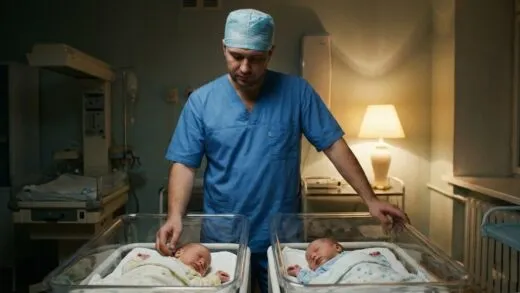
And so Peter began his story again, this time for Michael. He spoke without taking his eyes off his son’s pale, tear-stained face. He told of that terrible night, of the death of nineteen-year-old Anna. He described how tiny and weak Michael had been at birth, how his heart had beaten erratically, how the other doctors had given him no chance.
“I couldn’t let you die,” he said, his voice breaking. “I saw in you… I don’t know what I saw. Maybe a continuation of the life I couldn’t save. Maybe my own chance at redemption.”
He told them about the sleepless nights spent by the incubator, about the first, most difficult surgery, which he had practically begged his friend, a famous cardiac surgeon, to perform. He told them how he had assisted and how his own hands had trembled with fear when the tiny heart stopped on the operating table.
“My hair turned white that day,” he said, running a hand through his completely white hair. “In those few minutes while we were restarting it.”
He spoke of the months spent in hospitals, the strict diets, the constant fear of infection, how he had left his prestigious job at a leading hospital for a position at a simple community clinic to be closer to home, closer to his son….