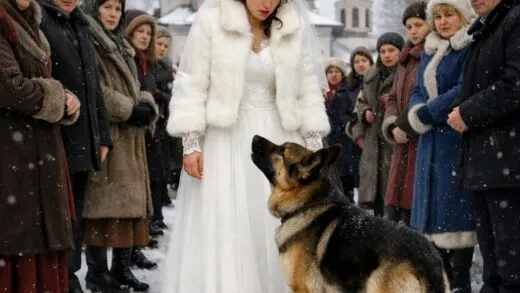
A homeless woman who had stolen my family to ensure a comfortable old age at my expense.
She was standing in the middle of the hall now, wrapped in a fur cape, yelling at the staff, demanding they check the heating. She was trembling. But not just from the cold I had unleashed on the house. She was trembling with fear that her house of cards would collapse. She didn’t know that the foundation had already been blown.
On the screen, I saw Trofim approach her, putting his arms around her shoulders, comforting her. He looked bewildered. He thought it was just a technical glitch. He still believed he was living in his own house with his wealthy mother-in-law, who would soon gift his grandson an apartment in Lipki.
Poor, naive boy. He had no idea he was feeding a person who would drag him to the bottom. I felt something harden inside me. If I had any doubts before this moment—maybe I’m being too cruel? maybe I should have just talked to them?—they had now evaporated. It’s useless to talk to parasites.
They need to be removed. I shifted my gaze to the clock. Time was passing. The “Second Chance” foundation’s bus must have already left the garage. “You wanted to live beautifully, Lukerya?” I whispered to the screen. “You wanted to hide your poverty? Well…
Tonight, your secret will become public knowledge. The irony is that you yourself invited the audience to your own execution.” I closed the laptop lid. It was time to get ready. I couldn’t miss the finale of this play. I had to see their faces when the masks were torn off.
I went to the dressing room. I needed something formal, black. A mourning for their illusions. I stopped the car in the shadow of a tall thuja, about fifty meters from the gates. The engine died down, and I rolled down the window, letting in the frosty air.
From here, my glass cube was in plain sight. And the spectacle, I must admit, was surreal. Due to my lighting settings, the house shone with a deathly pale, surgical light, cutting through the cozy twilight of the neighborhood.
Through the panoramic windows, I could see the guests. They resembled frozen mannequins in the window of an expensive boutique. Women in evening gowns were wrapped in shawls and their companions’ jackets. Men shifted from foot to foot, pretending that plus fifteen degrees indoors was the latest European fashion for freshness.
Lukerya darted among them like a wounded bird. She was wearing a heavy velvet dress the color of overripe cherries and a fur mantle she hadn’t taken off. I saw her forcefully shoving glasses of champagne into the hands of shivering guests, laughing loudly with her head thrown back, and actively chattering about something, trying to distract them from the fact that their breath was visible in the air.
It was a theater of the absurd. A feast during the ice age. Suddenly, the music, which was barely audible from the street, was drowned out by the strained roar of an engine. It wasn’t the soft purr of a Mercedes or a Bentley that the residents of this neighborhood were used to.
It was the cough of an old, tired diesel engine. A bus pulled up to the gates, brakes screeching. It was an old yellow “Bogdan” bus, with rust streaks down its sides. A logo was stenciled on its side: two hands breaking chains, and in large letters, the words—SECOND CHANCE FOUNDATION.
The bus stopped right across the entrance, blocking the polished SUV of some official. The doors hissed open. The music inside the house stopped. The guests, glad for an excuse to leave the “refrigerator,” moved towards the windows and the veranda.
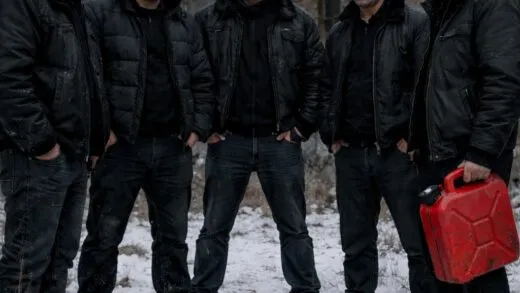
The first to get off the bus was Ignat. He was in his usual leather jacket with a folder under his arm. As calm as a rock. Behind him, their boots thundering on the asphalt, his wards began to disembark. Twelve men. These were not the kind of people one was used to seeing at receptions in this area.
Sturdy men with faces on which life had left deep scars. Shaven-headed, in work overalls stained with lime and paint. On the forearms of many, blue tattoos were visible: rings, domes, gothic script. They unloaded in a businesslike manner, without fuss.
One brought out an aluminum stepladder. Two others carried heavy toolboxes. A fourth, a huge guy with a broken nose, easily slung a sledgehammer over his shoulder. They didn’t look at the stunned guests in tuxedos. They looked at the house. As an object. As a job.
The gate swung open, and Trofim ran out to meet them. He was without a jacket, in just a shirt, and he was shaking from either the cold or terror. “Hey! Who are you?”