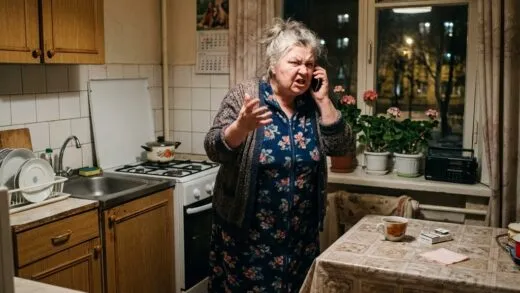
— Let’s see, let’s see, — Larisa Andreevna mumbled, tracing the lines with her finger. — Housing maintenance, heating, cold water, hot water, sewage, garbage disposal, capital repairs… Good Lord, how much they’ve written, the crooks! Total due… — She paused dramatically and then read aloud, with feigned, indignant astonishment: — Five thousand eight hundred forty-three hryvnias and twenty kopecks.
She tore her gaze from the paper and stared at Kira. Righteous anger burned in her colorless eyes.
— What are they charging such money for? — she exclaimed as if Kira herself had printed the bill. — For what? I pay two thousand seven hundred for my three-room apartment. And even that I consider robbery. And here it’s almost six thousand for this kennel, for forty meters? Have they all gone mad over there?
She waved the bill in the air like a prosecutor brandishing irrefutable evidence of the defendant’s guilt.
— That’s almost the entire pension of my neighbor, Baba Nyura! She’s a veteran of labor, by the way. This is how we live. Some are rolling in clover, taking out their mortgages, paying insane money for air, while others count their pennies. There’s no justice in the world. None!
She finished her tirade with bitterness and threw the bill back onto the pile.
And at that moment, something inside Kira snapped. Loudly, distinctly, like flipping a switch. All evening she had felt like a victim, an object of attack, a target. She had been angry, hurt, lost. But now, listening to this passionate monologue about money, about injustice, about someone else’s pension and her own three-room apartment for 2,700, she suddenly stopped feeling. The rage and hurt evaporated, giving way to an icy, crystal-clear understanding. She looked at Larisa Andreevna, at her flushed, indignant face, and saw not a monster, not a tyrant, but a calculating machine. A person for whom the entire world was divided into debit and credit, “entitled to” and “not entitled to,” “expensive” and “cheap.” This woman did not understand the language of feelings, did not appreciate coziness, did not see beauty. Her world was a world of numbers, benefits, subsidies, and market prices for potatoes. She had devalued Kira’s apartment because she didn’t understand its intangible value: the value of freedom, independence, a dream. But she perfectly understood its material component: the mortgage, the monthly payment, the utility costs. This was her language. A language she had just, on her own initiative, proposed they speak.
The key. There it was, the key to solving the problem. It was lying right there, on the surface. Kira had just been handed a weapon and taught how to use it.
She slowly stood up.
— I’ll put the kettle on again, — she said calmly. — Does anyone want more tea?
Her voice was even, without a trace of emotion. Both Roman and Larisa Andreevna looked at her in surprise. They had probably expected tears, excuses, a counter-argument. Instead, they got this—a calm, almost indifferent offer of tea. Without waiting for a response, Kira turned and went to the kitchen. Her steps were firm and measured. She was back in her sanctuary, but this time not to hide, but to sharpen her blade.
She leaned her back against the cool surface of the refrigerator and closed her eyes. The silence of the kitchen after the clamor in the living room was deafening. Her mind was quiet and clear, like a winter morning after a snowfall. There was no more chaos of thoughts, no more lump of resentment choking her. There was only one clear and distinct thought, cold as steel. “Now this living room is mine.” She hadn’t uttered those words yet, but Kira could already hear them. Larisa Andreevna would definitely say them. The entire logic of her behavior led to it. She had already seized the sofa, was already in command of the television, already passing judgment on her curtains and books. The final chord had to be exactly that—a direct proclamation of her rights to the territory. She expected Kira to fight for this territory on her own turf—the field of emotions, scandals, tears. On that field, Kira would have lost. Larisa Andreevna was more experienced, more audacious, more ruthless.
But what if she moved the game to Larisa’s own turf? The turf of numbers, expenses, and square meters?
Kira opened her eyes. Her gaze fell on a magnet on the refrigerator—an ad for some pizza delivery service. She took it off, turned it over in her hands. Then she took a pen from a drawer and turned the cardboard over to the clean side. She began to calculate. Mentally, quickly, as she did every day at work.
The living room. 18 square meters. She remembered that from the apartment floor plan.
The market rate for renting a room in their neighborhood, in a new building. Kira knew it precisely. Just a year and a half ago, she had rented one herself. It was about 25,000 hryvnias a month. Maybe a little more, but 25,000 was a solid, indisputable figure. So, 25,000.
Next. Utility payments. Larisa Andreevna herself had drawn attention to them. The total was almost 6,000 for 42 square meters. Kira quickly calculated the cost per meter in her head. 6,000 divided by 42 is about 140 hryvnias per meter. Now multiply that by the 18 square meters of the living room. That comes out to about two and a half thousand.
Total: 25,000 for rent plus two and a half thousand for utilities. 27,500 hryvnias a month.
Kira looked at the numbers she had scribbled on the cardboard. They looked convincing. These were not emotions. This was a calculation. A business plan. Larisa Andreevna would understand this language. Oh, she would understand it better than anyone. For her, who counted every kopeck of her subsidized rent, for her, who was outraged by six thousand, this sum—27,500—would sound like a clap of thunder.
There was no malice in Kira’s chest, no vengeful triumph. There was only the cold, calm satisfaction of a surgeon who has found the precise place for an incision. She wasn’t going to scream, she wasn’t going to cry or prove anything. She would simply present the bill. Politely, with a smile…