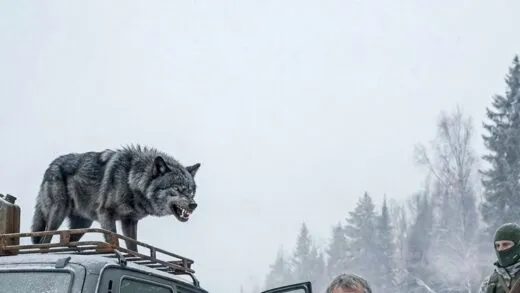
She pulled her knees to her chest and covered her head with both hands, trying to make herself disappear. Her shoulders shook. Mike froze where he stood and made no sudden move.
She stared at him from the corner, and in her wide eyes was the kind of concentrated terror seen only in people who have been hurt for a long time. She opened her mouth. Her lips trembled.
Her voice came out raw and hoarse. “Please… not solitary,” she whispered, shrinking farther into the wall. “Please. I can’t do the ice water again.”
Mike swallowed hard and said nothing.
“I’ll work,” she said, her voice breaking into desperate tears. She wasn’t really looking at him—she was looking through him. “I’ll do double shifts. Just don’t hit me. Please. I’ll do whatever you say.”
Then she covered her face again, bracing for a blow she was certain was coming. Mike felt something heavy rise in his throat.
He had seen plenty. Death. Cruel weather. Poachers willing to do anything for a hide. But the fear in this young woman’s eyes hit him harder than any knife. He didn’t go toward her. Didn’t reach for her.
Very slowly, so he wouldn’t scare her more, Mike lowered himself onto one knee. He raised both hands and showed her his open palms. Empty.
“Easy,” he said. His voice had changed. It was no longer the blunt, commanding tone he used with most people. It was low, calm, almost gentle. The kind of voice you used with a spooked horse near a cliff.
“Rest.” She flinched at the sound, then lowered her hands just enough to see his empty palms. “You’re deep in the woods.”
He spoke slowly, clearly. “Nearest town is a long way off. There’s no lockup here. No guards. No dogs.”
She listened without breathing, as if afraid to believe him.
“My name’s Mike. I’m the warden out here.” He looked straight at her, steady and direct. “And as long as I’m alive, nobody’s laying a hand on you. Not here.”
A long silence settled over the cabin. All that could be heard was the crack of wood in the stove and the wind against the window.
Slowly, the woman lowered her hands to her knees. Her shoulders, which had been pulled tight up around her ears, dropped all at once. She looked at the open hands of this big stranger, at his calm face in the firelight.
In her exhausted, battered mind, his words began to break through the fear. Her face twisted. Her lower lip trembled.
She didn’t sob loudly. Didn’t throw herself at him. She just leaned her head back against the log wall and closed her eyes. And down her dirty, hollow cheeks rolled the first heavy tears.
They were the tears of someone who, for the first time in months, believed she would not be hit. Mike stood up slowly. He picked up the bearskin from the floor, stepped to the bunk, and without another word, covered the crying woman up to her chin.
Outside, the storm raged and buried every track in the snow. But inside that little cabin at the edge of nowhere, it was warm for the first time in a long while.
February brought long, grinding blizzards. The wind moaned in the stovepipe for days at a time, hurling hard snow against the little window. But inside the cabin it stayed warm. Two months had passed since Mike carried the half-dead woman out of the woods.
Anna was back on her feet. Her soles still ached by evening, and the skin remained thin and tender, but she could move around the room with confidence now and had taken over the simple household work. That evening they sat by the hot stove.
Potatoes baked in a cast-iron pot on the stovetop, filling the cabin with the rich smell of food and black currant tea. Mike sat on a stool with a leather harness between his knees, punching holes with an awl and pulling heavy thread through the hide.
Anna sat across from him on the edge of the bunk. In her hands was one of Mike’s old flannel shirts. She was sewing a neat patch over a worn elbow.
The cabin was quiet. Not awkward quiet—good quiet. The kind where two people don’t need to fill the air with talk. But tonight Anna kept stopping.
The needle would hang in the air just above the cloth. She stared at the fire behind the stove door, lips pressed tight. At last she laid the shirt in her lap.
“You never asked,” she said quietly, though her voice carried clearly over the wind.
Mike didn’t look up right away. He finished a stitch, pulled the thread tight, and only then glanced at her from under his heavy brows.
“Asked what?”
“Who I am. How I ended up in prison. Why I was wearing that number.”