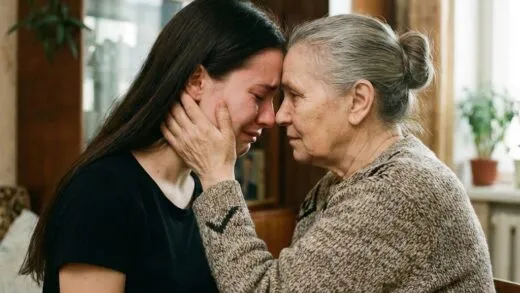

“I don’t know,” the woman answered quietly. “But I think we’re about to find out.”
She suddenly turned and started walking quickly back the way they came, toward another police car that was just pulling over to the shoulder.
“Wait!” Susan ran after her. “Where are you going?”
The woman didn’t answer. She walked up to the police car and tapped on the window. The glass rolled down, and Susan saw a young officer with a tired face.
“What’s the problem, ma’am?” he asked.
“Officer,” the woman’s voice was steady and calm. “There’s a regional shuttle bus up ahead. You have to stop it. Immediately!”
“There’s a man on board. He did something to the brakes. I saw him with my own eyes, messing around under the bus before we left the station. His hands were covered in grease.”
The officer frowned.
“Are you sure?”
“I’m as sure as I am that I’m standing here right now. You have to stop that bus before it’s too late. There’s a steep downhill coming up. If the brakes fail…”
She didn’t have to finish. The officer was already grabbing his radio, speaking quickly, rattling off numbers and locations.
Susan stood beside them, feeling her world crumble. Everything she had believed in for the last twenty years, everything she had thought was her life—it was all a lie. A monstrous, terrifying lie.
The bag in her hand suddenly felt impossibly heavy. She dropped it on the ground and unzipped it automatically. Inside were the usual things: her wallet, the cabin keys, a water bottle, a bag of sandwiches. And something else, wrapped in a rag, at the very bottom. Susan pulled out the bundle with trembling hands. She unwrapped it. And she felt everything inside her break.
On the rag lay a tool—some kind of specialty wrench she’d never seen before. And a pair of gloves. Work gloves, stained with something dark and oily.
“He…” she couldn’t form the words. “He packed this. He did.”
The woman in the scarf came over and gently took the bundle from her hands.
“Officer,” she called out, “you’d better take a look at this. I think you’ll find it useful.”
The policeman got out of his car and walked over. He was young, maybe thirty, with sharp gray eyes and a crew cut. The name tag on his jacket read “Sgt. Miller,” Susan read absently, though the letters were blurring through her tears.
“What have we got here?” He looked from the bundle in the woman’s hands to Susan. “Is this your bag?”
Susan nodded. She couldn’t speak—it felt like an invisible hand was squeezing her throat.
“I found this at the bottom,” the woman said, handing him the rag with the tool and gloves. “She didn’t know it was in there. Her husband packed the bag this morning.”
The officer’s brow furrowed as he examined the items. Then he gave Susan a long, searching look.
“Her husband? The one who stayed on the bus?”
Susan nodded again. Tears were streaming down her face, but she didn’t notice. The radio on the officer’s shoulder crackled to life, and a voice cut through the static:
“Dispatch to Unit Three, come in! Bus has been stopped at mile marker 42. All secure, passengers are safe. Awaiting instructions.”
Miller raised the radio to his lips. “Received. Don’t let anyone off. Pay close attention to a male passenger in the rear of the vehicle. I’m on my way.” He turned to the women. “Get in the car. Both of you.”
Susan wanted to protest—she wasn’t a criminal, she was the victim, she hadn’t done anything! But her legs carried her to the car on their own. The woman in the scarf sat beside her, and her dry, warm hand found Susan’s and gave it a squeeze. For some reason, that simple gesture helped. Susan felt the iron band around her chest loosen its grip. She wasn’t alone. Someone was with her, someone understood, someone believed her.
The car sped off, and within minutes they were at mile marker 42. The bus was pulled over on the shoulder, just before the start of the steep descent. Susan knew this spot: from here, the road dropped sharply, winding between hills. The guardrails were flimsy, and in the ravine below, you could see the rusted remains of more than one car that hadn’t made the turn.
Several police cars were already surrounding the bus. The passengers were clustered in a group on the shoulder—confused, frightened, with no idea what was happening. A young mother clutched her child, who was crying. An elderly man with a cane sat on a rock, breathing heavily. The two men in work jackets were smoking off to the side, talking in low voices. Mark was not among them.
Susan got out of the car on unsteady legs. She scanned the crowd for him, afraid of what she would see. What would she say to him? What would he say to her? How could they ever look at each other again?
“Susan Miller?” Another officer, older, with a captain’s bars on his collar, approached her.
She nodded.
“Please come with me. We need to ask you a few questions.”
They led her to one of the cars and had her sit in the back. Someone brought her a plastic cup of water; she drank it without tasting it. The questions came one after another: when did you and your husband buy the cabin, whose name is on the deed, what was your relationship like, had you noticed any strange behavior from him? Susan answered like a robot; her voice sounded like it was coming from far away, like it belonged to someone else.
And then she saw Mark. Two officers were escorting him to a police car, holding his arms firmly. He wasn’t in handcuffs, but he looked like a prisoner all the same: slumped, pale, with a dead look in his eyes. He wasn’t resisting or shouting or trying to explain himself. He just walked, staring at the ground.
When his eyes met hers, Susan saw something she didn’t expect. Not anger, not fear, not remorse. Emptiness. A complete, dead emptiness, as if something inside him had been burned to ash.
“Sue,” he said, his voice hoarse and unfamiliar. “I…”