At the wheel was a gray-haired volunteer named Nick Bennett, a man who regularly risked his life bringing supplies to the line. He gave Mike a friendly nod and motioned toward the open seat in back, half-covered with flattened cardboard boxes.
The heavy door slammed shut with a solid thud, cutting Mike off from the world of frozen trenches and constant danger. The engine growled, and the armored vehicle lurched forward, crawling through shell craters and rutted roads. Mike rested his forehead against the cold window and watched the wrecked houses of an abandoned frontline village slide past.
As they drove, a plan took shape in his tired mind—a simple, good one. He decided not to tell Mary he was coming. He wanted to see her face when he walked in. He pictured himself opening the door with his old key and stepping inside during Easter dinner, catching both his girls completely off guard.
That thought warmed him more than the truck’s heater ever could. He carefully pulled from his inside pocket a worn photograph of Mary and Annie, the one he always kept close to his heart. Their faces looked back at him from the glossy paper, the two people he was trying to protect every day he stayed alive.
The drive to the nearest relatively safe city took hours over broken roads and cratered pavement. More than once they had to pull off and kill the engine when enemy drones appeared overhead. Every stop brought that familiar cold knot of fear. Even on the road home, a man could still get killed for no good reason.
By late evening, the landscape outside began to change. There were fewer shelled-out buildings, and regular civilian cars started appearing on the road instead of military vehicles. At the first major rear-area checkpoint, Nick calmly showed his papers to the armed officers on duty, who gave Mike a respectful nod when they saw his uniform.
Just past the checkpoint, the wail of an air-raid siren rolled over the dark fields. It had become part of daily life now, a reminder that nowhere in the country was ever fully safe. Nick only tightened his grip on the wheel and pressed harder on the gas, determined to get his passenger to the train station.
Mike watched the setting spring sun stain the horizon a deep red that reminded him too much of blood. He knew he still had a long overnight train ride ahead of him, crossing half the country to get home. But now no distance and no danger felt big enough to stop him.
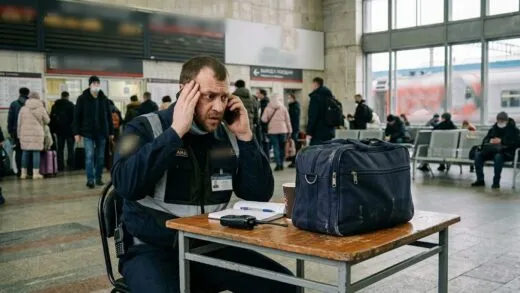
The train station hit him with noise and motion, almost jarring after months near the front. Civilians hurried along the bright platform with heavy suitcases, trying to make departures before curfew. Mike shook Nick’s hand hard and thanked the older volunteer for the ride and for all the lives he’d helped save.
With his overstuffed pack slung over one shoulder, Mike headed for the ticket windows, hoping to get on the next night train. His field uniform, still stained with dried mud and smoke, made people step aside without a word. At the counter, an older woman in a knit scarf quietly waved him ahead, blinking back tears.
The tired young clerk behind the glass checked his military ID and found him a lower bunk in a sleeper car. With a little over an hour until departure, Mike bought a hot coffee from a tiny station kiosk. The simple drink tasted better than anything he could remember, as if it were putting strength back into him one sip at a time.
When the loudspeaker announced boarding, his heart picked up. He swung the heavy pack onto his shoulder and walked toward his car with steady purpose. Tomorrow would be Easter Sunday, and he was sure it would be the happiest day of his life.
The overnight train rocked gently on old rails, carrying him farther and farther from shellfire and stray rounds. Mike lay on the narrow bunk under a scratchy gray blanket and breathed in the almost-forgotten smells of civilian travel. The rhythm of the wheels sounded strangely soothing, pushing the sharp edges of yesterday’s battle farther back in his mind.
He stared a long time into the dark window, where now and then he caught the dim lights of distant villages and the silhouettes of damaged power stations…