
She thought she would sign a few papers and be done with it. But the small island on the cold lake that came to her as an inheritance from Mike’s grandfather held more than an old cabin and rotten boards. When former Army medic Eleanor Carter arrived there with her young son, she found a bundle of yellowed letters.
Inside those letters was the reason Arthur Kline refused to sell the island, even after he had nothing left. A reason he took to the grave. What Eleanor and her son discovered on that forgotten island would change their lives.
Morning in town was cold and gray. Low clouds hung over the industrial outskirts, and the last of the winter snow had turned the streets into a maze of slushy puddles. Eleanor Carter sat by her fourth-floor window in a small apartment and held a mug of lukewarm tea. Her hands were broad and weathered, the sort you get from hauling supplies and carrying stretchers — a reminder of a life she mostly kept to herself.
She was thirty-five. Tall, with a straight back and broad shoulders, the kind you expect from someone used to heavy gear. Her dark hair was usually in a simple ponytail, and her face looked calm, if tired. A pale thin scar ran along her left temple — a fragment from years ago when she was a medic overseas. The war had taught her a lot, especially how to stay quiet.
These days she worked as a nurse at the community clinic. It was steady and routine — exactly what she wanted after everything she’d seen. But the quiet in her apartment felt different: too deep. A photo hung in a plain wooden frame over the couch. It was of her husband, Mike Carter — a big man with a thick beard and calm eyes. In the picture he was holding their son.
Three years had passed since a knock on the door changed everything. Sometimes Eleanor felt Mike’s presence in small things: his coffee mug in the sink, an old pocketknife in the desk drawer, a silence that used to be his.
From the next room came the clatter of blocks.
“Mom, look!”
Sam poked his head in. He was ten, thin and energetic, with messy blond hair and serious gray-green eyes — Mike’s eyes. Sam was quiet, but moved with purpose. He held a wooden block boat he’d built.
“That’s a ship!” he announced.
“Looks like a fort,” Eleanor said.
“It’s a ship-fort,” he corrected, deadpan.
She nodded. Sam was her anchor. For him she got up every morning, taught herself how to start over.
On the kitchen table lay a stack of mail: ads, bills, the usual. Eleanor was about to push it aside when a cream-colored envelope caught her eye. Her name was written in tidy black ink: “Eleanor Carter.”
It smelled of old paper and dust. Inside was a formal letter. Eleanor read the first line and stopped. It was from a notary. The letter said she was the heir to property owned by the late Arthur Kline.
The name nudged something in the back of her mind. “Kline.”
“Mike’s grandfather,” she said softly.
Sam looked up:
“Whose grandpa?”
“Your dad’s.”
The document said a small island and the cabin on it would pass to her. Eleanor almost smiled. “An island,” she thought — it sounded absurd. Had Mike ever talked about his grandfather? Once, late at night, he’d called the old man “stubborn” and changed the subject. Eleanor recalled that and felt how certain topics carry weight for people.
“Mom,” Sam asked, cautious. “What does it say?”
“Looks like we got an island.”
Sam’s eyes widened.
“A real island?”
“Sounds like it.”
He leaped up.
“Are there bears?”
“I hope not.”
“Is there a house?”
“Probably.”
“Is there a boat?”
She laughed for the first time in a while.
“I don’t know.”
She called the notary that day. A man answered with a steady voice and introduced himself as Nicholas Roper. He was businesslike, the kind who speaks slowly because he deals with other people’s lives every day. He confirmed the paperwork: Arthur Kline’s estate had no immediate heirs until archives linked their family to Eleanor.
“There’s one formality,” he said. “You need to inspect the property yourself.”
“Why?”
“We can’t transfer ownership without a visit.”
“So we have to go?”
“Yes.”
Eleanor looked at Sam. He sat very still, absorbing the call.
“Okay,” she said. “We’ll come.”
Three days later they left. The old car rolled north. Towns gave way to pines, then to small villages with sagging porches and mailboxes that leaned. It felt like driving back through time.
They stopped at a roadside diner that smelled of coffee and pine sap. The owner, Ed Danley, was a thin man with a long gray beard and bright eyes. He moved slow but looked alive.
“Coffee?” he offered.
“Yes, please.”
When Eleanor mentioned the Kline island, Ed lit up.
“Kline? Arthur Kline?”
“That’s the one.”
Ed smiled.
“Stubborn old coot,” he said. “Made the best boats on the lake.”
Sam leaned forward.
“You knew him?”
“A little. After his wife died he didn’t leave much.”
“Why didn’t he sell the place?”
Ed looked out at the darkening trees.
“Some things you just don’t sell.”
Before they left Ed dug in a drawer and handed Eleanor a small, tarnished bronze key.
“He left this here years back. Said someone would come for it someday.”
Eleanor turned the key in her hand. It felt heavy and oddly cool. When they walked out, the air was already close to night. Sam walked beside her.
“Mom,” he said.
“Yeah?”
“What do you think is on the island?”
Eleanor looked down the road and felt a pull she couldn’t name — not foreboding, just the sense that a door had been opened. But what Arthur Kline had left behind, and why he expected someone to return for that key, remained a mystery.
The lake met them with a cold wind and a steel-gray sky. By morning they reached a small wooden dock that seemed to grow right out of the rocky shore. The water lay flat and dark. The air smelled like damp wood and distant snow.
Sam ran to the edge and pointed.
“There it is!”
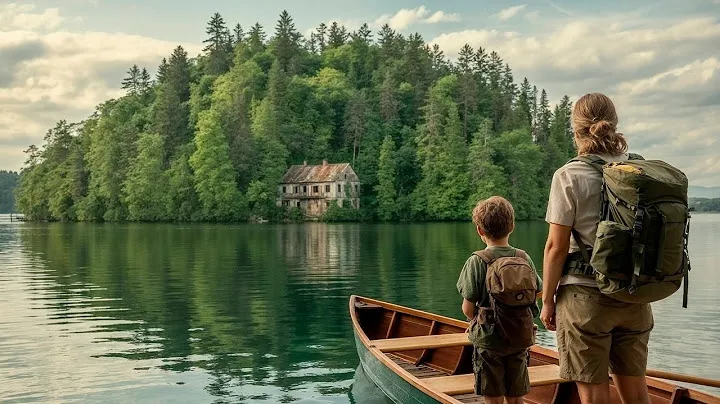
The island was bigger than Eleanor had pictured: a low hill of pines and birches with the ridge of an old roof peeking above the treetops. A weathered wooden skiff was tied to the dock. Its bow still showed a carved letter “K.” Eleanor fitted the bronze key into a small padlock on the skiff’s chain. The lock turned easily.
“He really did expect us,” Sam said, eyes bright.
Eleanor didn’t answer. She untied the boat.
The ride over was quiet. Oars sliced the water. The lake’s silence felt deep and old. Birds called once in a while; their cries sounded louder against the hush. The island drew near. Sam couldn’t sit still.
“Are there paths?”
“Maybe.”
“What if there are bears?”
“Then you’ll be the first to spot one.”
He grinned. When the skiff bumped the rocky shore, water lapped at their shoes. Moss grew thick between boulders; birches leaned toward the lake as if listening. Sam was the first to step out.
“We’re home!” he declared.
The word landed strange and right. A cabin stood near the center of the island: old but upright, its roof sagging a little and steps overgrown. The door was unlocked. Inside was dark and cool but intact. A table stood neat in the middle of the main room, a woodstove in the corner. Pots hung on hooks, tools on a shelf — someone had lived here carefully.
Sam wandered off. “There’s a ladder!” he called from a corner.
Eleanor climbed the narrow ladder to the loft. Dust and the smell of old wood met her. Light came through a small window. Nets, chests, fishing gear and a few boxes filled the space. Sam was already rummaging through one.
“Look!” he said, holding up a photo.
It was a man with a thick dark beard and stern eyes — Arthur Kline. Beside him stood a little boy of six who could have been Mike. Eleanor felt her chest tighten. The boy in the picture looked so much like Mike it hurt.
She ran a finger over the photo.
“So he did come here,” she said softly.
Sam peered at the picture.
“Is that Dad’s grandpa?”
“Yes.”
The loft felt arranged, as if someone could return any day. Afternoon sunlight moved through the trees while Sam explored old trails and found mushrooms. He was happy in a way Eleanor hadn’t seen in a long time. She sat on the cabin steps and listened: wind in the pines, a fish slap on the water, a far gull — a different kind of quiet.
That night they built a small fire. The sky went black and the cabin creaked. Eleanor fell into sleep thinking of Mike, wondering why he never talked about this place and what kept his grandfather here alone.
She woke early to fog that lay low over the lake. Sam was up, tossing stones into the water. “Can we stay a few days?” he asked.
She looked at the cabin and the trees and felt a hesitation melt. “A few days,” she said.
There was a sense, now, that the island had been waiting for them. But what else had Arthur left behind? What else had he been protecting?
The next morning the air was cool and damp. Eleanor found an old chest in a corner she’d missed. It was a heavy oak trunk with metal corners. Inside were folded clothes, a small knife with a wooden handle — and a bundle of papers tied with a faded blue ribbon.
She untied the ribbon. The letters inside were addressed to Mike. Her heart caught. She opened the first one. The handwriting was large and steady but the ink had bled a little from moisture.
“Mike, the wind broke one of the pilings at the dock again today. I fixed the roof, but the boards go quicker than I do.”
Arthur’s early letters read like practical notes about winters, ice that cracked at night, boat repairs and the weather. There was loneliness between the lines.
“The fox came by again,” one letter said. “Guess we got used to each other.”
Eleanor read them like listening to a voice she had never heard. Sam came to sit beside her.
“What are you reading?” he asked.
“Letters. From your grandfather’s grandfather.”
Another letter came later; the handwriting showed fatigue. “Mike, I don’t know if you get these, but I’ll keep writing. Sometimes you have to tell things to paper.” Eleanor felt a weight settle in her chest. The letters became personal. Arthur mentioned his wife — Maria. “After Maria died, the island changed. The quiet got heavier.”
She pictured Maria: a practical northern woman, hands used to cold water and quiet work. Losing someone like that would change a place.
Arthur had written, “I thought about leaving, but every time I did, I realized I’d be taking from the last place our family still existed.” Eleanor read that line again and understood why Mike never brought the subject up. It wasn’t anger he kept hidden; it was something unfinished.
Sam asked softly, “Was he a bad man?”
“No,” Eleanor said. “Just alone.”
There were more papers. Underneath the letters was a rolled set of plans. Large sheets with measured lines. Not for this little cabin, but for something sturdier — a house drawn to withstand long winters and strong winds. At the bottom, a note: “A house that will stand up to solitude.”
Sam studied the drawing like it was a treasure map.
“He wanted to build a new house?”
“Looks that way.”
Each beam, each angle had a purpose. Arthur knew building. On the back of one sheet someone had written, “If you ever come back, finish it.”
The phrasing struck Eleanor hard. It felt like a message to Mike — and to her. She picked up Sam’s small hand. “We could build it,” he said plainly.
She smiled at him. “We?”
“Yeah. He wanted someone to finish it.”
She looked at Sam’s thin fingers, the small calluses from years of kid work. The war had taught her to break big tasks into small steps.
“All right,” she said finally.
Sam’s face lit up.
“Really?”
“We’ll try.”
“We’ll need to clear the site first.”
They picked a spot near the shore with a few young pines. Eleanor found an old axe in the shed. It was heavy and balanced, the kind of tool that belonged to someone who did things right. The first tree came down with a thud. Her shoulders remembered old strength.
The first days were hard. They hauled logs, cleared brush, moved rocks. The work left a satisfying kind of exhaustion, real and honest. Evenings were for the fire and for Sam’s small carved boats. He had found a short knife and made a little fleet.
“This will be the navy,” he said seriously, placing three boats in a line.
“A very small navy,” Eleanor agreed.
Slowly the foundation went in. Eleanor studied Arthur’s plans carefully. The house needed a deep base and crossed beams to stop the wind from twisting it. She felt like she was listening to a craftsman who’d planned carefully for bitter winters.
“Here he wanted to reinforce the corner,” she told Sam.
“So the door goes here?” he asked.
“Seems like it.”
When the first beams were in place Eleanor felt something shift. Not the house so much as her life. She smiled more than she had in years.
“You laughed today,” Sam said one evening. “You haven’t done that in a long time.”
She thought about the years after Mike, when she learned to keep herself small. Up here, moving wood and setting beams, something thawed.
They made steady progress. Walls went up, and at last a roof was put on. Wind still moaned through the pines at night, but the structure stood firm.
One evening, as stars came out and the lake mirrored them, Eleanor said to Sam, “Your great-grandfather was stubborn.”
“Like you?” Sam asked.
“Maybe.”
Storms came as they always do on the lake — fast and uncompromising. Eleanor woke to the sound of wind: a low, menacing roar. She had heard that sound overseas; it meant power coming down fast. The unfinished house stood near the old cabin, its roof still waiting for shingles. They threw on jackets and went outside.
Rain hit like cold nails. The frame creaked and groaned. A birch on the edge of the clearing began to bend. “Back!” Eleanor yelled.
The tree crashed into the half-finished roof with a thunderous crack. Beams splintered. A wall leaned. Eleanor felt the weight of a week’s work collapse in a single instant.
“We should leave,” she said at first, voice flat. “Go back to the city. I don’t want to lose everything.”
Sam stood in the rain, soaked and steady.
“Remember the letter?” he asked. “It said a house gets built not when it’s easy.”
She looked at him. Children often see what adults avoid. The war had taught her how quickly plans can vanish. The thought to retreat rose up, but she steadied herself.
“Then we finish it,” she decided. “First we clear the birch.”
They worked through the storm. Eleanor cut, Sam hauled. The wind tried to knock them back, but slowly they cleared the wreckage. Some beams were ruined; the foundation remained. By dawn the worst had passed. The island looked battered, but the rising frame still stood — crooked, but alive.
Sam sat on a log and exhaled. “We did it.”
Eleanor wiped water from her face and felt something like quiet pride. It wasn’t that the house was perfect. It was that they had stayed. Victory, she realized, sometimes means simply not giving up.
The next morning the sky was clear and the house looked like it belonged there. They fixed the broken parts and kept going. The work became a ritual: morning chores, afternoon carpentry, evenings by the stove. The structure rose into something modest and sturdy.
One calm morning they were interrupted by the sound of a motor. A white cabin cruiser cut across the lake and pulled up at the rocks. A man in a dark jacket stepped out — confident, neat, the kind who spoke in deals.
“Good morning,” he said, approaching. “You Eleanor Carter?”
She nodded. “Yes.”
“I’m Len Baxter with North Shore Development.”
He scanned the property like he was appraising it.
“Looks like you’ve decided to stay.”
“For now,” Eleanor said.
He opened a leather folder. “I’ll be direct. Our company is building a resort a few miles down the lake. We’re interested in buying this island. We can offer you a serious sum — enough to buy a house anywhere and set Sam up.”
Sam gripped his carved boat. Eleanor thought of bills and steady pay and the small, safe life she could have. Len’s voice was persuasive, smooth. For a moment the old pull of convenience tugged at her.
“No,” she said simply.
He blinked. “You don’t understand the scale of this offer.”
“I do,” she replied. “We’re not selling.”
Len put his papers away, practiced patience. “Money changes things.”
“I know,” Eleanor said, looking at the lake and the cabin and her son. “Some things you can’t buy.”
He closed his folder. “If you change your mind, here’s my card.”
He left as swiftly as he had come. When the motor faded the island fell back into its quiet.
Sam tugged at her sleeve. “We’re not selling?”
“Nope.”
He beamed. “Good.”
Autumn arrived softly. Birch leaves turned gold and the air sharpened. The house was finished — a single room, a woodstove, a window that looked out over the water. It fit the land like it had always been there. Above the door, Sam carved their initials into a beam: “E + S.”
“What should we call it?” he asked.
“Northern Hearth,” Eleanor said without thinking. The name felt right.
That evening they lit the stove for the first time. The glow filled the room and the place began to feel like a home. Eleanor sat with an old notebook she’d found in the trunk — Arthur’s notes on weather and fish. At the bottom of the chest she found a small sealed envelope labeled: “For the one who stays.”
Her hands went slightly numb as she broke the seal. Arthur’s handwriting was weak now.
“If you’re reading this, someone stayed. I figured someone might. I realized an island isn’t just land. It’s memory. If you stayed, you understand.”
Eleanor folded the letter and handed it to Sam.
“It says the island has found a new keeper.”
“Us?” he asked.
“Looks like it.”
Sam moved to the door and looked at the lake. “Then we have to take care of it.”
She felt a calm settle in her chest and knew what to do next. She wrote a short note of her own, describing the house, the work, the wind and the boy. She sealed it in a glass jar and tucked it into a gap behind a board near the stove.
“For whoever comes after us,” Sam said.
“So the island remembers,” she replied.
They sat on the porch while the sun set and the lake turned gold. Eleanor thought about how strange life can be: she had come to sign papers and close a chapter, but the island gave her a beginning. Sometimes what people call miracles are quiet things — a warm fire, a child’s laugh, a stubborn old plan that finally gets finished. A house, she realized, is more than timber and nails. It’s a place where memory turns back into hope.