
Agrippina would lie down on the bed, stretch out flat, and stay still for ten minutes until it eased. Then she’d get up. Check whether the stove pipe was closed, and go to sleep.
In the morning she got up at four, and it all started again. That evening, August twenty-third, she finished later than usual. She milked Zorka, shut in the chickens, gave the goats hay. Put yesterday’s cabbage soup on to warm—she always kept a big pot on the stove.
She made a cast-iron potful to last three days. She wiped her hands on her apron. Went out onto the porch just to sit for five minutes. The sun was setting behind the far woods.
Out west, beyond the fields and tree line, the big mixed forest began. Birch, oak, aspen, six miles deep. The sky turned orange, then dark red, then copper. Beautiful in the way only August can be, when the heat starts to let go toward evening and the air softens a little.
Crickets rasped in the grass without stopping. The village was quiet—thirty households, and by that hour everybody was indoors. Agrippina sat on the porch step thinking about firewood.
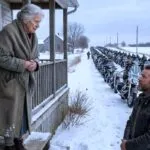
She was estimating how much she could split herself before October if she started the next day. She was doing the math in her head when she heard footsteps outside the gate. Not one person. Several.
Three, she knew right away. That’s how several people sound on a dusty village road in the evening quiet. They walked steadily, not hurrying, not stumbling. Tired, but not aimless. Agrippina stood and went to the gate.
On the way she picked up the handle of a shovel leaning against the shed wall. It always stood there, just in case. Not because she was frightened. Just because a woman alone in a darkening yard follows certain rules, same as locking the door at night.
Three men stood outside the gate. Later, when it was all long over and life had become something else, Agrippina wrote in her notebook that the first thing she felt when she saw them was not fear. It was surprise. Because they didn’t look dangerous.
They looked tired past the point where fear had much energy left in it. In themselves or in anybody looking at them. The three of them stood at the gate and didn’t push, didn’t shout, didn’t demand. They just stood there the way people stand when they’re used to waiting and have nowhere left to hurry to.
The oldest, tall and lean, around forty-five, said evenly and quietly, “Ma’am, would you let us stay the night? We’re not drunk, not looking for trouble. We just don’t have anywhere else to go.” His voice was clear, not rough, with careful diction.
The voice of a man who knew how to speak and thought before he opened his mouth. He wore a jacket clearly borrowed from somebody else. Broad in the shoulders, short in the sleeves, worn but buttoned neatly all the way up. Under it, a shirt and slacks that had once had a crease.
His shoes were worn out but polished. Agrippina noticed that right away. Polished shoes meant the man hadn’t let himself go all the way. He wore wire-rim glasses, one lens cracked diagonally but still in place.
Straight nose, slight bump in it, high cheekbones. His hands hung loose at his sides. He didn’t hide them, didn’t clench them, didn’t fuss with them. His eyes met hers directly, without darting away and without that pleading look people get when they’re used to begging.
He wasn’t begging. He was offering a bargain: a night’s shelter in exchange for the fact that they were decent men. This was Semyon Arkadyevich, forty-seven. Former mechanical engineer from an agricultural machinery plant in Kharkiv. He had served seven years on a political charge.
Later Agrippina would learn the details, but for now she looked at him through the crack in the gate and read what she knew how to read in people. The second man stood a little behind and to the left. That way of standing, partly behind another man, didn’t suggest cowardice. It suggested the habit of not stepping first into places where you hadn’t been invited.
He was short, broad-shouldered, with a face life had marked so heavily it was hard to tell his age. Thirty-five maybe, maybe forty. His nose had been broken and healed crooked. That break, and the way he held his shoulders, suggested a man who had taken plenty of blows and learned how to stay on his feet.
On his right hand he was missing two fingers, the index and middle, old healed stumps. He wasn’t looking at Agrippina but off to the side, as if it embarrassed him to stand there waiting on somebody else’s decision. Like a man used to deciding for himself, not waiting. This was Grisha, Grigory Nilovich, thirty-eight.
He had three convictions, twelve years in labor camps altogether out of thirty-eight years lived. The first time he stole, he was seven years old and took a loaf of bread from a market stall during the famine of 1933. Then again, and again. Not because he was born bad, but because nobody taught him anything else, and he never found another way on his own.
The third stood a little apart from the other two. Not behind them and not beside them, but off to one side, like a man used to taking up his own space and not somebody else’s. Tall, wiry, about thirty-five, though he looked older. Gray had come early to his temples, and his face looked as if something in it had gone still a long time ago and never started moving again.
Not stony. Just paused. He looked at the ground, not from fear and not from embarrassment. More like a man for whom looking at the ground had become a habit over a long stretch of time, when raising his eyes had no point or carried risk. This was Tikhon, Tikhon Ivanovich Malyshev, thirty-five, a former sergeant.
He had fought from June of ’41 near Kyiv that first winter, then near Odessa, then near Kharkiv. He had seen the kind of things that either break a man or harden him. Tikhon, by the look of him, had hardened. In 1944 he deserted.
Not out of cowardice—there was a reason, and a serious one, but that comes later. He got ten years. He was released early in ’53 with credit for work days, the way many men were that year. Agrippina looked at all three of them through the crack between the boards of the gate.
She looked a long time, thirty seconds maybe, forty. By village standards that’s an eternity when you’re standing at somebody’s gate in the dark and waiting for an answer. They didn’t hurry her, didn’t start talking again, didn’t shift nervously or glance around. They just stood and waited…