
The Amnesty Year and Roads That Led Nowhere
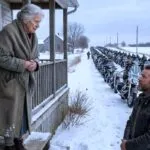
In 1954, more than a million people were moving along the roads of Ukraine. A million. That’s not a figure of speech, and it’s not exaggeration for effect. That’s how many people were released under the 1953 amnesty. With cheap suitcases, release papers, and not a dollar to their name, they walked, hitchhiked, and rode whatever they could find.

They slept in haystacks and train stations, in freight cars and out on the ground under the open sky. Think about that for a second: a million people. Not an army. Not an evacuation. Just people the state let out of a cage and told, “Go on, then.”
Go where? No one said. Live on what? No one explained. How were they supposed to start over? No one showed them.
Just go. Cities wouldn’t take them. Without residency papers, they couldn’t get work, and without work, they couldn’t get residency papers. A closed loop with no exit, and the government offered none. This wasn’t one person being cruel.
It was the system. It worked exactly the way it had been built to work, and in that system there were no people, only categories and clauses. In the villages, folks shut their gates and hid their livestock. Word that former prisoners had been seen nearby spread faster than the men themselves could travel.
Local police in district towns met the released men right at the station and walked them to the edge of town. Polite enough, no raised voices, but the message was clear: you don’t belong here. Not here, not there, not anywhere. Most of them disappeared into the gap between prison and ordinary life.
They found no place for themselves on either side of that line. Some ended up back inside, not because they wanted to or because they were drawn to the old life, but because they couldn’t find another road. And there was nobody nearby to point one out. Some died in the first winter under a fence somewhere.
Some simply vanished without a trace. And nobody looked for them, because there was nobody to look. But once in a while, rarely, something else happened. I heard this story from the nephew of Agrippina Nosova twenty years ago, when I was working in the regional archives in Poltava.
His name was Vasily. He was a short, slightly stooped man in his mid-forties. He spoke quietly and slowly, the way people do when they’re used to thinking before they talk. He came to see me without calling ahead, without warning, just knocked on the office door and stood there in the doorway.
In his hands he held an old notebook with a waxed cover, worn through, its pages swollen with age, with a ring stain from a mug in one corner. He said his aunt had asked him to pass it along to somebody who knew how to listen. I didn’t understand right away what he meant by that. Later I did.
It meant someone who wouldn’t retell it badly, wouldn’t dress it up, wouldn’t throw out the important part for the sake of a better line. Someone who would keep it as it was. In that notebook, his aunt had written everything down in her own hand, in large uneven letters, the handwriting of a person who didn’t write often but thought constantly and remembered exactly. Dates, names, conversations word for word, details, what the weather was like that day, what was cooking on the stove, how people looked at one another.
It was all written down as if she was afraid not that she herself would forget, but that everyone else would. That time would pass and it would all disappear as if none of it had happened. I read that notebook for three days straight. Some pages I read more than once. And now listen closely.
Because what that woman chose to do on a warm August evening in 1954—and what it led to twenty years later—is not something I could have invented, even if I’d tried hard.
A Capable Widow in Dry Hollow
So, Agrippina. If you had gone into the village of Dry Hollow in the Poltava region in the summer of 1954 and asked the first person you met who the strongest hand in town was, you would have gotten the answer right away. Nosova. Agrippina Vasilievna Nosova, the widow at the end of the road.
Not a man. Not the collective farm chairman. Not a foreman. A fifty-two-year-old woman living alone, no husband, no grown children nearby. But she ran a place so solid that the neighbors envied her in silence and tried not to say much to her face. It felt a little shameful, envying a widow. But not envying her was hard.
Dry Hollow sat on a gentle rise above a small river called the Lesovka, shallow in summer, wide and fast in spring. Thirty households, a well in the middle of the road, three birch trees by the farm office. The collective farm was called Lenin’s Way and kept cows, hogs, and grain fields all around. People didn’t live rich, but they weren’t starving either.
That part of the country was good land if you worked it, and most people did. Agrippina worked harder than anybody. Her house stood at the very edge of the village, the last one on the road. Beyond it was a field, then a stand of birch, then open land clear to the horizon. A sturdy five-room log house had been built there back in the thirties by her father-in-law, her husband Stepan’s father, a careful, methodical man when it came to wood and land.
He used to say: