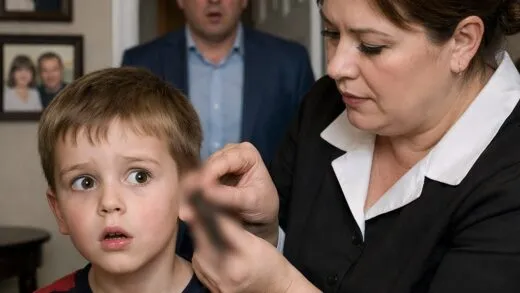

Snezhana looked at him, at this pathetic, weak, cowardly creature who had pretended to be a loving husband for two years, who had tried to play the predator and had failed spectacularly.
— “Kefir” has no authority to stop a criminal investigation.
Angelina, white as a sheet, clutched her stomach and turned to Vadim, still not grasping the scale of the catastrophe. — You promised to take care of us, you said everything would be fine.
Snezhana looked at her, and there was no hatred in her gaze. She herself had once been in a similar trap.
— You have five minutes to get out of here. He’s a liar, Angelina, a professional, talented liar. You’re the next victim, you just haven’t realized it yet. Run while you still can.
Angelina ran out of the apartment without looking back, without saying goodbye, and the sound of her heels on the stairs faded into the silence, leaving only an echo behind. The police officer snapped the handcuffs on Vadim’s wrists, metal clinking against metal, and the sound seemed to Snezhana the most beautiful music she had ever heard.
The divorce was quick, almost mundane. Vadim contested nothing, understanding that any resistance would only worsen his position in the criminal trial that loomed ahead like an inevitable shadow. Snezhana kept all her assets, the apartment on Frantsuzkyi Boulevard, and something far more important: her self-respect, trampled and reborn from the ashes.
At the criminal trial, held in the courthouse, Larisa Arkadyevna, sitting on the defendant’s bench next to her son, testified against him, trying to reduce her own sentence.
— He forced me to accept that money, — she said, not looking at Vadim. — I didn’t realize they were kickbacks, I thought they were his bonuses.
Snezhana watched Vadim’s face at the moment his own mother betrayed him to shorten her sentence, and the look of utter devastation that flickered in his eyes almost elicited pity from her. Almost.
Vadim received four years in a general-regime penal colony. Larisa Arkadyevna received a two-year suspended sentence and community service.
Snezhana stepped out of the courthouse into the sunlight of an October day, and the wind from the sea hit her face, cold and clean. She was 32 years old. She was divorced, free, and completely alone. The frightened girl who had hidden under a hotel bed was gone forever, but in her place was a woman forged in the fire of betrayal, and that fire had left burns that took a long time to heal.
The three years that followed the trial turned Snezhana into what Odesa’s business circles called the “ice queen of logistics.” She officially joined her father’s holding, not as an assistant or the director’s daughter, but as the commercial director, a position she had earned through sleepless nights over reports and negotiations.
She worked 16 hours a day, came home after dark, and didn’t date anyone. Every man who smiled at her aroused immediate suspicion, and she would ask herself if he saw her or her millions, her mother or a lottery ticket.
Music became her solace. Snezhana bought a grand piano, an antique Bechstein, which took up half the living room in her apartment, and every evening she poured her rage, pain, and loneliness into the keys. Chopin, Rachmaninoff, Tchaikovsky, composers who understood suffering better than any psychotherapist.
Vitaliy Tikhomirov appeared at a charity event at the Philharmonic Hall when Snezhana was 35 and had already resigned herself to the idea of being alone forever. He approached her at the buffet table, where she stood with a glass of champagne and the expression of someone serving a sentence.
— You look like you’d rather have a tooth pulled without anesthesia than be here, — he said instead of a greeting.
Snezhana turned around. A man of about 38, in a suit that fit well but looked slightly worn at the elbows. His hands, she noticed immediately, were working hands, with calluses and traces of paint under his nails, not the hands of a man who only signs checks and shakes hands at receptions.
— I’m a restorer, — he explained, catching her glance. — I restore historic buildings. It’s basically impossible to get my hands completely clean.
He talked her into going into the empty concert hall, where a grand piano stood, and playing something, “because you look at the instrument like an old friend, and at people like potential enemies.”
Snezhana sat down at the piano and played a Chopin Nocturne, so full of longing that she herself was surprised at how many unshed tears she had inside. When the last note faded in the empty hall, Vitaliy looked at her, not at her jewelry, not at her dress, and asked:
— Who hurt you so badly, Snezhana?
The question was so direct, so unexpected, that it pierced her armor through and through. She stood up and left, almost ran, without saying goodbye.
The next day, a package was delivered to her office, a rare album with photographs of old Odesa, published in a tiny print run. The note read: “For the soul, no strings attached. Vitaliy.”
For six months, they drank coffee in the small cafes of the old city, discussed history and restoration, and Vitaliy didn’t know who her father was. For the first three months, he thought she was just a high-level manager at some company. When he found out the truth, his reaction was not at all what she expected.
— Great, — he sighed. — Now I have to worry that people will think I’m a fortune hunter. Can you imagine how hard it is to buy a birthday present for a woman who can buy the entire Black Sea fleet?…