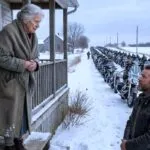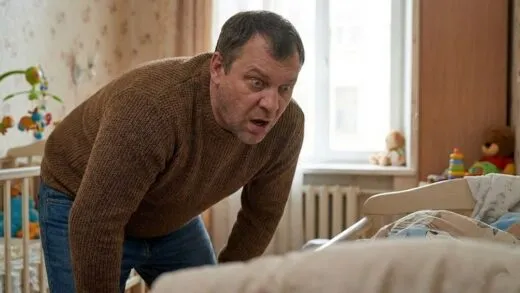

— Take your junk, Dad, and get out of here! Nadya’s voice broke into a shriek, but in her eyes—I managed to notice it in that split second before she looked away—there was a kind of wild, animal terror. Behind her, in the doorway of our former, now their, apartment, Vitalik loomed. He stood casually, leaning his shoulder against the doorframe in his puffy brand-name vest over a house t-shirt, and with a smirk twisting his lips, he filmed the scene on his phone.
The red recording light blinked like a sniper’s scope. The black plastic bag hit me right in the chest. Hard, muffled, as if someone had punched me in the solar plexus with a fist wrapped in rags. I staggered, grabbing the rough, marker-covered wall of the entryway with my hand, and barely stayed on my feet, feeling my breath catch and the sharp smell of dust and someone else’s malice hit my nose. The bag fell at my feet with a dull thud, pinning down the shoes I had polished just that morning, preparing, as I thought, for a new life.
The iron door slammed shut with a clang that cut me off from the past. One lock clicked, then a second, then the night latch clanked. I was left alone in the cold landing of the ninth floor. Silence fell instantly, broken only by the hum of the elevator somewhere in the shaft and my own hoarse breathing. I looked at the peeling blue paint on the wall, the dirty tiled floor, and this black, tightly packed bag at my feet.
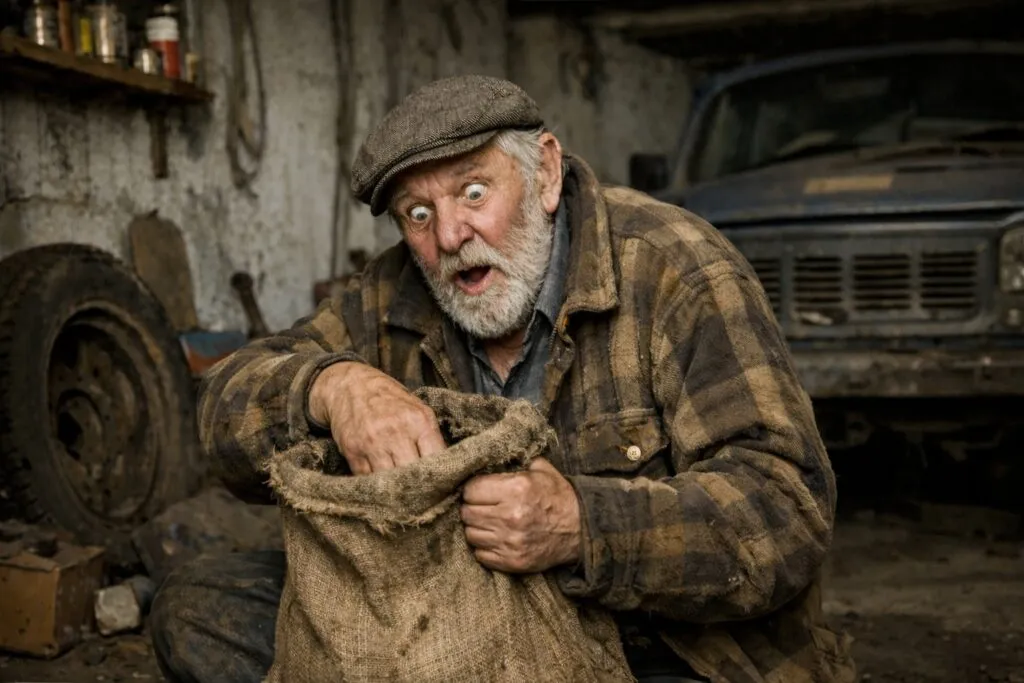
One hundred and twenty liters, for construction, extra durable. They use bags like these to haul out broken bricks after a renovation. Or a person’s life that has suddenly become construction debris. I am sixty-eight years old. My name is Pavel Petrovich Astakhov. I have a higher technical education, forty years of experience at an instrument-making plant, a certificate from the Ministry in the sideboard, and arthritis in my right knee that always aches before a snowfall. And I no longer have a home.
I bent down, feeling my lower back creak, and grabbed the neck of the bag, sealed with gray reinforced tape. Heavy. Fifteen kilograms, at least. What did she stuff in there? My old sweaters? Photo albums where we stood young and happy in Odessa by the sea? Or just junk, to humiliate me one last time?
The elevator wasn’t working; the call button had been burned out back in the nineties and had gaped like a black hole, a rotten tooth, ever since. I had to drag my burden down the stairs. I walked slowly, step by step, flight by flight. The third floor smelled of fried capelin and someone’s desperate laundry. On the second, someone was smoking cheap cigarettes, and a gray haze hung thick in the air.
Leaving the building, I took a deep breath of the frosty January air. The courtyard was packed so tightly with cars that you could only get through sideways. My old, dark cherry “Niva,” my faithful armored car, was parked with one wheel on the icy curb. I opened the trunk and threw the bag inside. It landed next to the toolbox and a canister of washer fluid.
I got behind the wheel but didn’t rush to start the engine. My hands were shaking. Not from the cold—the heater in the “Niva” was always a beast—but from that sticky, humiliating feeling you get when you’re hit and can’t hit back. I looked in the rearview mirror. An old man with gray stubble and the eyes of a beaten dog stared back at me.
“Well, Pasha,” I said aloud to my reflection. My voice sounded foreign and cracked. “Played your games, have you? Helped the young ones?” I took a pack of cigarettes from the glove compartment and flicked the lighter. The flame lit up the cabin, highlighting an icon of Nicholas the Wonderworker on the dashboard, which Galya had glued there ten years ago. Galya! If only she could see this now. If only she could see how our Nadenka, our princess, our pride, was throwing her father out into the cold like a mangy dog.
I closed my eyes and leaned back against the headrest. To understand how I ended up here—in winter on the outskirts of the city, in a car packed with my belongings—you have to rewind the tape. Not by an hour, not by a day, but exactly one year, to the day time stopped in our apartment. It all started with the wake, or rather, with the silence that followed it. Galya passed away in February. Her heart. A massive heart attack; the ambulance took forty minutes to get through the Kyiv traffic, and the doctors just threw up their hands.
We had lived together for forty-two years. You know, that’s a length of time when you’re no longer two different people, but a single organism. She was my memory, my conscience, my dinner on the table, and my ironed shirt. And I was her wall, her hands, her confidence in tomorrow. And then the walls came down. We held the wake at home, according to old tradition.
In our spacious “Stalinka” three-room apartment in the center, not far from Khreshchatyk. High ceilings, stucco molding, parquet flooring that creaked on a specific note in the second octave if you stepped on it by the threshold. We pushed the tables together, covered them with a fringed tablecloth, neighbors came, a couple of my former colleagues from the plant, some distant relatives. We ate kutia, drank vodka without clinking glasses. They spoke quietly, remembering what a hostess Galina Sergeevna was, how she baked cabbage pies.
Nadya sat next to me, dark, gaunt, her eyes red from crying. She held my hand, and her palm was cold and clammy. And across from us sat Vitalik, my son-in-law. He behaved decently, refilled guests’ glasses, ran to the kitchen for hot food, carried out empty plates, but I caught his glances.
He wasn’t looking at me, the grieving widower; he was looking at the walls, the ceilings, the oak sideboard. He was sizing it up. In his small, deep-set eyes, which were always darting around as if looking for something to steal, a calculator was now frozen. When the guests left, and that very cottony, deafening silence hung in the apartment, the three of us were left in the kitchen. Nadya was washing dishes, I was sitting at the table, twirling an empty shot glass in my hands.
“Dad,” Vitalik began, leaning his hip against the windowsill (he loved these master-of-the-house poses). “How are you doing, anyway?”