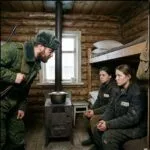

She had seen that before in Stepan in the first months of the war, when he was still home and poured cold water over himself every morning in the yard. He used to say there wouldn’t be warm water at the front, so a man ought to get used to it. She called them to the table: porridge, bread, fresh milk from Zorka, still warm. She set it out and sat across from them with a mug of tea, watching and thinking.
Semyon ate neatly, held his spoon properly, not in a fist but the way people do who are used to a table. He didn’t tear at the bread, broke off small pieces. He ate without rushing, but not slowly either, the way people eat who know the value of food without making a show of it. Grisha ate quickly; you could see he wanted to eat faster and more, but he held himself back on purpose.
He kept his eyes on the bowl, and when the porridge was gone he didn’t reach for more, though the pot sat right there on the stove in plain sight. He didn’t ask. Tikhon ate slowly, looking into his bowl, and didn’t raise his eyes once through the whole breakfast. When they were done, Agrippina set the mugs in the washbasin and said, without turning from the stove:
“There’s work. The garden fence is down, the kitchen roof leaks, and the firewood isn’t split. If it’s done by evening, I’ll feed you supper and let you stay another night. After that, we’ll see.” Semyon looked at the other two.
Grisha shrugged as if to say, what’s there to discuss. Tikhon was already on his feet and heading into the yard. Agrippina went out after them. Tikhon stood by the woodpile looking at the splitting maul lying on the chopping block.
He picked it up, set the first round upright, adjusted it slightly, swung, and struck. The log split clean on the first blow. Good. Agrippina took a knife and a basket and went to the garden to cut cucumbers.
Behind her she heard the steady thud of the maul. One, one, one. Even, no wasted motion, no extra force. That’s how a man works when he knows what he’s doing. She walked between the rows, bent down, cut, and thought.
“We’ll see in the morning,” she had told herself in the night. Well, here was morning, and she was seeing. So far everything pointed one way. By noon they had done what would have taken her three weeks, maybe more. Tikhon split the firewood.
Not just split it—he sorted it by size. Thin pieces for kindling, medium for daytime fires, big ones for overnight. He stacked it under the lean-to tight and square, offset every other row so it wouldn’t collapse and air could move through it to keep the wood dry. Agrippina came out to look and stopped.
Her late husband Stepan had stacked wood exactly that way, sorted it, offset it. She had used to laugh at him and say it all burned the same in the end, so what difference did it make how it was stacked. Stepan would answer seriously, without smiling: “Depends on the person. The way you keep things is the way you live.”
She hadn’t understood then. Looking at Tikhon’s woodpile, she did. And she understood something else too, though she couldn’t have put it into words right away. Semyon repaired the fence. He found old poles in the shed—she had all sorts of leftovers in one corner from earlier repairs and barely knew what was there herself.
He found nails in an old paint tin and a hammer with a cracked handle. He picked it up, looked it over, found a rag, wrapped the crack, and wet it so the wood would swell and hold. He didn’t ask permission or advice. He just did it. Worked methodically and correctly.
First he walked the whole length of the fence, every section. He studied each stretch for a few seconds. Which post was rotten at the base and needed replacing, which had simply fallen and could be reset, where the slats were sound and only loose. He made a plan in his head; Agrippina could see that, though there was no paper involved.
You could tell by the way he stood at each section and looked before moving on. Then he worked steadily, calmly, without fuss. Agrippina passed by around midday and looked at what he’d done. There was nothing to say. It was done right.
Better than she would have done it herself, because she would not have bothered sorting out what needed replacing and what only needed bracing. She would have repaired it in order from left to right. Grisha climbed onto the roof. That was something to watch.
Short, with hands that at first glance looked clumsy, he moved over the steep slope quickly and confidently, almost without looking where he put his feet. The catlike assurance of a man who has done risky things so many times he no longer counts them as risky. He found the leak, but not where Agrippina thought it was. She had blamed the left corner, because that was where it always dripped after rain.
Grisha found it about a foot and a half to the right. There was a weak spot in the rafter, and the water ran along it before dripping into the corner. He found three rotten shingles and one cracked one. Climbed down, asked if there were boards, and Agrippina pointed to the shed.
Grisha climbed back up and worked another forty minutes or so. Agrippina heard the hammer, not often but accurately. He climbed down and said it was done. The next rain would tell for sure, but it ought to hold, and Agrippina nodded without comment.
At noon she called them in to eat: buckwheat with fried onions in butter, bread, and kvass in a pitcher. They sat down, and Agrippina watched and thought. Well now. In one morning three strange men had done what she had been thinking about since May and couldn’t manage.
They had done it on their own, without being asked twice, without instructions, without her standing over them explaining what and how. Each one had taken something and done it. Grisha could have sat and smoked while Tikhon split wood and Semyon fixed the fence, and nobody would have said a word. She hadn’t assigned him anything specific. But he hadn’t sat. He had gone up on the roof nobody had told him to touch.
That she noticed. That she remembered, the way you remember something that later turns out to matter. After lunch Semyon came to her on his own. Said the hayloft roof was bad too: from the corner of the yard you could see two boards loose on the side. Not a problem in summer, but by fall water would get in and the rafters would start to rot…